All species › Passerines › New World warblers › Santa Marta Warbler
Santa Marta Warbler | Myiothlypis basilica
Santamartazanger | Reinita de Santa Marta | Pula-pula-de-santa-marta
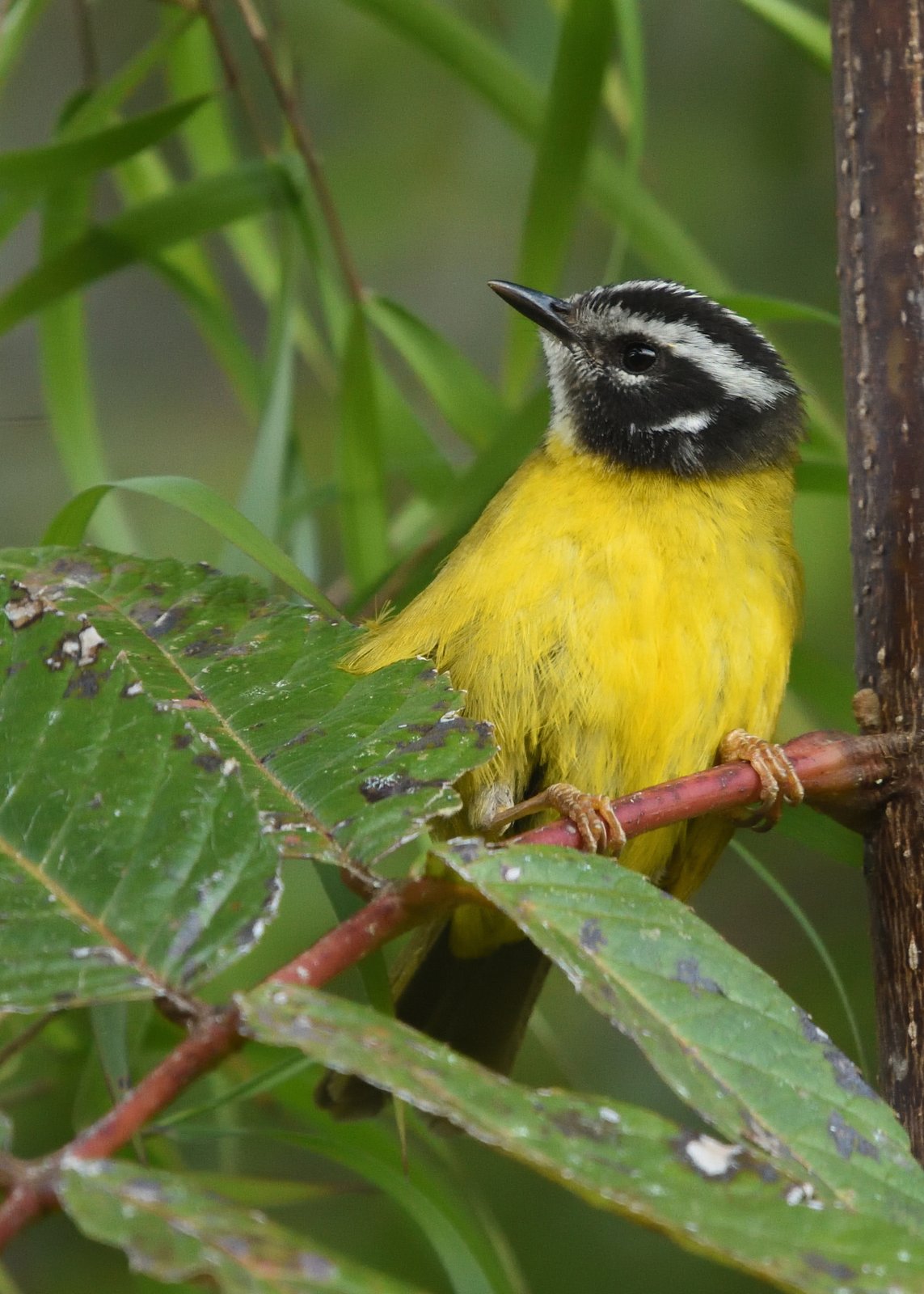
The Santa Marta Warbler is a large warbler found only in the Sierra Nevada de Santa Marta in northern Colombia. With its black-and-white head it differs from most other Myiothlypis warblers, which are olive and yellow. It lives in pairs or small groups in the understorey of cloud forest, often together with other species.
Voice
The call is a high, dry tsip, often repeated while foraging. The song is a fast series of high, thin notes; members of a group often call at the same time.
Recording: Ross Gallardy — CC BY-NC-SA 4.0 · xeno-canto
Identification
14–15 cm, with a fairly long tail. The head is black, with a broad white median crown stripe, a long white supercilium and a white spot below the eye. The throat is white. The upperparts are olive, the underparts yellow, with olive flanks. The bill is dark. The sexes are alike. Young birds are duller, with a less sharply marked head.
Confusion species
White-lored Warbler Myiothlypis conspicillata, also restricted to the Sierra Nevada de Santa Marta, has a grey head without black and white, with white lores and eye-ring, and usually lives lower. Three-striped Warbler Basileuterus tristriatus of the Andes is smaller, with a head striped in black and buff and no white throat.
Habitat
Understorey and edges of humid montane forest and cloud forest, especially with dense shrubs and Chusquea bamboo, roughly between 2100 and 3000 m, locally lower. It forages low in the vegetation for insects and spiders, often in mixed flocks. As in related species, the nest is probably built on or just above the ground.
Where the bird is most at home, classified by the vegetation units of the Andes and the west coast.


Range and movements
In Colombia only in the Sierra Nevada de Santa Marta, on all slopes of the massif. Absent from Ecuador, Peru, Bolivia and the Galápagos. Does not occur outside the guide area.
- Resident
- dark = core range, pale = thinly spread
How and when to look
Search the understorey along the road from Minca to the Cuchilla de San Lorenzo, above about 2100 m, especially early in the morning. Groups often travel with mixed-species flocks and give themselves away by their dry calls.
Conservation status
Near Threatened. The range is small and the forest on the slopes of the Sierra Nevada is threatened by logging, fire and agriculture. Part of its habitat lies within a national park.
Scientific name
Myiothlypis basilica | (Todd, 1913) (GBIF: Basileuterus basilicus)
Todd described the species in 1913 as Hemispingus basilicus; because it was later moved to another genus, the author and year stand in brackets. The genus Myiothlypis was introduced in 1851 by Cabanis. The genus name combines Greek muia, 'fly', with thlupis, an unidentified small bird. The species name comes from Latin basilicus, 'grand, princely', from Greek basilikos, 'royal'; possibly after the striking black-and-white head pattern. The specimen the first description was based on came from San Lorenzo, Sierra Nevada de Santa Marta, Colombia.