All species › Passerines › New World warblers › Citrine Warbler
Citrine Warbler | Myiothlypis luteoviridis
Bonapartes zanger | Reinita citrina | Pula-pula-citrino
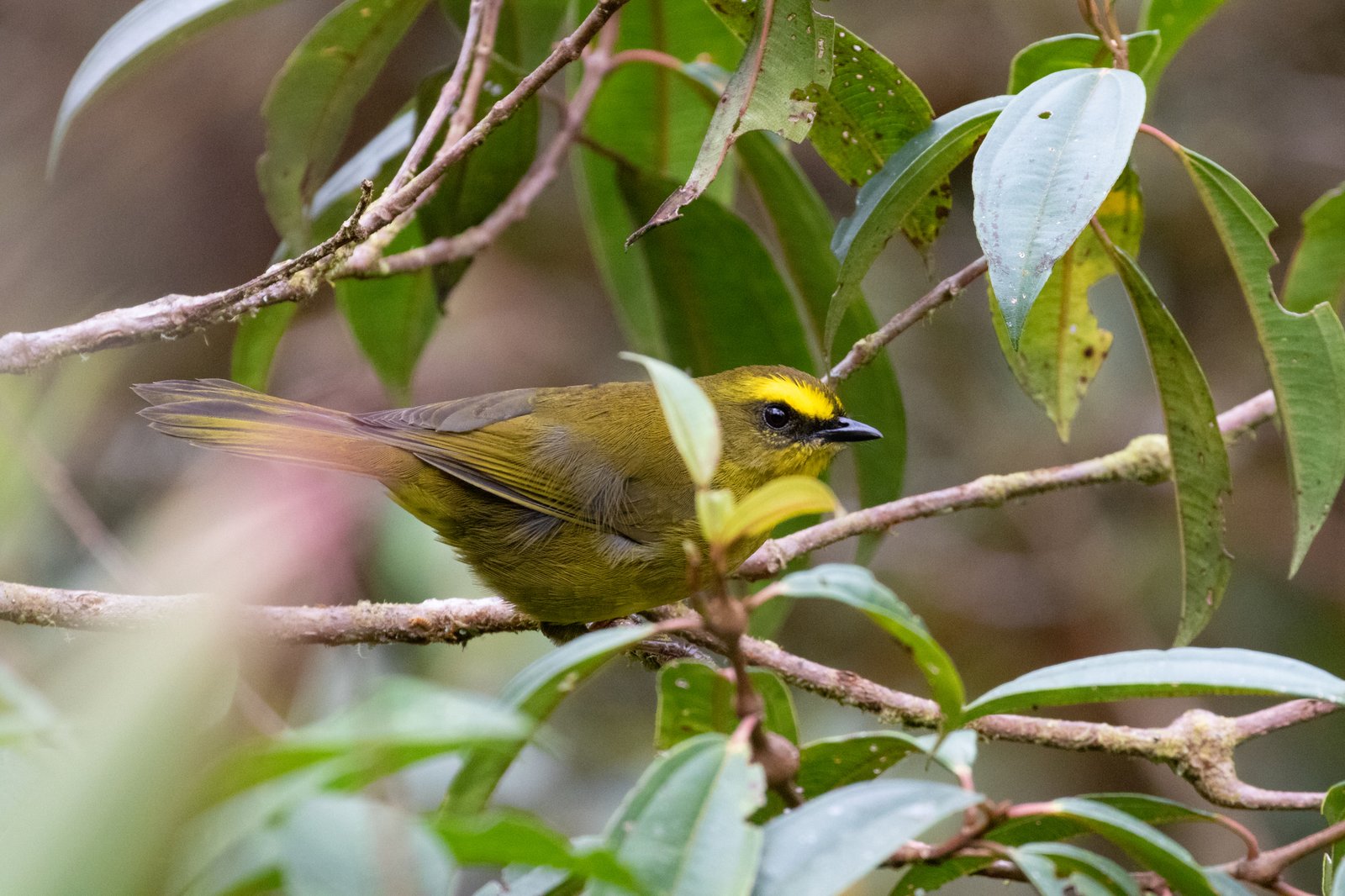
The Citrine Warbler is a large, olive and yellow warbler of the upper cloud forest of the Andes, from Colombia to Bolivia. It lives low in dense shrubbery and bamboo, usually in pairs or as part of mixed flocks. The southern forms, with a longer yellow supercilium, are treated by some authors as a separate species.
Voice
The call is a dry tsip. The song is a fast, stuttering series of high notes that accelerates and is sometimes sung by a pair as a duet.
Recording: Jacob Wijpkema — CC BY-NC-SA 4.0 · xeno-canto
Identification
14 cm. The upperparts are plain olive, the underparts yellow with an olive wash on the breast and flanks. The yellow supercilium is short in the northern forms and mainly in front of the eye; in the forms of southern Peru and Bolivia it is longer and brighter. The lores are dark. The legs are darker than in Pale-legged Warbler. The sexes are alike. Young birds are duller and browner.
Confusion species
Pale-legged Warbler Myiothlypis signata is smaller, with pale pink to yellowish-brown legs, a shorter yellow streak in front of the eye and darker cheeks. Black-crested Warbler Myiothlypis nigrocristata has a black central crown and black lores. Russet-crowned Warbler Myiothlypis coronata has a grey head with a rufous crown stripe between black stripes. Some olive hemispinguses (tanagers) resemble it, but have a thicker bill.
Habitat
Understorey and edges of humid cloud forest and upper montane forest, often with bamboo, roughly between 2300 and 3400 m. It forages low to mid-level in the vegetation for insects and spiders, often in mixed flocks. The nest is a domed structure on or near the ground.
Where the bird is most at home, classified by the vegetation units of the Andes and the west coast.


Range and movements
In Colombia in all three Andean ranges. In Ecuador on both slopes of the Andes. In Peru along the east slope from north to south. In Bolivia in the Yungas of La Paz and Cochabamba. Absent from the Galápagos. Outside the guide area only in western Venezuela.
- Resident
- dark = core range, pale = thinly spread
How and when to look
In cloud forest near the treeline, listen for the dry tsip from dense shrubbery and bamboo, and follow mixed flocks; the birds often appear briefly at the edge of the shrubbery.
Conservation status
Not Evaluated in its current species limits. It is widespread in the Andes and locally fairly common; loss of cloud forest is the main threat.
Scientific name
Myiothlypis luteoviridis | (Bonaparte, 1845)
Bonaparte described the species in 1845 as Trichas luteoviridis; because it was later moved to another genus, the author and year stand in brackets. The genus Myiothlypis was introduced in 1851 by Cabanis. The genus name combines Greek muia, 'fly', with thlupis, an unidentified small bird. The species name combines Latin luteus, 'yellow', and viridis, 'green'. The specimen the first description was based on came from Bogotá, Colombia.