All species › Passerines › New World warblers › Flavescent Warbler
Flavescent Warbler | Myiothlypis flaveola
Amazonezanger | Reinita amarillenta | Canário-do-mato
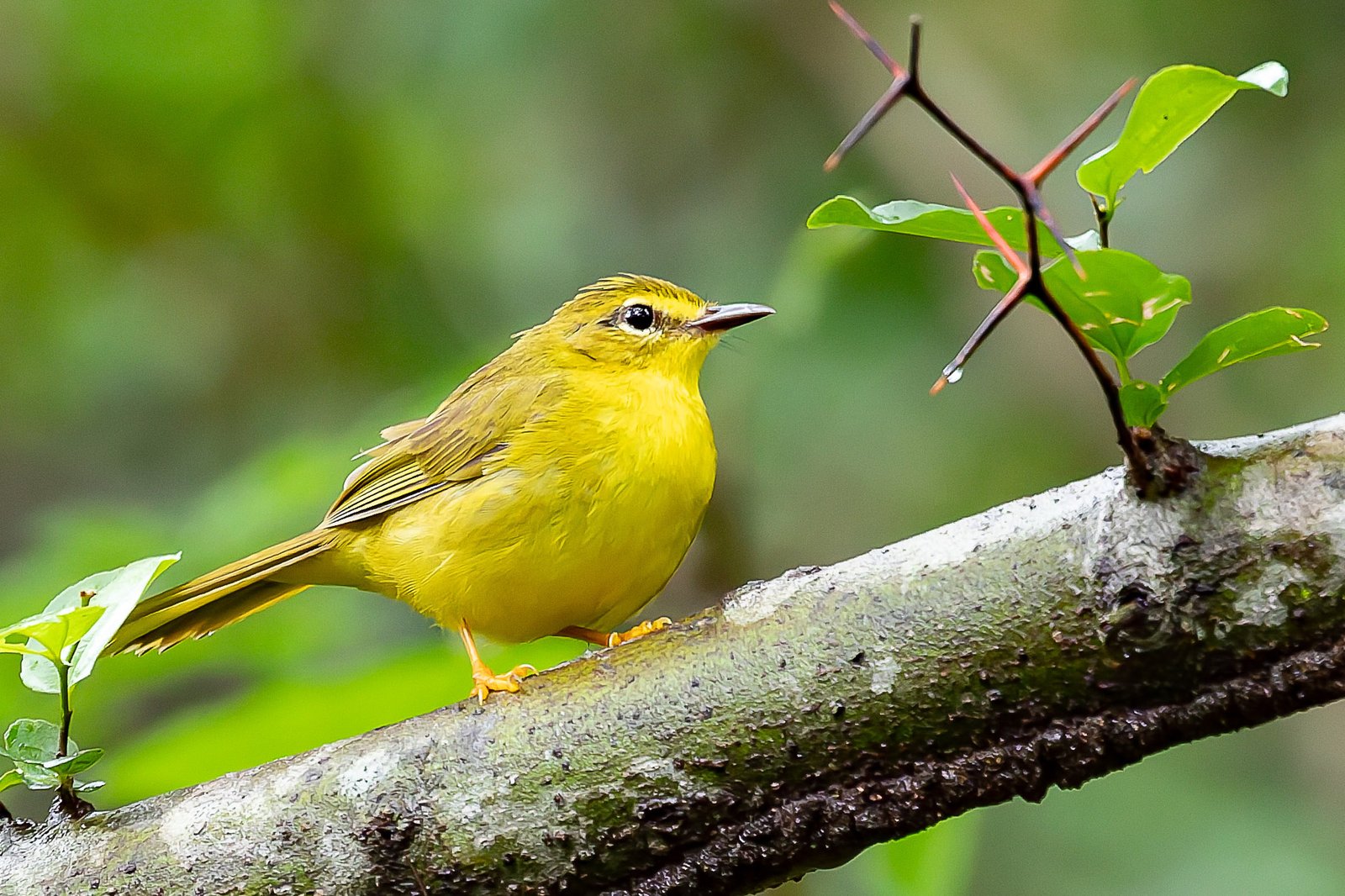
The Flavescent Warbler is an olive and yellow warbler of dry forest and gallery forest in the lowlands east of the Andes. Its range is centred on Venezuela, Brazil and Paraguay; in the guide area it occurs only at the margins, in eastern Colombia and eastern Bolivia. It forages low in the vegetation or on the ground, often pumping its tail.
Voice
The song is a clear, rising series of whistled notes that becomes stronger towards the end. The call is a sharp chik.
Recording: JAYRSON ARAUJO DE OLIVEIRA — CC BY-NC-SA 4.0 · xeno-canto
Identification
14 cm. The upperparts are olive, the underparts bright yellow, with an olive wash on the flanks. A yellow supercilium is bordered below by a dark eye-stripe. The legs are pale, yellowish to flesh-coloured. The sexes are alike. Young birds are duller and browner.
Confusion species
Golden-crowned Warbler Basileuterus culicivorus has a greyer head with black crown stripes and a yellow or orange median stripe. Citrine Warbler Myiothlypis luteoviridis and Pale-legged Warbler Myiothlypis signata are similar in colour, but live high in the Andes, not in the lowlands.
Habitat
Understorey of semi-deciduous and dry forest, gallery forest and forest edges in the lowlands, mostly below 1000 m. It forages low in the vegetation and on the ground for insects and other invertebrates, often pumping its tail. The nest is a domed structure on the ground.
Where the bird is most at home, classified by the vegetation units of the Andes and the west coast.


Range and movements
In Colombia only in the east, locally in gallery forest and dry forest in the lowlands along the border with Venezuela. In Bolivia in the east, mainly in the Chiquitano dry forest of Santa Cruz and adjacent parts of Beni. Absent from Ecuador, Peru and the Galápagos. Outside the guide area in northern Venezuela and over much of eastern and central Brazil to Paraguay.
- Resident
- dark = core range, pale = thinly spread
How and when to look
In Bolivia, search the understorey of Chiquitano dry forest and gallery forest; listen for the rising song and watch for birds pumping their tails low in the bushes.
Conservation status
Least Concern. The range is large; habitat is lost locally to clearing for agriculture and cattle ranching.
Scientific name
Myiothlypis flaveola | Baird, 1865
Baird described the species in 1865 and placed it straight away in the genus where it still stands. The genus Myiothlypis was introduced in 1851 by Cabanis. The genus name combines Greek muia, 'fly', with thlupis, an unidentified small bird. The species name comes from Latin flaveolus, 'yellowish'. The specimen the first description was based on came from Paraguay (probably the Paraguay River).