All species › Passerines › Tapaculos › Ancash Tapaculo
Ancash Tapaculo | Scytalopus affinis
Ancashtapaculo | Churrín de Ancash | Macuquinho-de-ancash
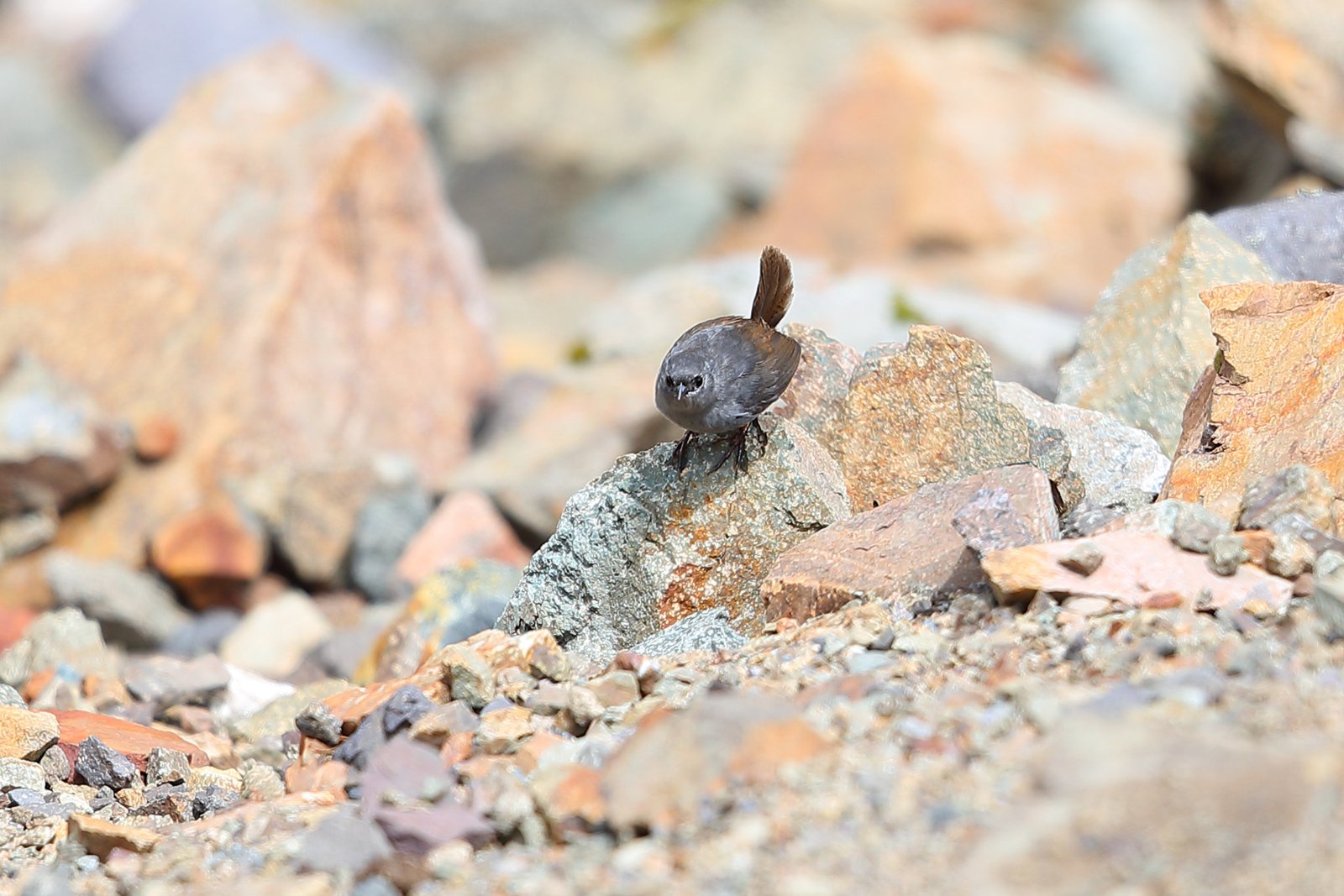
The Ancash Tapaculo is a small, grey tapaculo found only in the high Andes of central Peru, mainly in the department of Ancash and adjacent La Libertad. It lives in Polylepis woodland and on shrubby, rocky slopes high in the mountains. As with other Scytalopus species, the song is the main identification feature.
Voice
The song is a fast, dry series of short notes, repeated at intervals. Also short, sharp calls. Recordings help to compare the song with that of related species.
Recording: Dries Van de Loock — CC BY-NC-SA 4.0 · xeno-canto
Identification
11–12 cm, small and round, with a short, often cocked tail. The plumage is grey, slightly paler on the throat and breast; the rump, flanks and undertail coverts are rufous-brown with dark barring. The bill is thin and dark. The sexes are similar, females somewhat browner. Young birds are brown with dense dark barring.
Confusion species
The Ancash Tapaculo is the only tapaculo in the Polylepis and scrub of the Cordillera Blanca and Cordillera Negra. Tschudi's Tapaculo Scytalopus acutirostris lives further east, in humid montane forest on the eastern slope, and is darker grey. Neblina Tapaculo Scytalopus altirostris lives further north and Junin Tapaculo Scytalopus gettyae further south-east. These species are mainly told apart by song and range.
Habitat
Polylepis woodland, scrub with Gynoxys and other shrubs, rocky slopes and ravines with dense vegetation, roughly between 3000 and 4600 m. It moves like a mouse among rocks, roots and dense shrubs, taking small insects and spiders. The nest is presumably a domed structure in a hole among rocks or in a bank.
Where the bird is most at home, classified by the vegetation units of the Andes and the west coast.


Range and movements
Only in Peru, in the Andes of the centre of the country, mainly in the Cordillera Blanca and Cordillera Negra in Ancash and locally in adjacent La Libertad. Absent from Colombia, Ecuador, Bolivia and the Galápagos. Does not occur outside the guide area.
- Resident
- dark = core range, pale = thinly spread
How and when to look
Search the Polylepis groves in the valleys of the Cordillera Blanca, for example in Huascarán National Park, and listen in the early morning for the dry song series among the rocks and shrubs.
Conservation status
Least Concern. The world range is small, and Polylepis woodland is degraded by cutting, fire and grazing, but a large part of the habitat lies within a national park.
Scientific name
Scytalopus affinis | Zimmer, 1939
Zimmer described the species in 1939 and placed it straight away in the genus where it still stands. The genus Scytalopus was introduced in 1837 by Gould. The genus name combines Greek skutalē or skutalon, 'stick', with pous, 'foot'. The species name comes from Latin affinis, 'related', as the form was described as related to other tapaculos. The specimen the first description was based on came from Yanac, Áncash, Peru.