All species › Passerines › Tapaculos › Magellanic Tapaculo
Magellanic Tapaculo | Scytalopus magellanicus
Magelhaentapaculo | Churrín magallánico | Macuquinho-de-magalhães
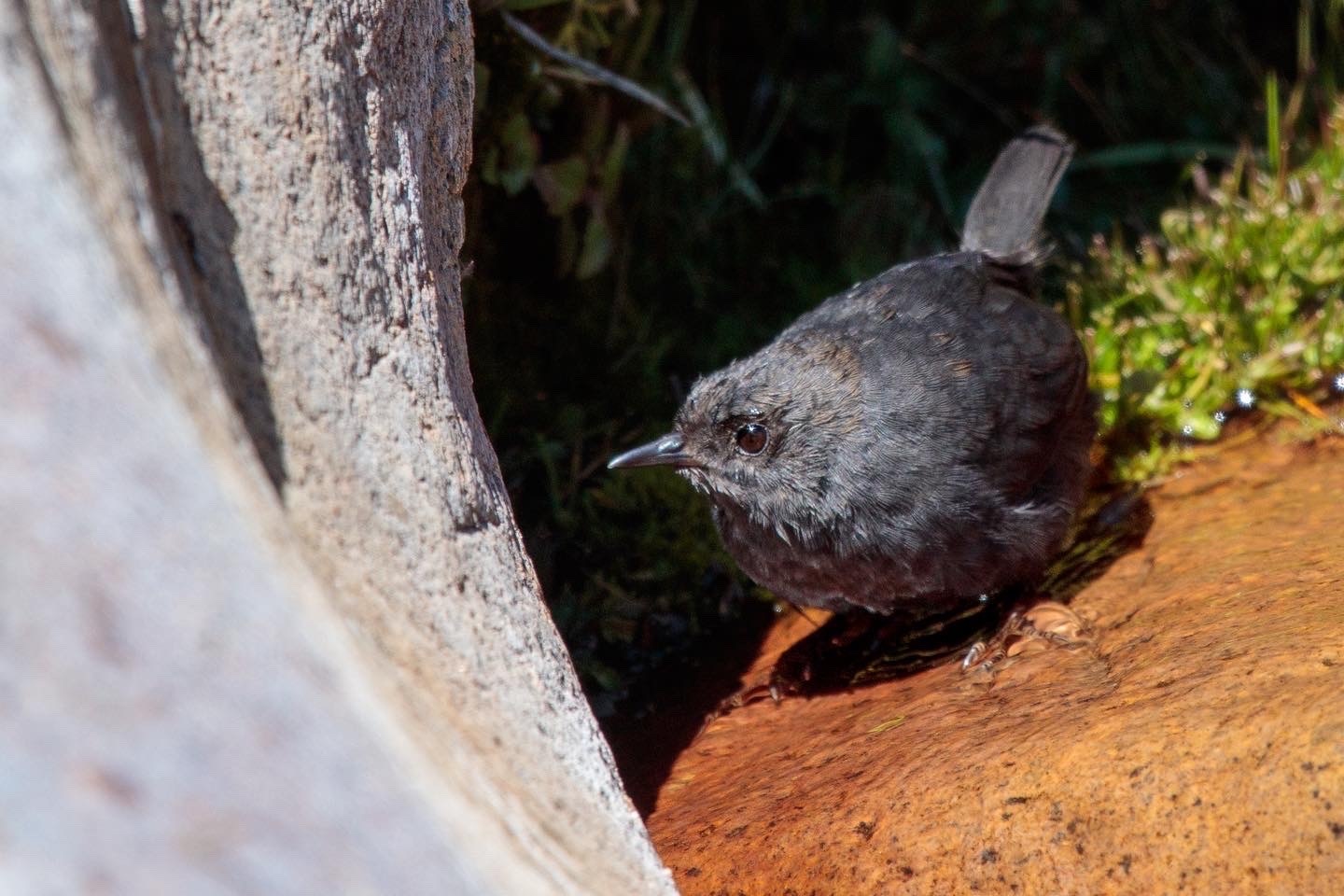
The Magellanic Tapaculo is a small, dark grey tapaculo of the temperate forests of southern Chile and Argentina. Formerly the grey tapaculos of the high Andes were also included in this species; these are now treated as separate species. Under current taxonomy the Magellanic Tapaculo does not occur in the guide area.
Voice
The song is a long, rhythmic series of repeated, two-syllable notes. Also short, sharp calls and a fast, shrill series when excited.
Recording: Eduardo Quintanilla — CC BY-NC-SA 4.0 · xeno-canto
Identification
10–11 cm, small and round, with a short, often cocked tail. The plumage is mostly dark slate-grey; the rump and flanks are brown with dark barring. Adult males often have a white spot on the forehead or crown. Females are browner, young birds brown with dense dark barring.
Confusion species
In the guide area grey tapaculos of the high Andes belong to other Scytalopus species, such as Puna Tapaculo Scytalopus simonsi in southern Peru and Bolivia, and Ancash Tapaculo Scytalopus affinis in central Peru. These species look very similar and are mainly told apart by song and range.
Habitat
Dense undergrowth of humid temperate forest with Nothofagus, bamboo and scrub, forest edges and shrubby slopes, from sea level to the treeline. It moves like a mouse on and just above the ground, taking small insects and spiders. The nest is a domed structure in a hole in a bank or among roots.
Where the bird is most at home, classified by the vegetation units of the Andes and the west coast.

Range and movements
Does not occur in the guide area. Older records under this name from Colombia, Ecuador, Peru and Bolivia refer to other Scytalopus species that were formerly included in the Magellanic Tapaculo. Outside the guide area in central and southern Chile and the adjacent west and south of Argentina, to Tierra del Fuego.
How and when to look
Not expected in the guide area. Records of a grey tapaculo in the high Andes belong to one of the other Scytalopus species in this guide.
Conservation status
Least Concern. In southern Chile and Argentina the species is common in forest and scrub.
Scientific name
Scytalopus magellanicus | (Gmelin, 1789)
Gmelin described the species in 1789 as Motacilla magellanica; because it was later moved to another genus, the author and year stand in brackets. The genus Scytalopus was introduced in 1837 by Gould. The genus name combines Greek skutalē or skutalon, 'stick', with pous, 'foot'. The species name magellanicus refers to the Strait of Magellan and southern South America, named after Ferdinand Magellan (c. 1480–1521); this is not necessarily the type locality. The specimen the first description was based on came from Tierra del Fuego.