All species › Passerines › Tapaculos › Ash-colored Tapaculo
Ash-colored Tapaculo | Myornis senilis
Grijze tapaculo | Tapaculo cenizo | Macuquinho-cinzento
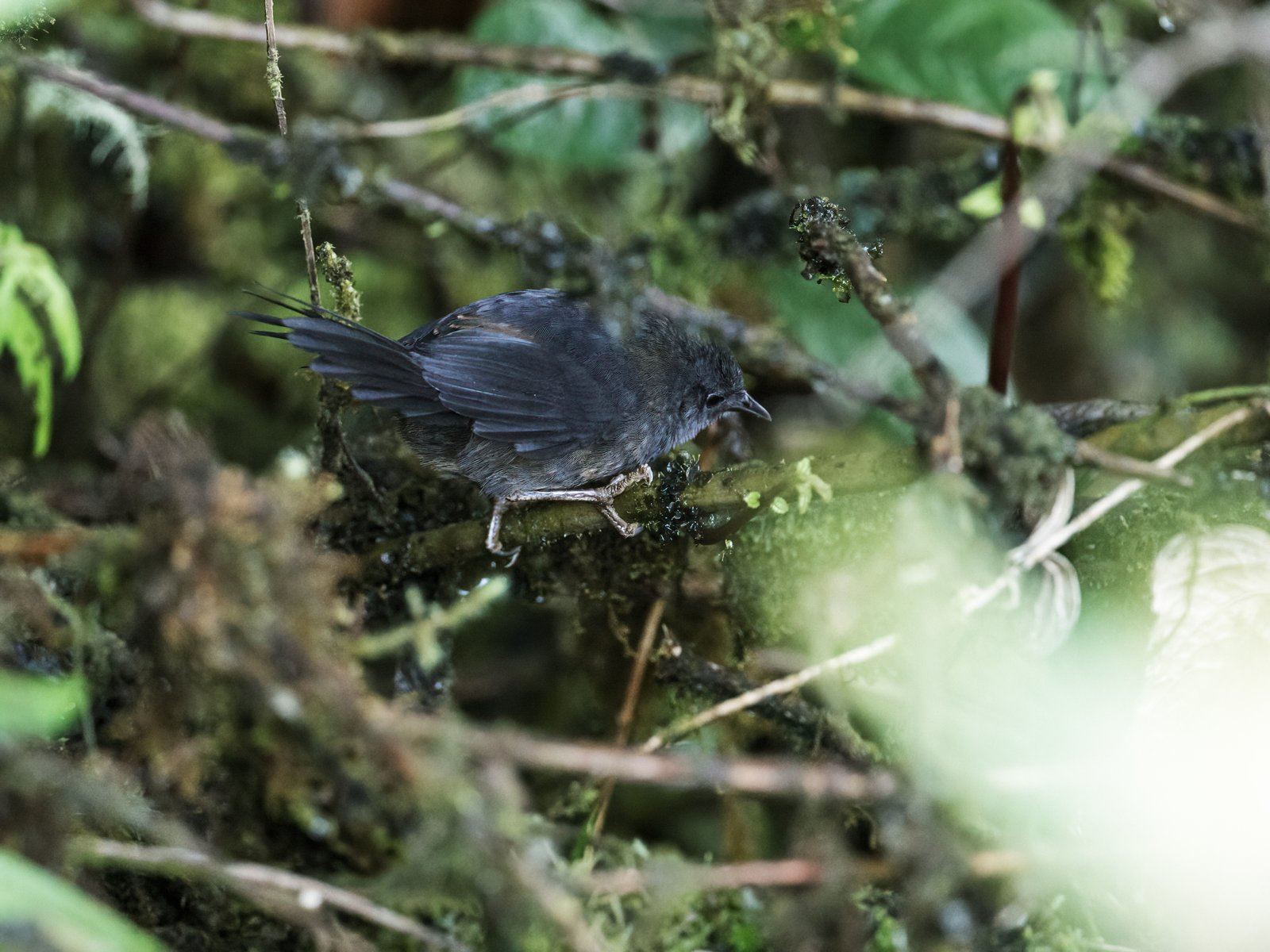
The Ash-colored Tapaculo is a uniformly grey tapaculo with a noticeably long tail, the only species of the genus Myornis. It lives in dense bamboo in the high montane forest of the northern Andes and moves through the undergrowth like a mouse. Its long, accelerating song is a familiar sound in that bamboo.
Voice
The song starts with separate, sharp notes that become ever faster and turn into a long, rattling trill or churr. Also short, sharp calls.
Recording: Simon Mills — CC BY-NC-SA 4.0 · xeno-canto
Identification
14 cm, slender for a tapaculo, with a long, often slightly cocked tail. The whole plumage is uniform slate-grey, slightly paler on the throat and breast; the flanks and undertail coverts can show a brownish tinge. The bill is thin and dark, the legs brownish. The sexes are alike. Young birds are browner, with a rufous tone on the belly and flanks and faint barring.
Confusion species
Scytalopus tapaculos in the same bamboo, such as Blackish Tapaculo Scytalopus latrans and Spillmann's Tapaculo Scytalopus spillmanni, are stockier and have a distinctly shorter tail; Blackish Tapaculo is also darker. Paramo Tapaculo Scytalopus opacus lives higher, around the treeline, and has brown-barred flanks. The song is the main distinction.
Habitat
Dense Chusquea bamboo and undergrowth in humid upper montane forest, cloud forest and elfin forest, up to the treeline, roughly between 2300 and 3500 m. It moves low through the vegetation, more above the ground than most Scytalopus species, and takes small insects and spiders. The nest is a domed structure of moss and plant material, low in dense vegetation.
Where the bird is most at home, classified by the vegetation units of the Andes and the west coast.


Range and movements
In Colombia in the Central and Eastern Andes and locally in the Western Andes. In Ecuador on both slopes of the Andes. In Peru in the north, south to about Huánuco. Absent from Bolivia and the Galápagos. Does not occur outside the guide area.
- Resident
- dark = core range, pale = thinly spread
How and when to look
Listen in dense bamboo in cloud forest for the accelerating series that turns into a trill. The bird sometimes shows itself briefly at the edge of a trail through bamboo, especially when it responds to another singer.
Conservation status
Least Concern. High montane forest is locally cleared and burned, but the species is present in suitable bamboo at many sites.
Scientific name
Myornis senilis | (de Lafresnaye, 1840)
De Lafresnaye described the species in 1840 as Merulaxis senilis; because it was later moved to another genus, the author and year stand in brackets. The genus Myornis was introduced in 1915 by Chapman. The genus name comes from Greek mus, 'mouse', and ornis, 'bird': a mouse bird, after its grey, mouse-like appearance. The species name comes from Latin senilis, 'of an old man', that is hoary, after the ash-grey plumage. The specimen the first description was based on came from Bogotá, Colombia.