All species › Passerines › Tapaculos › Rusty-belted Tapaculo
Rusty-belted Tapaculo | Liosceles thoracicus
Roestbuiktapaculo | Tapaculo fajirrojizo | Corneteiro-da-mata
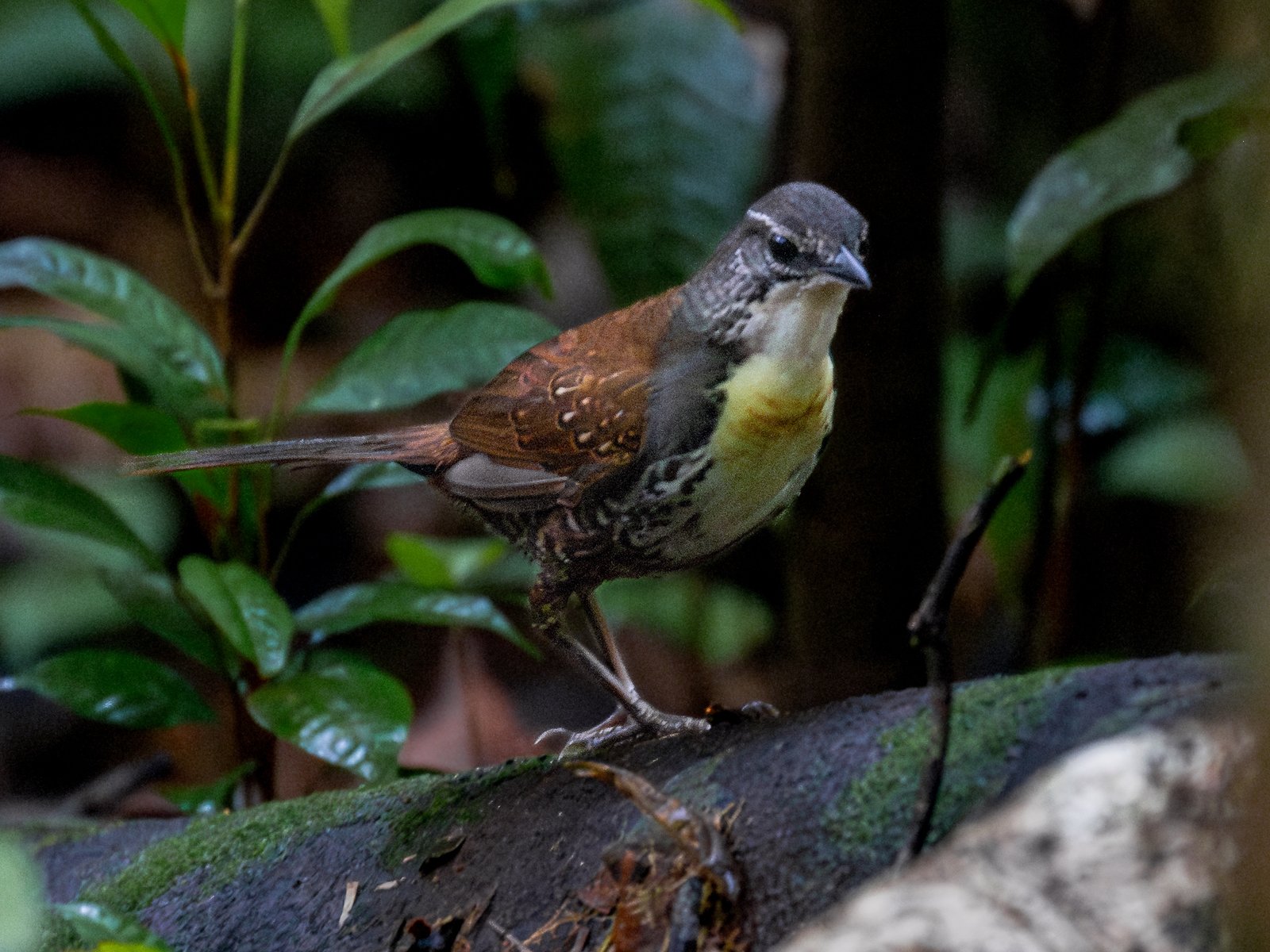
The Rusty-belted Tapaculo is the only tapaculo of the Amazonian lowlands: a fairly large, short-winged ground bird of the forest floor in undisturbed rainforest. It walks with its tail cocked among fallen trunks and dense tangles and usually stays hidden. Its presence is mainly revealed by its series of descending whistles.
Voice
The song is a series of five to ten clear, somewhat plaintive whistles that gradually descend in pitch and sometimes slow down. The call is a short, dry chek.
Recording: JAYRSON ARAUJO DE OLIVEIRA — CC BY-NC-SA 4.0 · xeno-canto
Identification
19–20 cm, with a fairly long, often cocked tail and strong legs. The upperparts are dark rufous-brown, the head grey with a paler supercilium. The throat and breast are white, with a broad rusty-orange band across the lower breast below. The belly and flanks are brown barred black and white. The sexes are alike; young birds are duller and less clearly marked.
Confusion species
No other tapaculo occurs in the lowlands. Black-faced Antthrush Formicarius analis also walks on the forest floor with its tail cocked, but has a black throat, grey underparts and no rusty band. Ringed Antpipit Corythopis torquatus is smaller and slimmer, with a black-streaked breast band on white underparts, and walks like a wagtail. Black-tailed Leaftosser Sclerurus caudacutus is plain dark brown with a pale throat and a black tail.
Habitat
The undergrowth and floor of humid terra firme forest in the lowlands, often at treefalls, root tangles and dense thickets, up to about 800 m. It walks on the ground, searching the leaf litter for insects and other invertebrates. The nest is a domed structure in a cavity or among roots low to the ground.
Where the bird is most at home, classified by the vegetation units of the Andes and the west coast.


Range and movements
In Colombia in the Amazonian lowlands of the south-east. In Ecuador in the lowlands east of the Andes. In Peru widespread in the Amazonian lowlands, mainly in the north and centre. In Bolivia at most in the far north; presence uncertain. Absent from the Galápagos. Outside the guide area in western Brazilian Amazonia.
- Resident
- dark = core range, pale = thinly spread
How and when to look
Listen in the early morning in tall terra firme forest for the descending series of whistles. The bird often sings from a fallen trunk or low in a tangle and stays in the same spot for a long time.
Conservation status
Least Concern. The species depends on undisturbed forest and disappears locally through deforestation, but its range is large.
Scientific name
Liosceles thoracicus | (Sclater, 1865)
Sclater described the species in 1865 as Pteroptochus thoracicus; because it was later moved to another genus, the author and year stand in brackets. The genus Liosceles was introduced in 1865 by Sclater. The genus name comes from Greek leios, 'smooth', and skelos, 'leg': 'smooth-legged'. The species name comes from Latin thorax, 'chest', after the rusty breast band. The specimen the first description was based on came from Salto do Girão, Rio Madeira, Rondônia, Brazil.