All species › Passerines › Ovenbirds and woodcreepers › Atlantic Plain Xenops
Atlantic Plain Xenops | Xenops minutus
Atlantische effen xenops | Picolezna liso atlántico | Bico-virado-miúdo
The Atlantic Plain Xenops is the plain xenops of the Atlantic Forest of eastern Brazil, Paraguay and north-eastern Argentina. It does not occur in the guide area. Until the recent split, the name Xenops minutus covered all plain xenops from Mexico to Argentina, so older literature and records from the guide area appear under this name; they refer to Amazonian Plain Xenops or to the plain xenops west of the Andes.
Voice
The song is a fast series of high, sharp notes, often slightly accelerating. The call is a short, high note.
Recording: Mateus Gonçalves Santos — CC BY-NC-SA 4.0 · xeno-canto
Identification
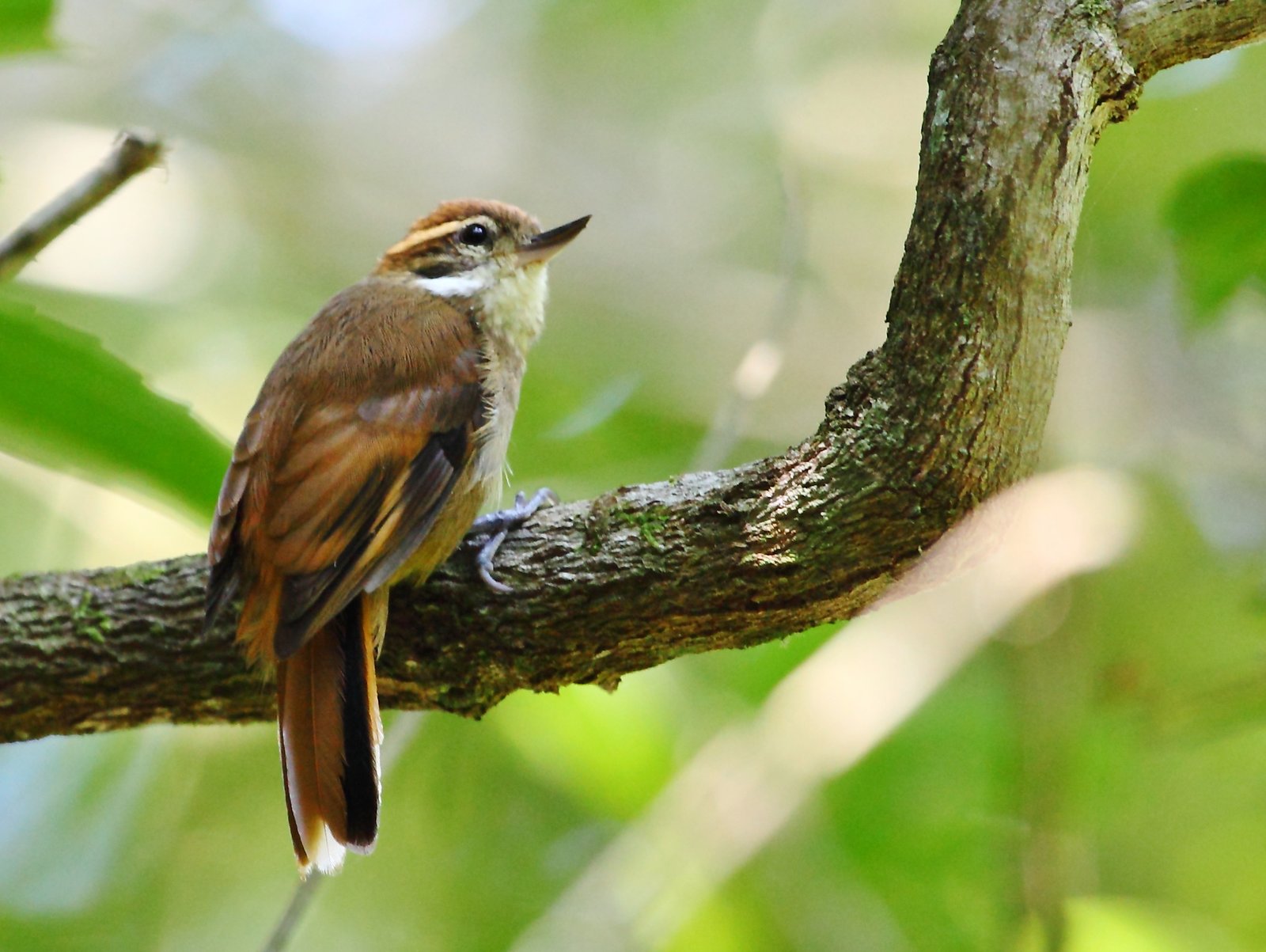
12 cm, small, with a short, wedge-shaped, upturned bill. The upperparts are plain olive-brown, the rump and tail rufous with black in the tail. A buff supercilium and a silvery-white stripe below the eye across the cheek. The underparts are olive-brown, with faint pale streaks on the breast. In flight a cinnamon band across the wing. The sexes are alike.
Confusion species
In the guide area a plain xenops is Amazonian Plain Xenops Xenops genibarbis, which is very similar and is separated mainly by location and song. Streaked Xenops Xenops rutilans, which also lives in the Atlantic Forest, is clearly streaked.
Habitat
Humid lowland and hill forest, forest edges and mature secondary forest in the Atlantic Forest. It forages in the lower and middle storeys along thin branches and vines for insects, often in mixed flocks. The nest is in a cavity in dead wood.
Where the bird is most at home, classified by the vegetation units of the Andes and the west coast.


Range and movements
Does not occur in the guide area: absent from Colombia, Ecuador, Peru, Bolivia and the Galápagos. The range lies in eastern Brazil, from Bahia south to Santa Catarina, in eastern Paraguay and in Misiones in north-eastern Argentina.
- Resident
- dark = core range, pale = thinly spread
How and when to look
Not found in the guide area. To see the species, look for mixed flocks in the midstorey of the Atlantic Forest.
Conservation status
Least Concern. The Atlantic Forest is highly fragmented, but the species tolerates secondary forest and forest edges.
Scientific name
Xenops minutus | (Sparrman, 1788)
Sparrman described the species in 1788 as Turdus minutus; because it was later moved to another genus, the author and year stand in brackets. The genus Xenops was introduced in 1811 by Illiger. The genus name comes from Greek xenos, 'strange, unusual', and ōps, 'face'. The original description stresses the bill, with a straight upper edge and an upturned lower edge. The species name comes from Latin minutus, 'small'. The specimen the first description was based on came from Rio de Janeiro, Brazil (assumed).