All species › Passerines › Ovenbirds and woodcreepers › Streaked Xenops
Streaked Xenops | Xenops rutilans
Gestreepte xenops | Picolezna rayado | Bico-virado-carijó
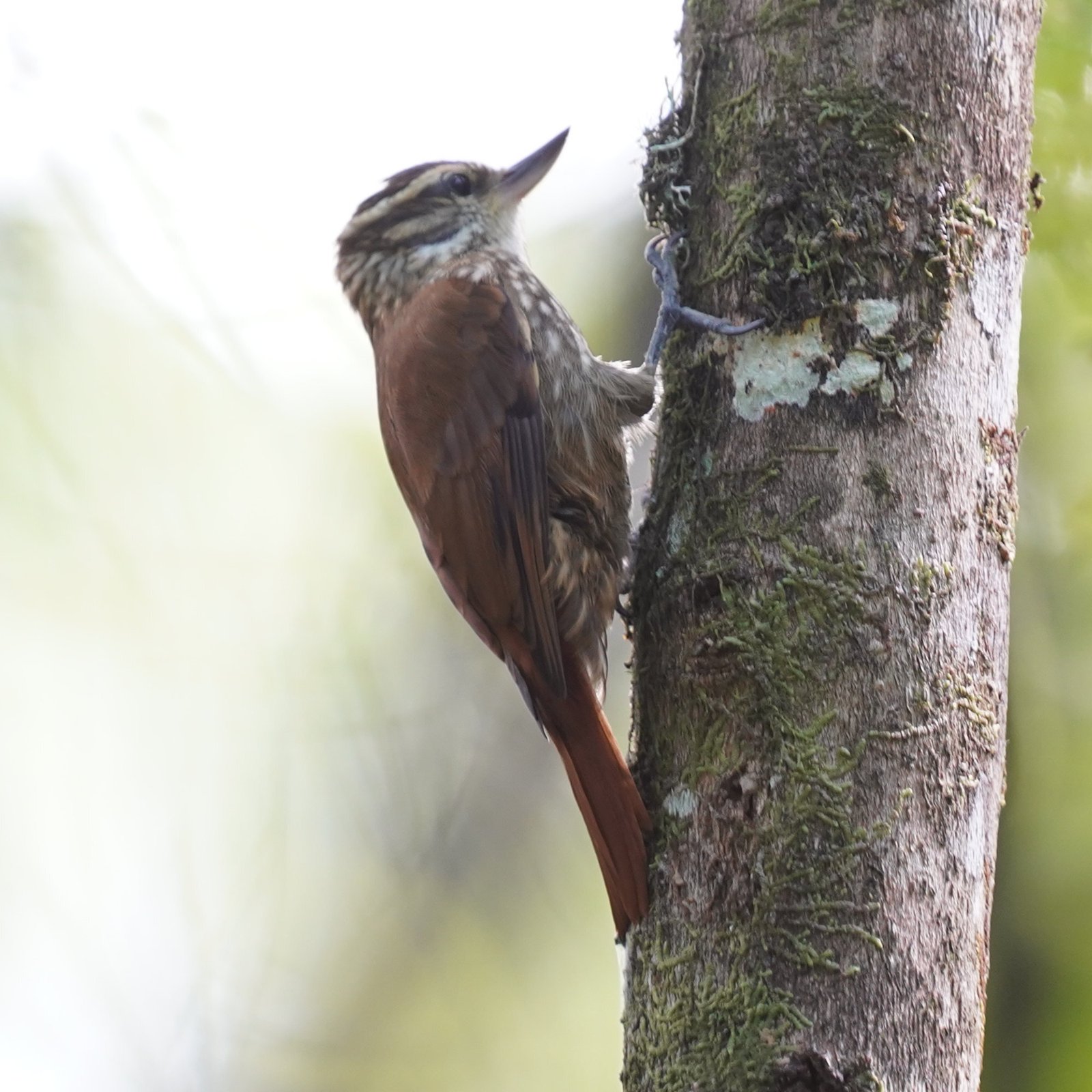
The Streaked Xenops is the most widespread xenops of the Andes. It clambers, hanging and twisting, along thin branches, vines and dead twigs and picks insects out of the wood with its upturned bill. It is a regular member of mixed flocks in montane forest and also occurs in dry forest west of the Andes.
Voice
The song is a short series of four to eight high, thin notes, first slightly rising and then falling, tsee-tsee-tsee-tsee. The call is a sharp, high tseet.
Recording: Juan Freile — CC BY-NC-SA 4.0 · xeno-canto
Identification
12 cm, small, with a short, wedge-shaped bill with a clearly upturned lower mandible. The head and mantle are brown with pale streaks; the rump and tail are rufous, the tail with some black on the inner feathers. A buff supercilium and a white stripe below the eye across the cheek. The underparts are olive-brown with distinct pale streaks on the throat, breast and flanks. In flight a cinnamon band across the wing. The sexes are alike.
Confusion species
Slender-billed Xenops Xenops tenuirostris has a thinner, less upturned bill and more black in the tail and lives in the Amazonian lowlands. Amazonian Plain Xenops Xenops genibarbis has unstreaked upperparts. Rufous-tailed Xenops Microxenops milleri has a straight bill and no white cheek stripe. Wedge-billed Woodcreeper Glyphorynchus spirurus climbs trunks and is not streaked.
Habitat
Humid montane forest, cloud forest, forest edges and mature secondary forest on both slopes of the Andes, mostly between 600 and 2000 m, locally to 2500 m; west of the Andes also in dry and semi-deciduous forest down to the lowlands. It forages in the middle and upper storeys along thin branches, vines and dead twigs for insects and larvae. The nest is in a cavity in dead wood, often self-excavated.
Where the bird is most at home, classified by the vegetation units of the Andes and the west coast.


Range and movements
Colombia: in the three Andean ranges, the Sierra de Perijá and the Sierra Nevada de Santa Marta. Ecuador: on both slopes of the Andes, in the west also in dry lowland forest. Peru: on the east slope of the Andes and in the dry north-west; locally in the Amazonian lowlands. Bolivia: in the Yungas and foothills, and in forest in the eastern lowlands. Absent from the Galápagos. Outside the guide area from Costa Rica to Venezuela, Trinidad, the Guianas, Brazil, Paraguay and northern Argentina.
- Resident
- dark = core range, pale = thinly spread
How and when to look
Follow mixed flocks in montane forest, for example along forest edges and roads; the xenops often hangs from thin dead twigs. The series of thin notes also carries from the canopy.
Conservation status
Least Concern. The species has a very large range and tolerates forest edges and secondary forest.
Scientific name
Xenops rutilans | Temminck, 1821
Temminck described the species in 1821 and placed it straight away in the genus where it still stands. The genus Xenops was introduced in 1811 by Illiger. The genus name comes from Greek xenos, 'strange, unusual', and ōps, 'face'. The original description stresses the bill, with a straight upper edge and an upturned lower edge. The species name comes from Latin rutilans, 'reddish, glowing'. The specimen the first description was based on came from Brazil.