All species › Passerines › Ovenbirds and woodcreepers › Wedge-billed Woodcreeper
Wedge-billed Woodcreeper | Glyphorynchus spirurus
Wigsnavelmuisspecht | Trepatroncos picocuña | Arapaçu-bico-de-cunha
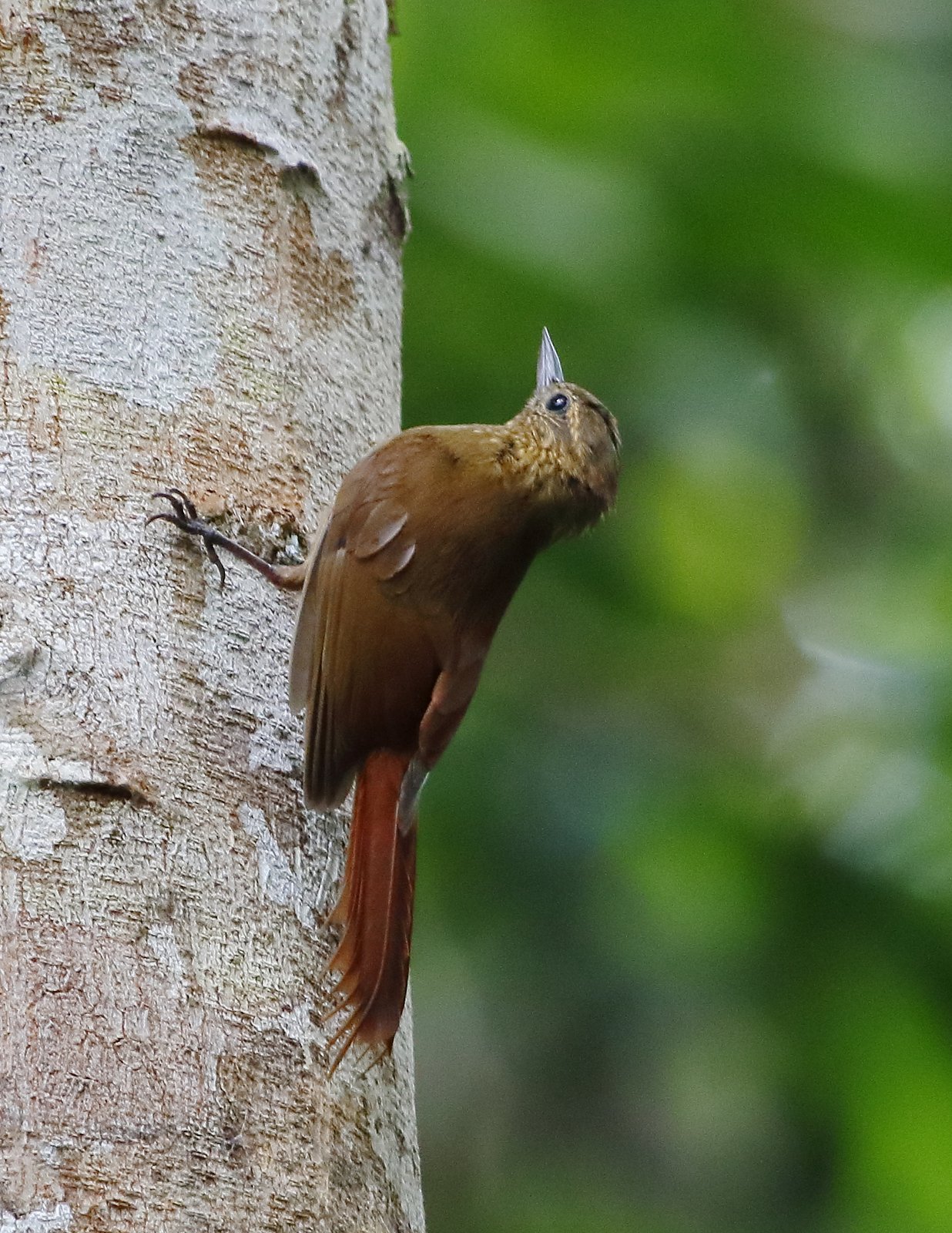
The Wedge-billed Woodcreeper is one of the smallest woodcreepers and one of the most numerous birds of tropical rainforest. It hitches up trunks in short, spiralling hops, often close to the ground, and then flies to the base of the next tree. Its short, wedge-shaped bill with a slightly upturned lower mandible is unique among woodcreepers.
Voice
The song is a rapid, rising series of sharp notes, chee-chee-chee-chee, ending in a trill. The call is a short, sharp, sneezy chif.
Recording: Jacob Wijpkema — CC BY-NC-SA 4.0 · xeno-canto
Identification
13–15 cm, small and slim, with a stiff, rufous tail and a short, wedge-shaped bill. The upperparts are olive-brown, and the rump and tail rufous. The face shows a buff supercilium behind the eye and a dark eyestripe. The throat is buff, and the breast olive-brown with small, pale, drop-shaped spots. In flight a cinnamon band is visible across the underside of the flight feathers. The sexes are alike.
Confusion species
Olivaceous Woodcreeper Sittasomus griseicapillus has a greyish-olive head and breast without spots and a straight, thin bill. Spot-throated Woodcreeper Certhiasomus stictolaemus has a spotted throat and a thinner, straight bill. Long-tailed woodcreepers (Deconychura) are larger, with a longer tail and a longer bill. Xenops (Xenops) also have an upturned bill, but show a white cheek stripe and forage along thin branches rather than trunks.
Habitat
The interior and edges of humid rainforest in the lowlands and foothills, also older secondary forest and shade cacao or coffee, up to about 1500 m, locally higher. It searches trunks for small insects and spiders in bark, moss and crevices. It often joins understorey mixed flocks. The nest is in a crevice or cavity in a trunk or stump.
Where the bird is most at home, classified by the vegetation units of the Andes and the west coast.


Range and movements
Colombia: in the Pacific lowlands, in the Magdalena and Cauca valleys and east of the Andes. Ecuador: west and east of the Andes. Peru: in the Amazon basin and in the foothills east of the Andes. Bolivia: in the lowlands and foothills of the north and east. Absent from the Galápagos. Outside the guide area from southern Mexico to Venezuela, the Guianas and Brazil.
- Resident
- dark = core range, pale = thinly spread
How and when to look
In the rainforest interior, watch for a small brown bird hitching jerkily low up trunks, often in a mixed flock. The sharp chif gives it away; the rising song is heard mainly in the early morning.
Conservation status
Least Concern. The species has a very large range and is locally common; it tolerates some forest disturbance but disappears where forest is cleared completely.
Scientific name
Glyphorynchus spirurus | (Vieillot, 1819)
Vieillot described the species in 1819 as Neops spirurus; because it was later moved to another genus, the author and year stand in brackets. The genus Glyphorynchus was introduced in 1831 by Wied-Neuwied. The genus name comes from Greek gluphē, 'carving', and rhunkhos, 'bill', after the short, wedge-shaped bill. The species name comes from Greek speira, 'coil', and -ouros, 'tailed'. Vieillot (1819) described tail feathers that curl into spirals towards the end and finish in a claw-like tip. The specimen the first description was based on came from Cayenne, French Guiana.