All species › Passerines › Ovenbirds and woodcreepers › Coastal Miner
Coastal Miner | Geositta peruviana
Kustholengraver | Minero peruano | Curriqueiro-costeiro
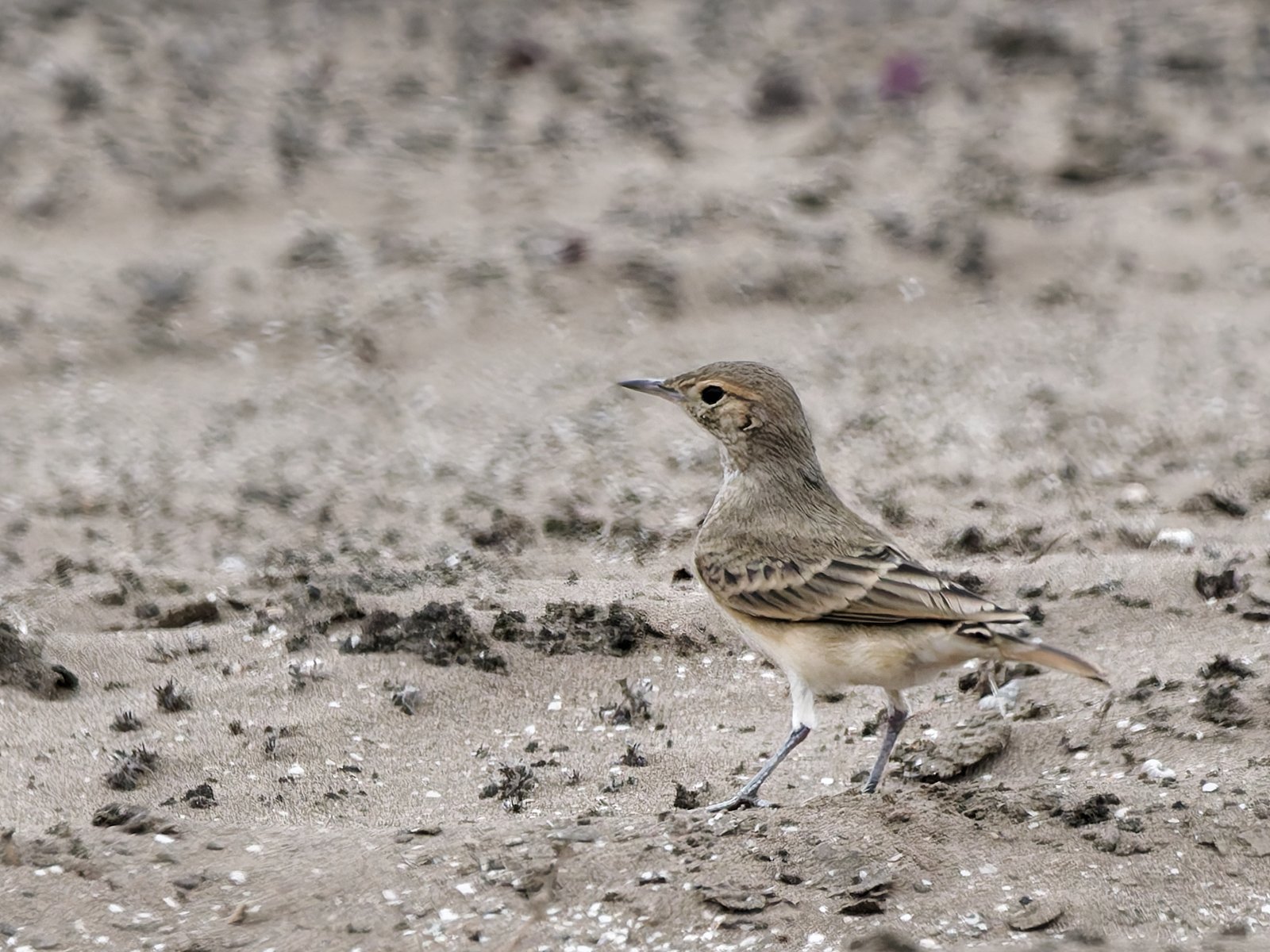
The Coastal Miner is a small, sandy-coloured miner found only in the coastal desert of Peru. It runs quickly over bare sand and among low vegetation and resembles a small pipit in posture. In flight it shows a pale rufous wing band.
Voice
The call is a squeaky 'cueet'. The song is given in display flight and is a dry, unmusical series of notes. Few recordings exist.
Recording: GABRIEL LEITE — CC BY-NC-SA 4.0 · xeno-canto
Identification
12–14.5 cm, with a short, thin, slightly decurved bill and fairly long legs. The upperparts are pale sandy brown, with a pale supercilium. The underparts are creamy white. The flight feathers are pale rufous to buff and form a pale wing band in flight. The tail is mostly black with creamy tips; the outer feathers are cream and pale rufous. The bill is bluish grey with a black tip, and the legs are greyish. The sexes are alike.
Confusion species
Greyish Miner Geositta maritima is greyer, with little rufous in the wing, and lives mainly on bare desert slopes in southern Peru. Common Miner Geositta cunicularia has a streaked breast and lives high in the Andes. Dark-winged Miner Geositta saxicolina has dark wings and lives in the puna of central Peru.
Habitat
Open, sandy plains of the coastal desert, from the dunes by the sea inland almost to the foot of the Andes, also in lomas and among sparse shrubs, from sea level to about 700 m. It forages on foot for insects. The nest is in a chamber at the end of a tunnel in the ground; only one nest has been described, with two eggs.
Where the bird is most at home, classified by the vegetation units of the Andes and the west coast.


Range and movements
Only in Peru, in the coastal desert from Tumbes and Piura south to Ica. Absent from Colombia, Ecuador, Bolivia and the Galápagos. Does not occur outside the guide area.
- Resident
- dark = core range, pale = thinly spread
How and when to look
Search open sandy flats, low dunes and lomas along the coast of northern and central Peru in the early morning, including north and south of Lima. Birds run off quickly and fly low over the sand.
Conservation status
Least Concern. Most of its habitat is unsuitable for farming or building, although suitable ground is lost locally around cities and irrigation projects.
Scientific name
Geositta peruviana | de Lafresnaye, 1847
De Lafresnaye described the species in 1847 and placed it straight away in the genus where it still stands. The genus Geositta was introduced in 1837 by Swainson. The genus name combines Greek geō-, 'earth, ground', with Sitta, the nuthatch genus. The species name refers to Peru. The specimen the first description was based on came from Lima, Peru.