All species › Passerines › Ovenbirds and woodcreepers › Slender-billed Miner
Slender-billed Miner | Geositta tenuirostris
Dunsnavelholengraver | Minero picudo | Curriqueiro-de-bico-fino
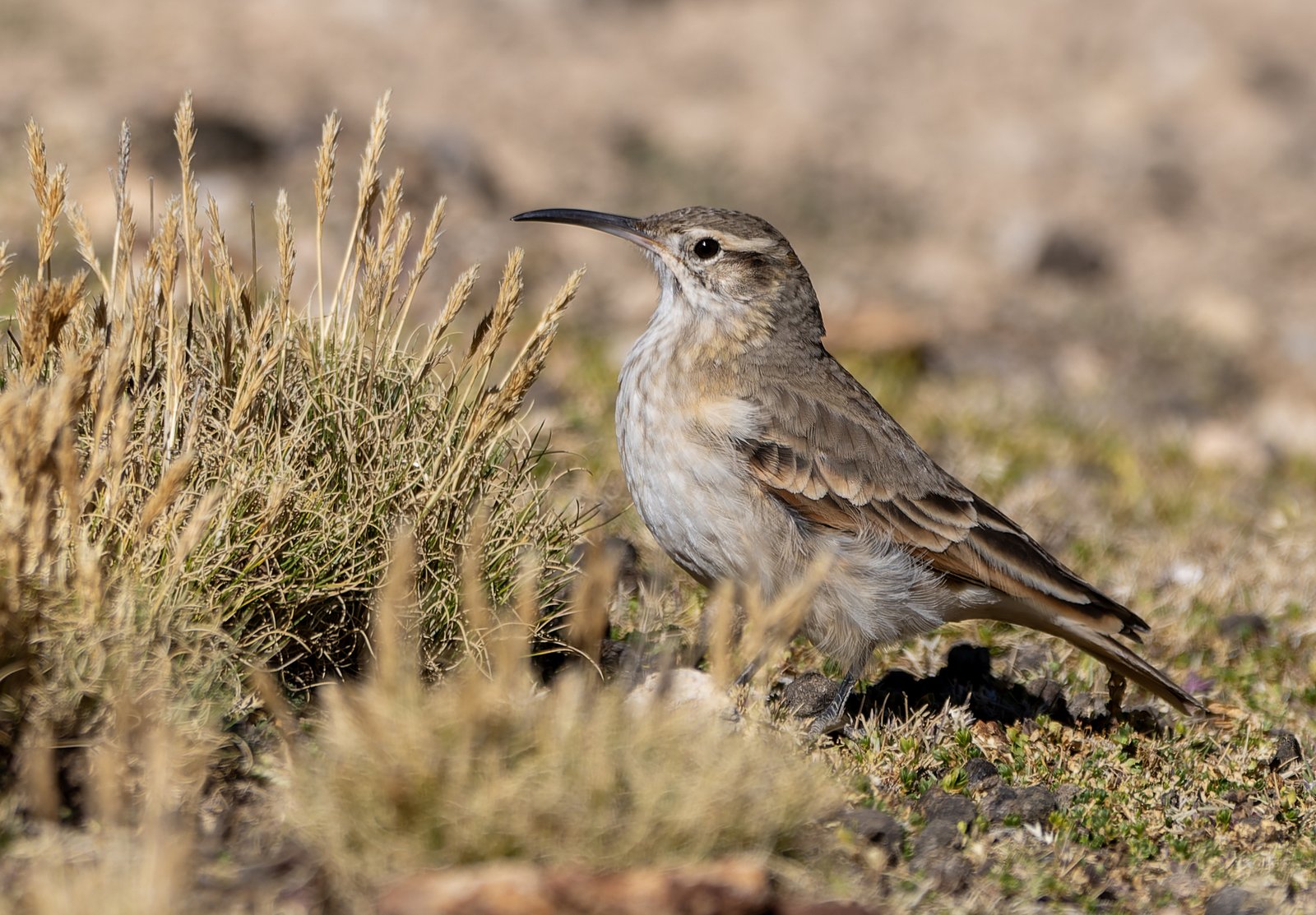
The Slender-billed Miner is the largest miner of the Andes of the guide area, with a long, thin, slightly decurved bill. It lives in open grassland, pastures and fields at high elevations and nests in tunnels in earth banks. A separate subspecies (kalimayae) lives in isolation in the central highlands of Ecuador.
Voice
The song is given in display flight and is a repeated series of short notes such as 'jit' or 'keek'. The calls are a drawn-out 'keeeeek' and a nasal 'kyeenh'.
Recording: Sjoerd Mayer — CC BY-NC-SA 3.0 · xeno-canto
Identification
16–18 cm, with a long, thin, slightly decurved bill. The face is pale buffy brown with a pale supercilium; the crown is finely streaked. The upperparts are greyish brown, and the outer tail feathers rufous. The dark wing coverts have pale buff tips that form wing bars. The breast is dull white with brown streaks. The sexes are alike. Ecuadorian birds are smaller and greyer, with darker wings and tail and more breast streaking.
Confusion species
Common Miner Geositta cunicularia is smaller, with a shorter bill and much rufous in the wing. Puna Miner Geositta punensis is smaller and paler, with a short bill and an unstreaked breast. Thick-billed Miner Geositta crassirostris has a thicker bill and lives on rocky slopes of the western Andes of Peru. Earthcreepers of the genus Upucerthia have a longer, more strongly decurved bill and a longer tail.
Habitat
Puna grassland, scrub, pastures and fields at high elevations, often near water, between about 2500 and 4600 m. It walks on the ground and extracts insects from the soil and between grass tussocks with its long bill. It breeds in the austral summer; the nest of dry grass is in a chamber at the end of a tunnel in an earth bank, sometimes in a burrow of an earthcreeper. The clutch is two eggs.
Where the bird is most at home, classified by the vegetation units of the Andes and the west coast.


Range and movements
In Ecuador only a small, isolated population in Cotopaxi. In Peru on both slopes of the Andes, from the border with Ecuador southwards. In Bolivia in the Andes and on the altiplano. Absent from Colombia and the Galápagos. Outside the guide area in north-western Argentina, south to Tucumán.
- Resident
- dark = core range, pale = thinly spread
How and when to look
Search open grassland, pastures and fields in the high valleys of Peru and Bolivia, especially near streams and damp places. In the breeding season the birds sing in display flight over the grassland.
Conservation status
Least Concern. The range is large, the population appears stable and no immediate threats are known; the Ecuadorian population is small and isolated.
Scientific name
Geositta tenuirostris | (de Lafresnaye, 1836)
De Lafresnaye described the species in 1836 as Alauda tenuirostris; because it was later moved to another genus, the author and year stand in brackets. The genus Geositta was introduced in 1837 by Swainson. The genus name combines Greek geō-, 'earth, ground', with Sitta, the nuthatch genus. The species name comes from Latin tenuis, 'slender', and rostrum, 'bill': 'slender-billed'. The specimen the first description was based on came from Sicasica, La Paz, Bolivia.