All species › Passerines › Ovenbirds and woodcreepers › Bamboo Foliage-Gleaner
Bamboo Foliage-Gleaner | Anabazenops dorsalis
Bamboebladspeurder | Rascahojas de bambú | Limpa-folha-do-bambu
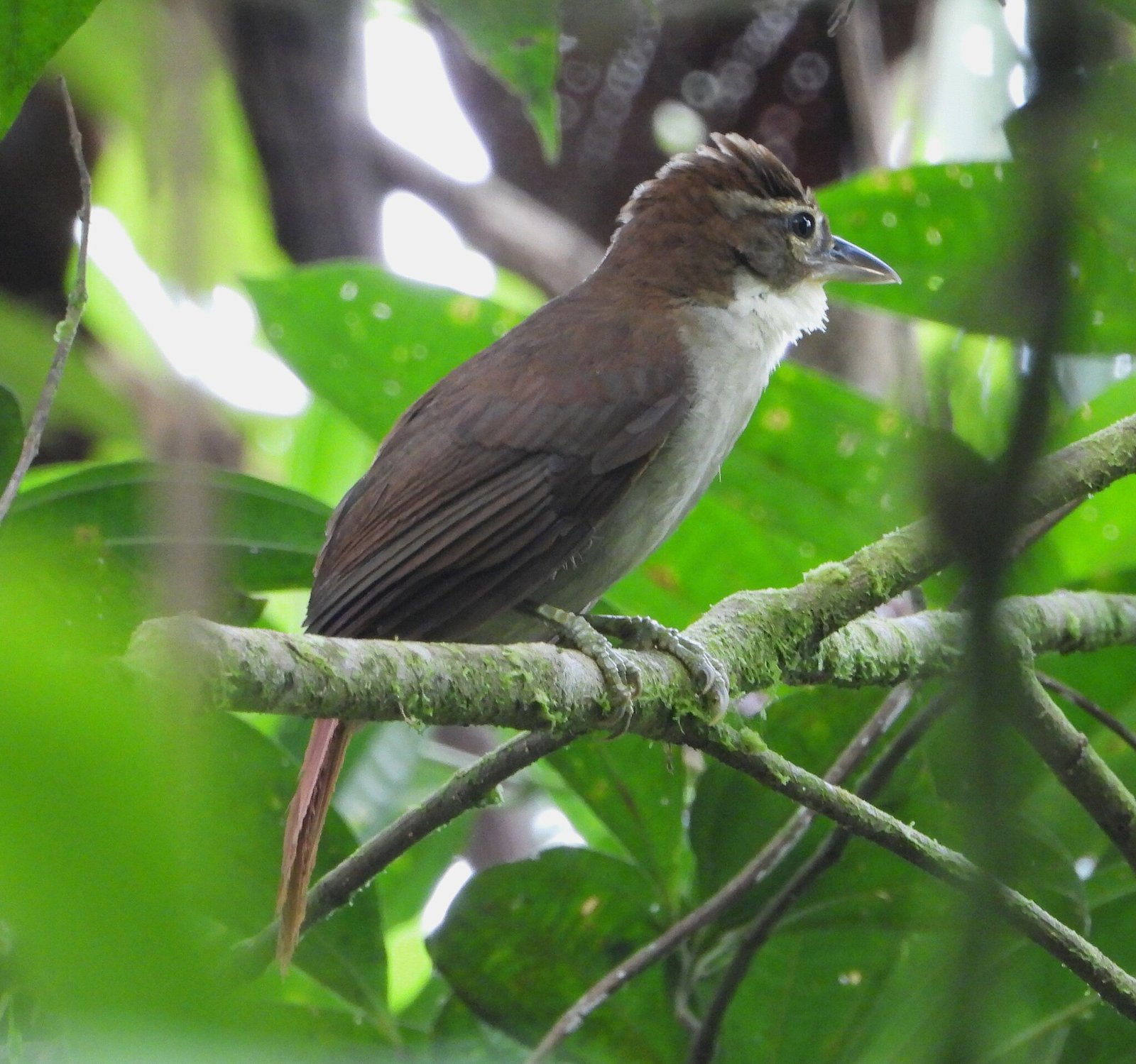
The Bamboo Foliage-Gleaner is a large foliage-gleaner that lives almost exclusively in dense bamboo thickets of south-western Amazonia. It clambers through the tangle of bamboo stems and searches dead leaves and hollow internodes for insects. Its former name, Dusky-cheeked Foliage-Gleaner, refers to the dark cheeks.
Voice
A loud, fast, rattling series of sharp notes, and repeated, dry chek calls, often answered between the birds of a pair.
Recording: John V. Moore — CC BY-NC-SA 4.0 · xeno-canto
Identification
18–19 cm, with a fairly stout, straight bill with a pale lower mandible. The upperparts are warm brown, the crown slightly darker and the tail rufous. A long, whitish to pale buff supercilium above dark cheeks. The throat is white; the underparts are greyish white to pale buff, browner on the flanks. The sexes are alike.
Confusion species
Brown-rumped Foliage-Gleaner Automolus melanopezus also lives in bamboo, but is darker brown, with a buff throat and no clear supercilium. Chestnut-crowned Foliage-Gleaner Automolus rufipileatus has a rufous crown, an orange eye and no supercilium. Peruvian Recurvebill Syndactyla ucayalae, also a bamboo species, has a bill with an upturned tip.
Habitat
Dense bamboo thickets (especially Guadua) in lowland forest and in foothill forest on the eastern slope, also along rivers and at forest edges, up to about 1500 m. It forages in pairs in the lower and middle levels of the bamboo, often with mixed flocks, among dead leaves and in bamboo stems for insects. Little is known about the nest.
Where the bird is most at home, classified by the vegetation units of the Andes and the west coast.


Range and movements
Colombia: very local in the south-east. Ecuador: locally in the eastern lowlands and foothills. Peru: in the Amazonian lowlands and foothills in the centre and south, where bamboo is widespread. Bolivia: in the north (Pando, La Paz, Beni, Cochabamba). Absent west of the Andes and from the Galápagos. Outside the guide area in western Brazil.
- Resident
- dark = core range, pale = thinly spread
How and when to look
Search large bamboo thickets in south-eastern Peru or northern Bolivia and listen for the rattling calls. Birds usually keep hidden in the dense bamboo and often respond to each other's calls.
Conservation status
Least Concern. The species is tied to bamboo, which covers large areas in south-western Amazonia, but disappears where the forest is cleared.
Scientific name
Anabazenops dorsalis | (Sclater & Salvin, 1880)
Sclater & Salvin described the species in 1880 as Automolus dorsalis; because it was later moved to another genus, the author and year stand in brackets. The genus Anabazenops was introduced in 1841 by De Lafresnaye. The genus name is a blend of the genus names Anabates and Xenops (via the variant Zenops). The species name comes from Latin dorsalis, 'of the back' (from dorsum, 'back'). The specimen the first description was based on came from Sarayacu, Ecuador.