All species › Passerines › Ovenbirds and woodcreepers › White-bellied Spinetail
White-bellied Spinetail | Mazaria propinqua
Witbuikstekelstaart | Pijuí ventriblanco | João-de-barriga-branca
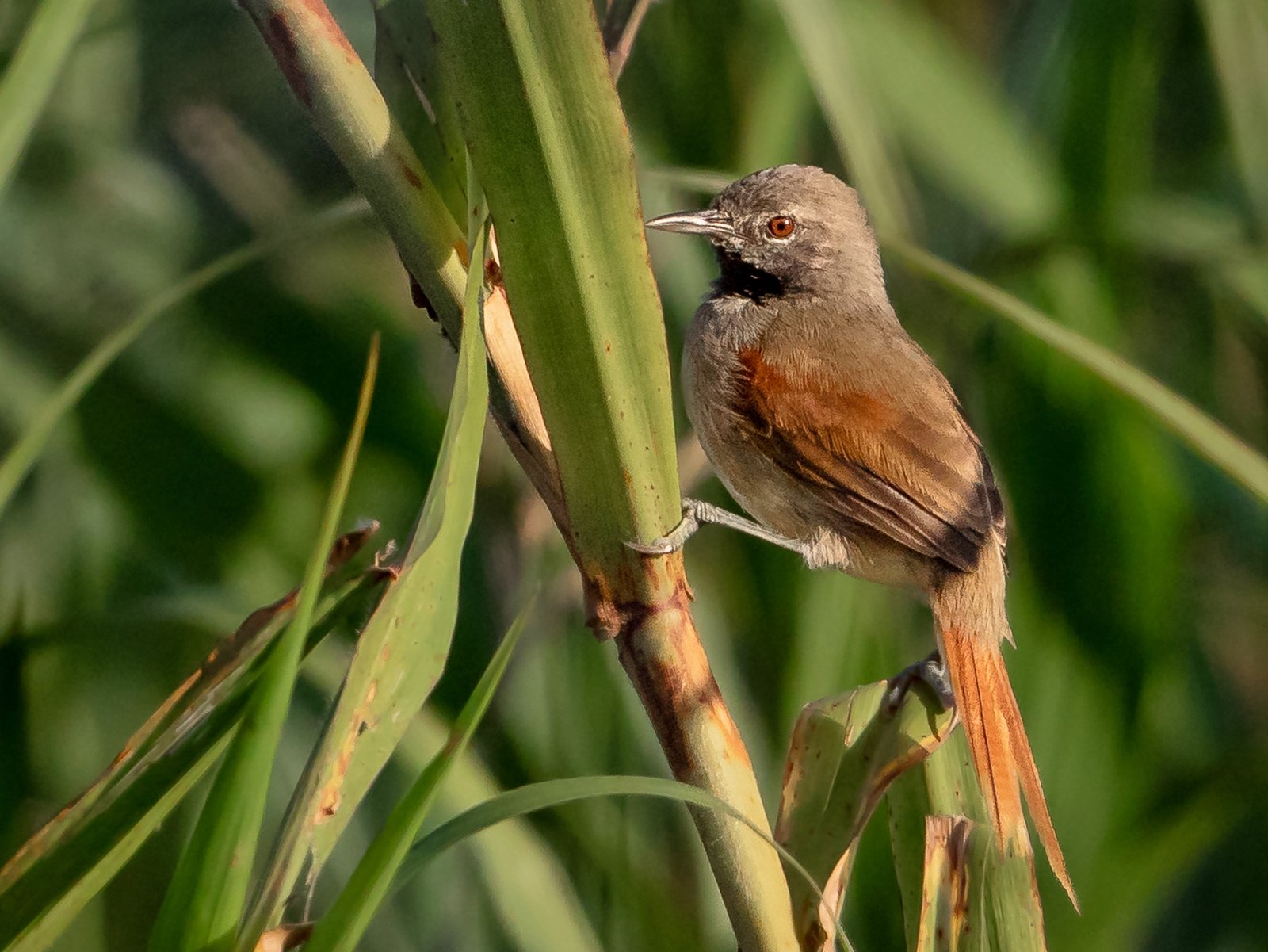
The White-bellied Spinetail is a greyish-brown spinetail of young vegetation on river islands in the Amazon basin. It lives in grassland with scattered shrubs and young trees that springs up on sandbars after floods. It was formerly placed in the genus Synallaxis.
Voice
The song is a strange, low, nasal churring. Also raspy snarls, scratchy notes and descending series of growls.
Recording: Juan Freile — CC BY-NC-SA 4.0 · xeno-canto
Identification
15–16 cm, with a long, dull rufous tail with pointed feathers. Crown, back and rump are greyish brown, the lores grey. The chin and upper throat are white, or black with white fringes; the lower throat is black with white feather tips. The breast is grey to pale brownish grey, the belly white and the flanks pale brown. The flight feathers are dusky with pale rufous edges. The sexes are alike. Juveniles are whiter below and lack the black on the throat.
Confusion species
Parker's Spinetail Cranioleuca vulpecula also lives on river islands, but has rufous upperparts, a pale supercilium and no black on the throat. Plain-crowned Spinetail Synallaxis gujanensis has rufous wings, paler underparts without a black throat patch, and lives in scrub along the banks. Dark-breasted Spinetail Synallaxis albigularis has a rufous crown and rufous wing coverts and a dark grey breast.
Habitat
Early successional growth on river islands and sandbars in the Amazonian lowlands, especially grassy patches with scattered shrubs and young trees, up to about 300 m. It searches for insects and other invertebrates low in the vegetation. Almost nothing is known about its breeding.
Where the bird is most at home, classified by the vegetation units of the Andes and the west coast.


Range and movements
Colombia: only in the far south-east, along the Amazon; its occurrence there has not been firmly established. Ecuador: in the eastern lowlands, along the large rivers. Peru: in the north-east and the centre of the eastern lowlands. Bolivia: locally in the north. Absent from the Galápagos. Outside the guide area along the rivers of the western Amazon basin in Brazil; one old record from French Guiana.
- Resident
- dark = core range, pale = thinly spread
How and when to look
Take a boat to young river islands in the Amazon, Napo or Ucayali, for example around Iquitos, and listen for the low churring from grassland with young shrubs. Birds sing most in the early morning.
Conservation status
Least Concern. The species is tied to young island vegetation, which is constantly renewed by river dynamics.
Scientific name
Mazaria propinqua | (Pelzeln, 1859) (GBIF: Synallaxis propinqua)
Pelzeln described the species in 1859 as Synallaxis propinqua; because it was later moved to another genus, the author and year stand in brackets. The genus Mazaria was introduced in 2014 by Claramunt. The genus name honours Juan Mazar Barnett (1975–2012), an Argentine ornithologist; Santiago Claramunt named the genus in 2014. The species name propinqua comes from Latin propinquus, 'related, similar', after its likeness to related spinetails. The specimen the first description was based on came from Rio Madeira, Amazonas, Brazil.