All species › Passerines › Ovenbirds and woodcreepers › Greater Scythebill
Greater Scythebill | Drymotoxeres pucheranii
Wulpbekmuisspecht | Picoguadaña grande | Arapaçu-foice-grande
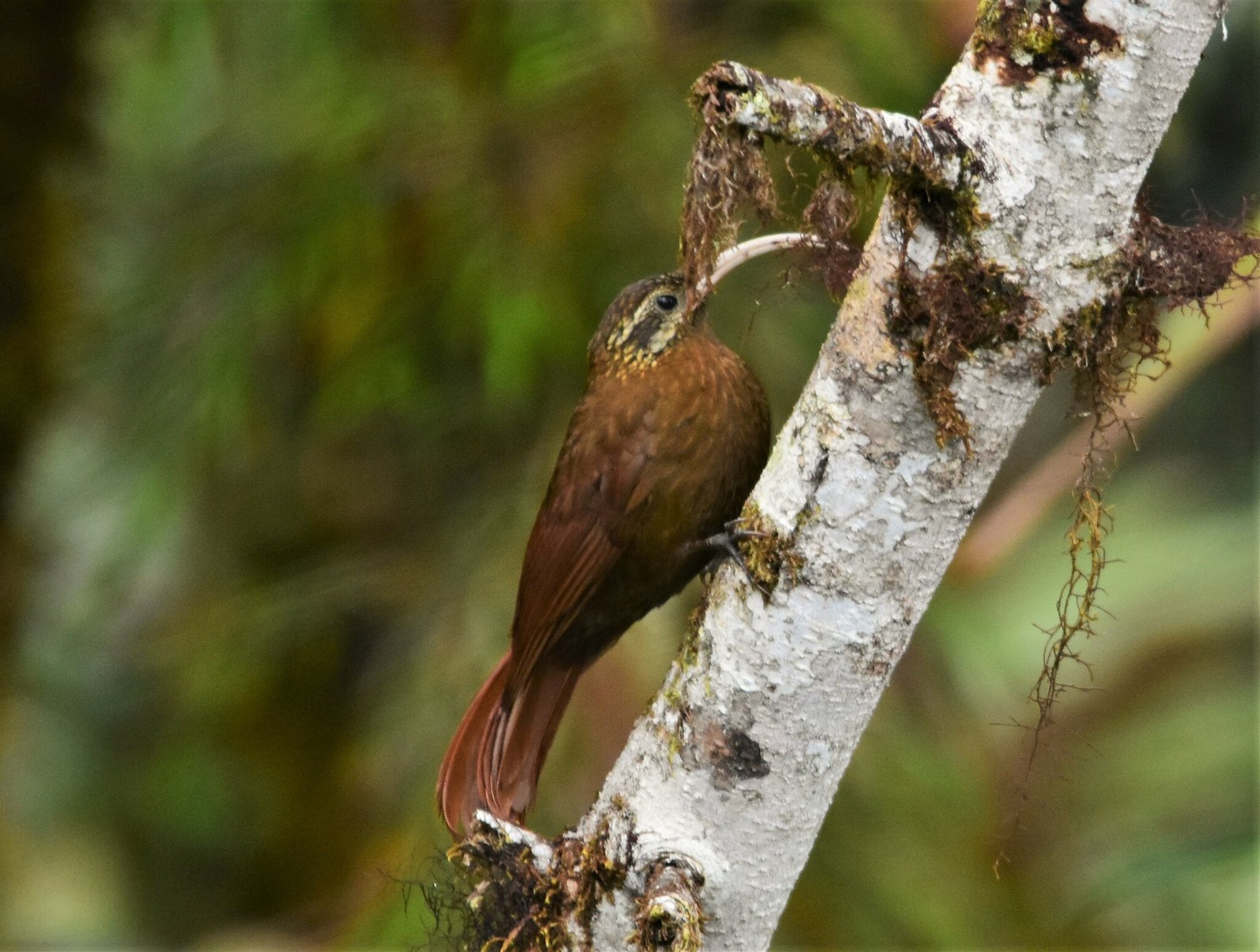
The Greater Scythebill is the largest of the scythebills, a bird of Andean cloud forest with a very long, strongly decurved, pale bill. It usually lives alone and joins mixed-species flocks. It uses the bill to probe moss, epiphytes and crevices for prey.
Voice
The song is an alternating series of twitters and nasal ik notes; also a weak, nasal, rising call. The voice differs clearly from that of the other scythebills.
Recording: Niels Krabbe — CC BY-SA 4.0 · xeno-canto
Identification
26–30 cm, large and dark rufous-brown, with a stiff, rufous tail and a very long, sickle-shaped, pale pinkish-horn bill. The head and mantle are brown with fine pale streaks. The face shows a whitish stripe below the eye and a whitish malar stripe. The underparts are olive-brown with narrow pale streaks on the breast. The sexes are alike.
Confusion species
Brown-billed Scythebill Campylorhamphus pusillus is smaller, with a darker bill, more heavily streaked upperparts and no white facial stripes, and usually lives lower on the slopes. Red-billed Scythebill Campylorhamphus trochilirostris is smaller, with a reddish bill, and lives in lowland and drier forest. Strong-billed Woodcreeper Xiphocolaptes promeropirhynchus is similar in size, but has a heavy, much less decurved bill.
Habitat
The interior and edges of humid montane forest, cloud forest and elfin forest, locally also banana plantings along the forest edge, between about 900 and 3250 m, mostly between 2000 and 2800 m. It climbs trunks and branches in the lower and middle levels and searches moss, bark and epiphytes for arthropods. One known nest was in a vertical tree cavity.
Where the bird is most at home, classified by the vegetation units of the Andes and the west coast.


Range and movements
Colombia: in the Central and Western Andes and in the south-west. Ecuador: on the western slope south to Pichincha and on the eastern slope. Peru: on the eastern slope south to Cuzco. Not known from Bolivia and absent from the Galápagos. The species does not occur outside the guide area.
- Resident
- dark = core range, pale = thinly spread
How and when to look
In mossy cloud forest, check mixed flocks; the Greater Scythebill usually climbs alone and rather slowly along thick trunks and branches. The long, pale bill shows well in the dim light of the forest.
Conservation status
Least Concern. The range is large, but the population is probably declining through deforestation and the species appears sensitive to forest disturbance.
Scientific name
Drymotoxeres pucheranii | (de Lafresnaye, 1849)
De Lafresnaye described the species in 1849 as Xyphorhynchus Pucherani; because it was later moved to another genus, the author and year stand in brackets. The genus Drymotoxeres was introduced in 2010 by Claramunt, Derryberry, Chesser, Aleixo & Brumfield. The genus name comes from Ancient Greek drumos, 'woodland', and toxērēs, 'equipped with a bow' (from toxon, 'bow'), for the strongly curved bill. The species name honours Jacques Pucheran (1817–1895), French zoologist at the Muséum national d'histoire naturelle in Paris. The specimen the first description was based on came from Bogotá, Colombia.