All species › Passerines › Ovenbirds and woodcreepers › Wren-like Rushbird
Wren-like Rushbird | Phleocryptes melanops
Rietzangerstekelstaart | Junquero | Bate-bico
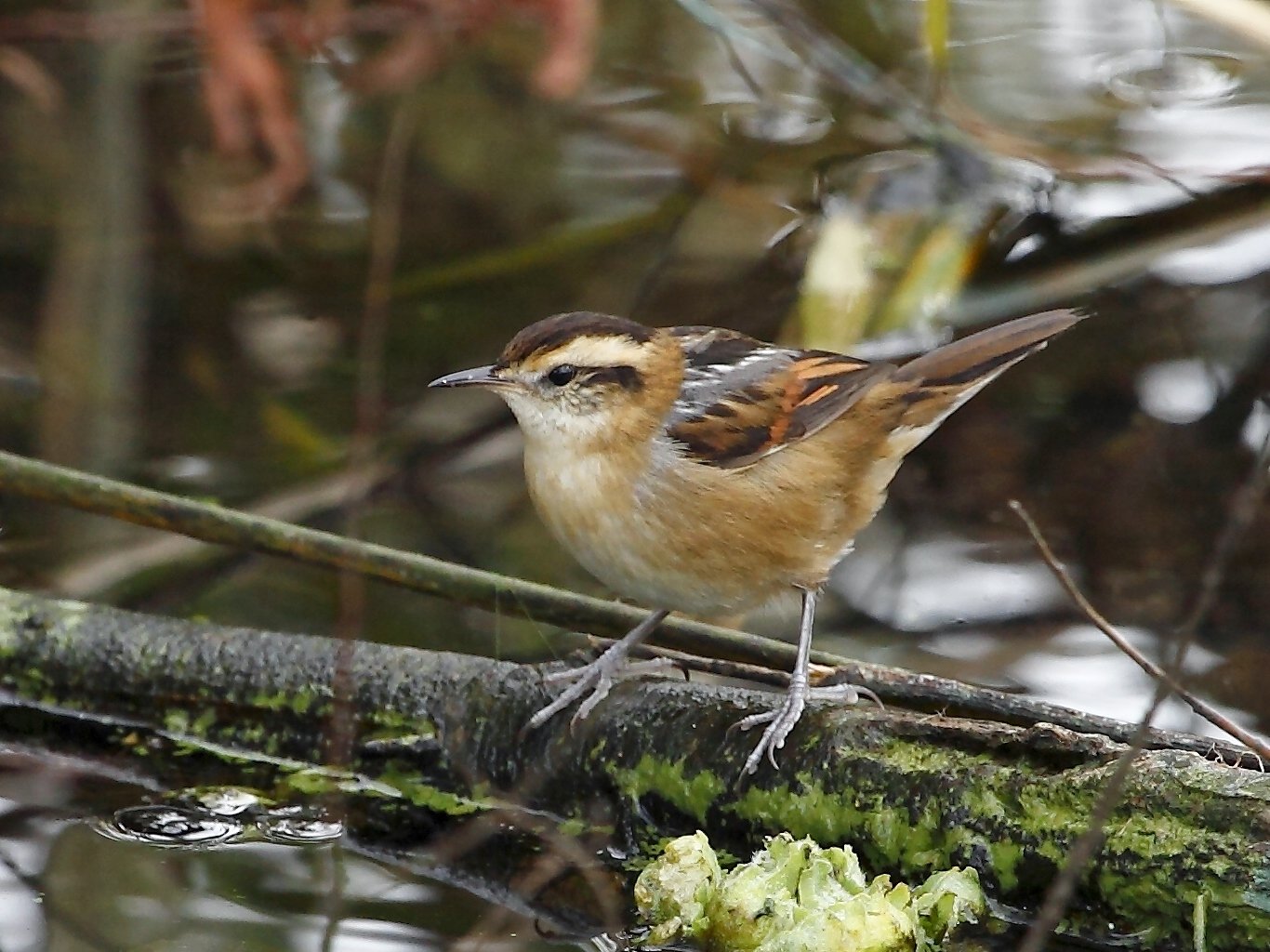
The Wren-like Rushbird is a small, streaked ovenbird of reedbeds and rushes, recalling a reed warbler in behaviour and appearance. It climbs among the stems of totora and reeds and builds a closed nest of wet plant material. It occurs from the coastal marshes to the lakes of the altiplano.
Voice
A dry, rhythmic ticking, like stones being knocked together, sometimes accelerating into a rattle. Also shrill, sharp calls.
Recording: Iván Lau — CC BY-NC-SA 4.0 · xeno-canto
Identification
13–14 cm, with a thin, straight bill. The crown is brown, with an obvious whitish supercilium. The mantle is streaked black and white, the wings are dark with a rufous wing band and the tail is brown. The underparts are whitish, with a buff wash on the sides of the breast and the flanks. The sexes are alike.
Confusion species
Grass Wren Cistothorus platensis also has a streaked back, but barred wings and tail, and lives in grassland and marsh edges. Many-colored Rush Tyrant Tachuris rubrigastra shares the same reedbeds, but is multicoloured, with yellow, red and green, and lacks a streaked mantle.
Habitat
Reedbeds, rushes (totora) and dense marsh vegetation along lakes, lagoons and rivers, from sea level on the coast to over 4000 m on the altiplano. It forages among the stems and just above the water for insects and larvae. The nest is a closed ball of wet plant material that hardens as it dries, with a side entrance, attached to reed stems.
Where the bird is most at home, classified by the vegetation units of the Andes and the west coast.


Range and movements
Absent from Colombia, Ecuador and the Galápagos. Peru: in marshes along the coast and in the high Andes, including around Lake Junín and Lake Titicaca. Bolivia: on the altiplano, around Lake Titicaca and other lakes. Outside the guide area in Chile, Argentina, Paraguay, Uruguay and southern Brazil; birds from the south move north in winter.
- Resident
- dark = core range, pale = thinly spread
How and when to look
Visit the totora beds of Lake Titicaca or the coastal marshes of Peru and listen for the dry ticking. The bird often climbs briefly to the top of a stem.
Conservation status
Least Concern. The species is common in suitable reedbeds, but depends on the conservation of marshes and totora beds.
Scientific name
Phleocryptes melanops | (Vieillot, 1817)
Vieillot described the species in 1817 as Sylvia melanops; because it was later moved to another genus, the author and year stand in brackets. The genus Phleocryptes was introduced in 1860 by Cabanis & Heine. The genus name combines Greek phleōs, a reed or marsh plant, and kruptō, 'to hide'. The species name melanops combines Greek melas, 'black', and ōps, 'face'. The specimen the first description was based on came from Paraguay.