All species › Passerines › Ovenbirds and woodcreepers › Plain Thornbird
Plain Thornbird | Phacellodomus inornatus
Noordelijke stekelkruin | Espinero liso | João-de-pau-liso
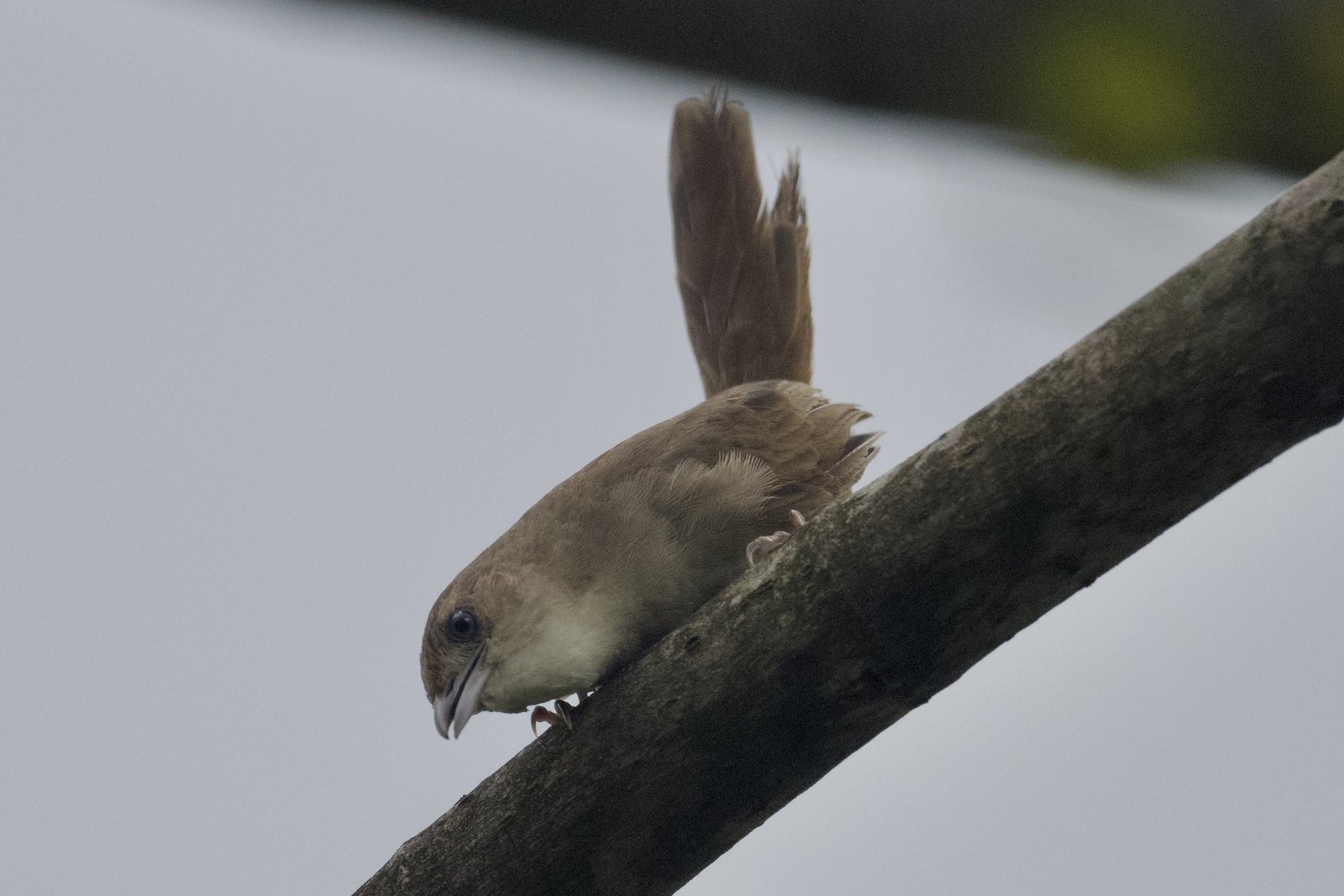
The Plain Thornbird is a plain brown ovenbird of the savannas and woodland edges of the Llanos. Pairs and family groups build huge, hanging nests of thorny twigs at the tips of branches. It was formerly included in Rufous-fronted Thornbird, but lacks that species' rufous forehead.
Voice
A loud series of shrill notes that first accelerates and then trails off, often as a duet by a pair. The call is a dry chek.
Recording: Oscar Humberto Marín Gómez & Juan Pablo López — CC BY-NC-SA 3.0 · xeno-canto
Identification
16 cm, with a straight, pointed bill and a fairly long, rounded tail. The upperparts are plain brown, the crown without rufous. A faint, pale supercilium. The throat is whitish, the underparts dull white to pale buff, browner on the flanks. The tail is brown. The sexes are alike; young birds are slightly warmer in tone.
Confusion species
Rufous-fronted Thornbird Phacellodomus rufifrons has a rufous forehead, but does not overlap with this species. Pale-breasted Spinetail Synallaxis albescens is smaller, with a rufous crown and wing patch and a narrow, graduated tail. Yellow-chinned Spinetail Certhiaxis cinnamomeus is rufous above and lives in marshes.
Habitat
Groves and edges of gallery forest in savanna, open woodland with scattered trees, pasture and farmyards with trees, in the lowlands up to about 500 m. It searches for insects among twigs and leaves. The nest is a hanging pile of thorny twigs with several chambers, which is enlarged over the years and reused by other birds.
Where the bird is most at home, classified by the vegetation units of the Andes and the west coast.


Range and movements
Colombia: in the Llanos east of the Andes, in Arauca, Casanare, Meta and Vichada. Absent from Ecuador, Peru, Bolivia and the Galápagos. Outside the guide area in northern Venezuela and the Venezuelan Llanos.
- Resident
- dark = core range, pale = thinly spread
How and when to look
Look along the edges of gallery forest and at farmyards with trees in the Llanos; the large stick nests on the outer branches of trees and palms lead the way, and the birds often give their loud duet.
Conservation status
Least Concern. The species tolerates a landscape of pasture with scattered trees.
Scientific name
Phacellodomus inornatus | Ridgway, 1887
Ridgway described the species in 1887 and placed it straight away in the genus where it still stands. The genus Phacellodomus was introduced in 1853 by Reichenbach. The genus name combines Greek phakellos, 'bundle of twigs', and domos, 'house', after the large stick nests. The species name inornatus comes from Latin inornatus, 'unadorned, plain'. The specimen the first description was based on came from Caracas, Venezuela.