All species › Passerines › Ovenbirds and woodcreepers › Rufous-fronted Thornbird
Rufous-fronted Thornbird | Phacellodomus rufifrons
Roodkapstekelkruin | Espinero frentirrufo | João-de-pau
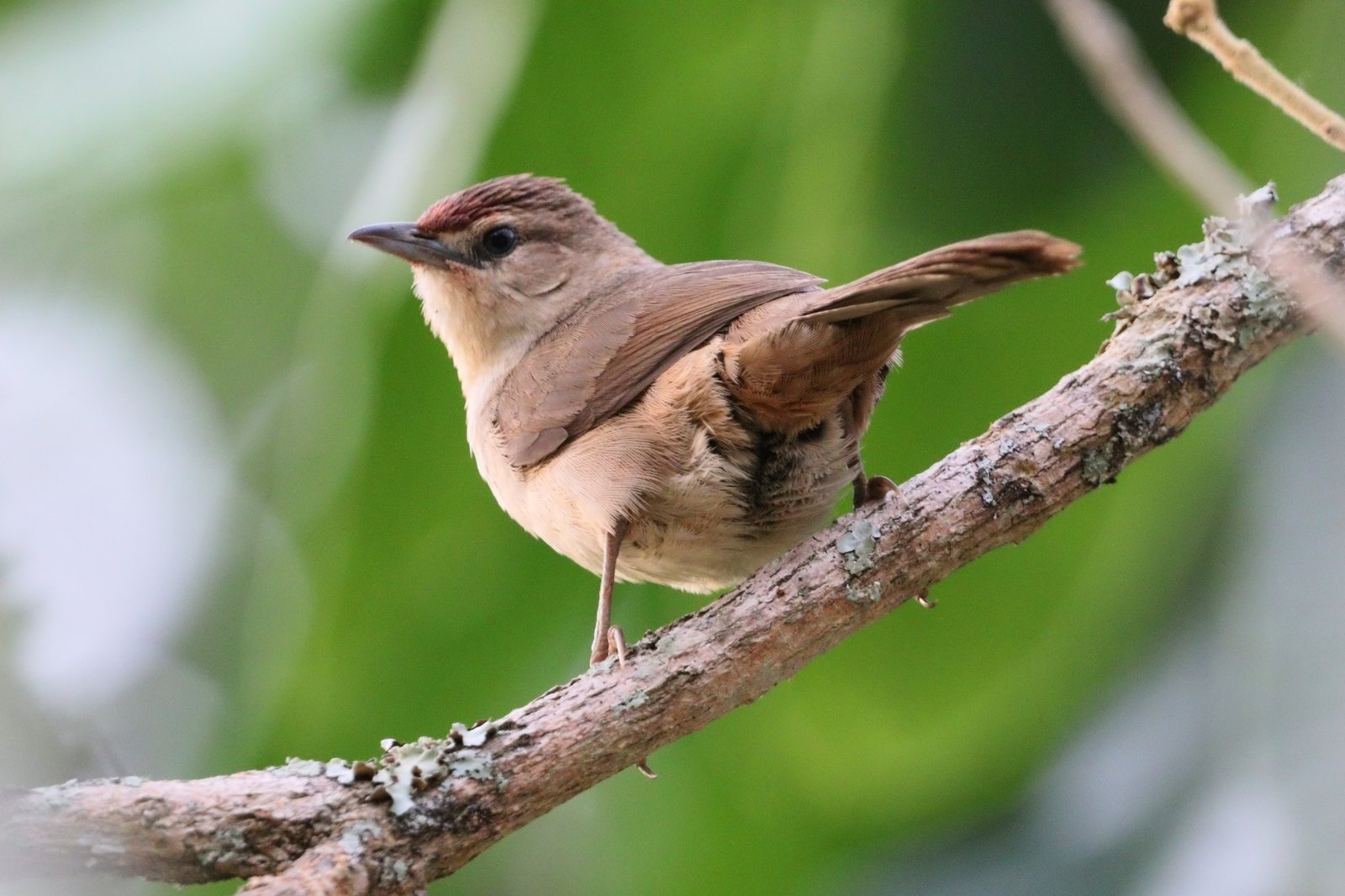
The Rufous-fronted Thornbird is a brown ovenbird with a rufous forehead, known for its large, hanging nests of thorny twigs. In the guide area it lives in two separate areas: in the dry valleys of southern Ecuador and northern Peru, and in eastern Bolivia.
Voice
A loud, accelerating series of shrill notes, often as a duet. The call is a dry chek, also repeated.
Recording: Robson Silva e Silva — CC BY-NC-SA 4.0 · xeno-canto
Identification
16–17 cm, with a straight, pointed bill and a fairly long, rounded tail. The forehead is rufous, the rest of the upperparts plain greyish brown. A pale supercilium. The throat is white, the underparts dull white, pale buff on the breast and flanks. The tail is brown, somewhat warmer in the northern Peruvian form. The sexes are alike.
Confusion species
Greater Thornbird Phacellodomus ruber in Bolivia is larger, with a rufous crown, wings and tail and a yellow eye. Streak-fronted Thornbird Phacellodomus striaticeps has a streaked forehead and lives much higher in the Andes. Chestnut-backed Thornbird Phacellodomus dorsalis of the Marañón is larger, with a chestnut back.
Habitat
Dry woodland, scrub and open woodland with scattered trees, also pasture, farmyards and forest edges; in northern Peru and southern Ecuador between about 500 and 2000 m, in Bolivia in the lowlands. It searches for insects among twigs and leaves. The nest is a hanging pile of thorny twigs with several chambers, often used by other birds.
Where the bird is most at home, classified by the vegetation units of the Andes and the west coast.


Range and movements
Colombia: absent. Ecuador: in the south, in the dry valley around Zumba in Zamora-Chinchipe. Peru: in the north, in the Marañón drainage in Cajamarca and Amazonas and adjacent San Martín. Bolivia: in the east, in Santa Cruz and Beni, in cerrado, Chiquitano dry forest and the edge of the Chaco. Absent from the Galápagos. Outside the guide area in eastern Brazil, Paraguay and northern Argentina.
- Resident
- dark = core range, pale = thinly spread
How and when to look
Look in the dry valleys around Jaén and Bagua in northern Peru, or in the dry forest around Santa Cruz de la Sierra in Bolivia; the large stick nests on the outer branches of trees can be seen from afar.
Conservation status
Least Concern. The species tolerates a landscape of pasture with scattered trees.
Scientific name
Phacellodomus rufifrons | (Wied-Neuwied, 1821)
Wied-Neuwied described the species in 1821 as Anabates rufifrons; because it was later moved to another genus, the author and year stand in brackets. The genus Phacellodomus was introduced in 1853 by Reichenbach. The genus name combines Greek phakellos, 'bundle of twigs', and domos, 'house', after the large stick nests. The species name rufifrons comes from Latin rufus, 'rufous', and frons, 'forehead': 'rufous-fronted'. The specimen the first description was based on came from Ribeirão da Ressaca, Bahia/Minas Gerais, Brazil.