All species › Passerines › Ovenbirds and woodcreepers › Straight-billed Woodcreeper
Straight-billed Woodcreeper | Dendroplex picus
Priemsnavelmuisspecht | Trepatroncos piquirrecto | Arapaçu-de-bico-branco
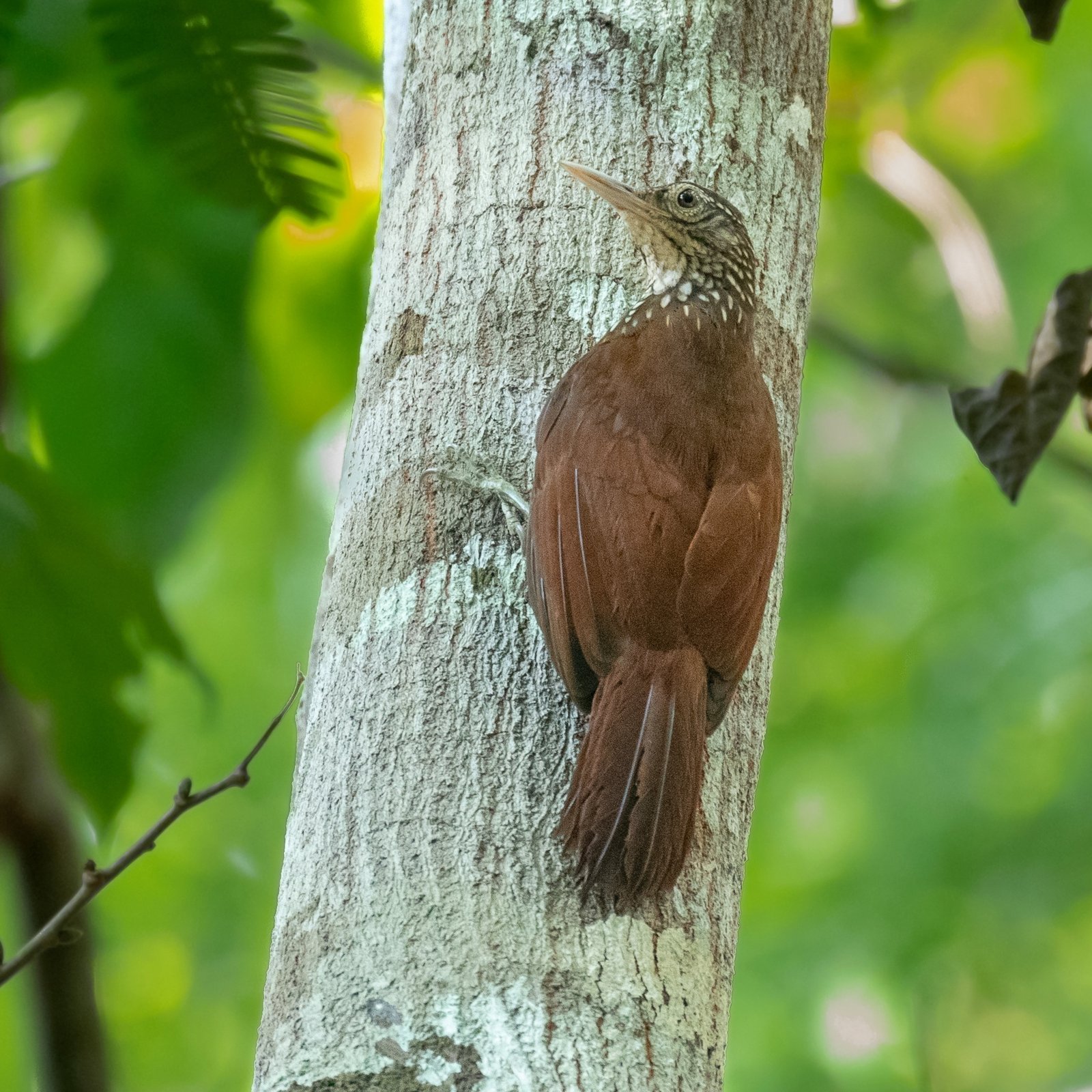
The Straight-billed Woodcreeper is one of the most widespread woodcreepers of tropical South America. Its straight, pale, dagger-shaped bill separates it from almost all other woodcreepers. It lives mainly in open and semi-open woodland: along rivers, in gallery forest, mangroves and plantations.
Voice
The song is a fast, descending trill of clear notes, tee-dee-dee-dee-dee-dee. The call is a short, sharp cheet.
Recording: JAYRSON ARAUJO DE OLIVEIRA — CC BY-NC-SA 4.0 · xeno-canto
Identification
20–22 cm, with a straight, pointed, pinkish-white to horn-coloured bill. The head and throat are whitish, with dark scaling on the crown and nape and a white supercilium. The back, wings and tail are rufous. The breast is brown with white, black-edged drops and streaks. The sexes are alike.
Confusion species
Zimmer's Woodcreeper Dendroplex kienerii has a slightly decurved, greyer bill and buff rather than white breast streaks. Striped Woodcreeper Xiphorhynchus obsoletus has a dark, slightly decurved bill and a streaked back. Streak-headed Woodcreeper Lepidocolaptes souleyetii and Narrow-billed Woodcreeper Lepidocolaptes angustirostris have a thin, decurved bill.
Habitat
Gallery forest, várzea, river banks and islands, mangroves, forest edges, wooded savanna, dry forest and plantations, from the lowlands to about 1000 m. It forages alone or in pairs on trunks and branches, also on palms and isolated trees, for insects and spiders. The nest is in a tree cavity.
Where the bird is most at home, classified by the vegetation units of the Andes and the west coast.


Range and movements
Colombia: in the Caribbean lowlands, the Magdalena valley, the Llanos and Amazonia. Ecuador: in the east, along rivers and on river islands. Peru: in Amazonia. Bolivia: in the lowlands of the north and east. Absent from the Galápagos. Outside the guide area from Panama through Venezuela and the Guianas to central Brazil.
- Resident
- dark = core range, pale = thinly spread
How and when to look
Search along river banks and on vegetated islands, or in the Llanos near gallery forest and scattered trees. The pale, straight bill and the descending trill identify the species.
Conservation status
Least Concern. The species is widespread and common and tolerates semi-open and human-modified landscapes.
Scientific name
Dendroplex picus | (Gmelin, 1788) (GBIF: Xiphorhynchus picus)
Gmelin described the species in 1788 as Oriolus Picus; because it was later moved to another genus, the author and year stand in brackets. The genus Dendroplex was introduced in 1827 by Swainson. The genus name comes from Ancient Greek dendron, 'tree', and plēssō, 'to strike'. The species name comes from Latin picus, 'woodpecker'. The specimen the first description was based on came from Cayenne, French Guiana.