All species › Passerines › Ovenbirds and woodcreepers › Zimmer's Woodcreeper
Zimmer's Woodcreeper | Dendroplex kienerii
Zimmers muisspecht | Trepatroncos de Zimmer | Arapaçu-de-zimmer
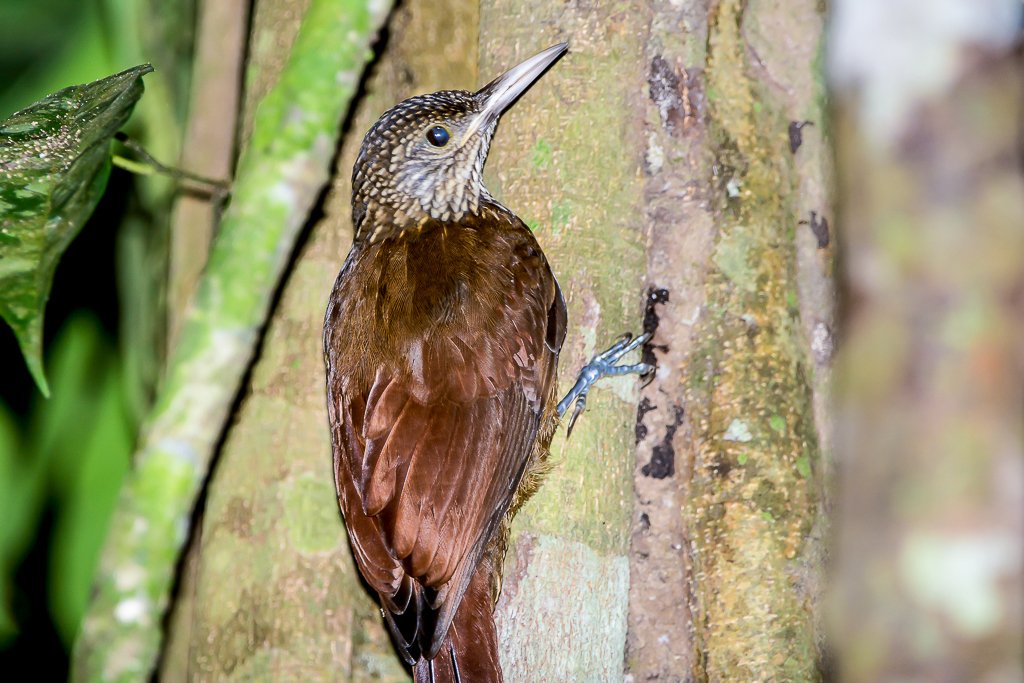
Zimmer's Woodcreeper is a woodcreeper of the flooded forests and river islands along the Amazon. It resembles Straight-billed Woodcreeper but has a slightly decurved bill and buff rather than white breast streaks. In the guide area it occurs only in northeastern Peru and extreme southeastern Colombia.
Voice
The song, given on and off through the day, is a fast, high-pitched series of notes. It resembles the song of Straight-billed Woodcreeper; a recording helps with the comparison.
Recording: Jerome Fischer — CC BY-NC-SA 4.0 · xeno-canto
Identification
21–24 cm, slim, with a short, slightly decurved, greyish bill. The crown is greyish-brown with pale streaks, the face streaked black and white with whitish lores and supercilium. The back is rufous-brown and streaked only at the top; the rump, tail and flight feathers are chestnut. The breast is cinnamon-brown with buff, black-edged streaks that fade on the more rufous belly. The sexes are alike; juveniles are duller, with a blackish bill.
Confusion species
Straight-billed Woodcreeper Dendroplex picus has a straight, pale, dagger-shaped bill, a whiter throat and white drops on the breast. Striped Woodcreeper Xiphorhynchus obsoletus of the same habitat is smaller, with a dark bill and a mantle streaked across the whole back. Buff-throated Woodcreeper Xiphorhynchus guttatus is larger, with a longer, heavier bill and a buff throat.
Habitat
Seasonally flooded forest (várzea and igapó) along large rivers and forest on river islands, also edges and older secondary forest, mostly below 200 m. It searches trunks and branches for insects and spiders. The nest is in a tree cavity.
Where the bird is most at home, classified by the vegetation units of the Andes and the west coast.


Range and movements
Colombia: in the extreme southeast, along the Amazon. Peru: in the northeast along the Amazon and the lower Ucayali. Absent from Ecuador, Bolivia and the Galápagos. Outside the guide area in Brazil along the Amazon to near the mouth of the Tapajós and along large tributaries, south to Rondônia.
- Resident
- dark = core range, pale = thinly spread
How and when to look
Around Iquitos and Leticia, search vegetated river islands and várzea forest, preferably by boat. Compare every Straight-billed Woodcreeper with this species and check bill shape and the colour of the breast streaks.
Conservation status
Least Concern; from 2012 to 2024 the species was listed as Near Threatened. The population is thought to be declining through clearance of flooded forest along the rivers.
Scientific name
Dendroplex kienerii | (des Murs, 1856)
Des Murs described the species in 1856 as Dendrornis Kienerii; because it was later moved to another genus, the author and year stand in brackets. The genus Dendroplex was introduced in 1827 by Swainson. The genus name comes from Ancient Greek dendron, 'tree', and plēssō, 'to strike'. The species name honours the French zoologist and conchologist Louis-Charles Kiener (1799–1881). The specimen the first description was based on came from Tefé (Ega), Amazonas, Brazil.