All species › Passerines › Ovenbirds and woodcreepers › Olivaceous Woodcreeper
Olivaceous Woodcreeper | Sittasomus griseicapillus
Grijze muisspecht | Trepatroncos oliváceo | Arapaçu-verde
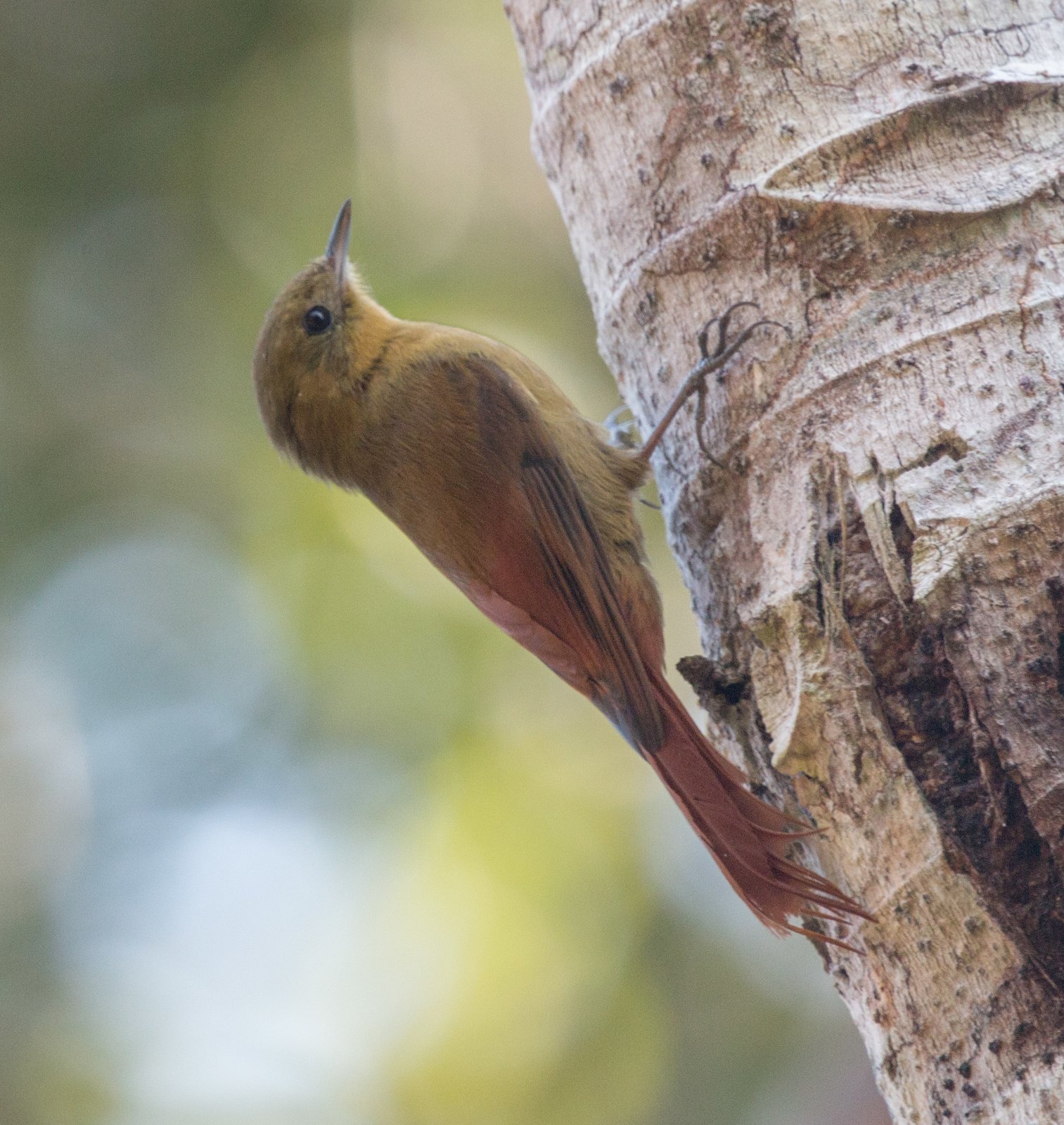
The Olivaceous Woodcreeper is a small, slim woodcreeper with a greyish-olive head and breast and rufous wings and tail. It has a huge range from Mexico to Argentina and lives in both humid and dry forest. Birds from different regions differ in plumage and especially in song, and the species may be split into several species.
Voice
The song is a rapid series of clear, whistled notes, often first rising and then falling, and differs strongly between regions; in western Ecuador and Peru it is more a dry, rapid trill. The call is a short, sharp cheep.
Recording: Juan Freile — CC BY-NC-SA 4.0 · xeno-canto
Identification
14–16 cm, small, with a short, thin, straight bill and a stiff, rufous tail. The head, neck, mantle and underparts are plain greyish olive, without streaks or spots; the back is slightly browner. The wings, rump and tail are rufous. In flight a broad buff band is visible across the flight feathers. Birds west of the Andes are more olive, those in Bolivia greyer. The sexes are alike.
Confusion species
Wedge-billed Woodcreeper Glyphorynchus spirurus has a short, wedge-shaped bill, a pale supercilium and a spotted breast. Spot-throated Woodcreeper Certhiasomus stictolaemus has a spotted throat and breast and a dark, dotted crown. Long-tailed woodcreepers (Deconychura) are larger, with a longer bill and a streaked throat. No other small woodcreeper in the guide area has such a plain grey head and breast.
Habitat
Humid and semi-humid forest, dry forest, forest edges and older secondary forest, from the lowlands to about 2000 m, locally higher. West of the Andes mainly in dry and semi-humid forest, in Bolivia also in the Yungas and in Chiquitano dry forest and the Chaco. It hitches jerkily up trunks and branches and also catches insects in flight or from the bark. It often joins mixed flocks. The nest is in a cavity or crevice in a tree.
Where the bird is most at home, classified by the vegetation units of the Andes and the west coast.


Range and movements
Colombia: in the Caribbean region, the Magdalena valley and east of the Andes in the foothills and lowlands. Ecuador: west and east of the Andes. Peru: in the north-west and east of the Andes. Bolivia: widespread in the lowlands, foothills and dry forests of the east and south. Absent from the Galápagos. Outside the guide area from Mexico to Venezuela, the Guianas, Brazil, Paraguay and northern Argentina.
- Resident
- dark = core range, pale = thinly spread
How and when to look
Search dry and semi-humid forest in western Ecuador and north-western Peru, or the foothills of the eastern slope, for a small woodcreeper climbing briskly up trunks. Note the plain greyish olive of the head and breast; the song is heard mainly in the early morning.
Conservation status
Not Evaluated. In its current circumscription, in which several forms may be separate species, the species has no assessment of its own. As a whole it has a very large range and is locally common; regional dry-forest forms may be sensitive to deforestation.
Scientific name
Sittasomus griseicapillus | (Vieillot, 1818)
Vieillot described the species in 1818 as Dendrocopus griseicapillus; because it was later moved to another genus, the author and year stand in brackets. The genus Sittasomus was introduced in 1827 by Swainson. The genus name combines the genus Sitta (nuthatches) and Greek sōma, 'body'. The species name griseicapillus combines Medieval Latin griseus, 'grey', and Latin capillus, 'hair of the head': grey-headed. The specimen the first description was based on came from Concepción, Paraguay.