All species › Passerines › Ovenbirds and woodcreepers › Rufous-rumped Foliage-Gleaner
Rufous-rumped Foliage-Gleaner | Neophilydor erythrocercum
Roodstuitbladspeurder | Limpiafronda lomirrufa | Limpa-folha-de-sobre-ruivo
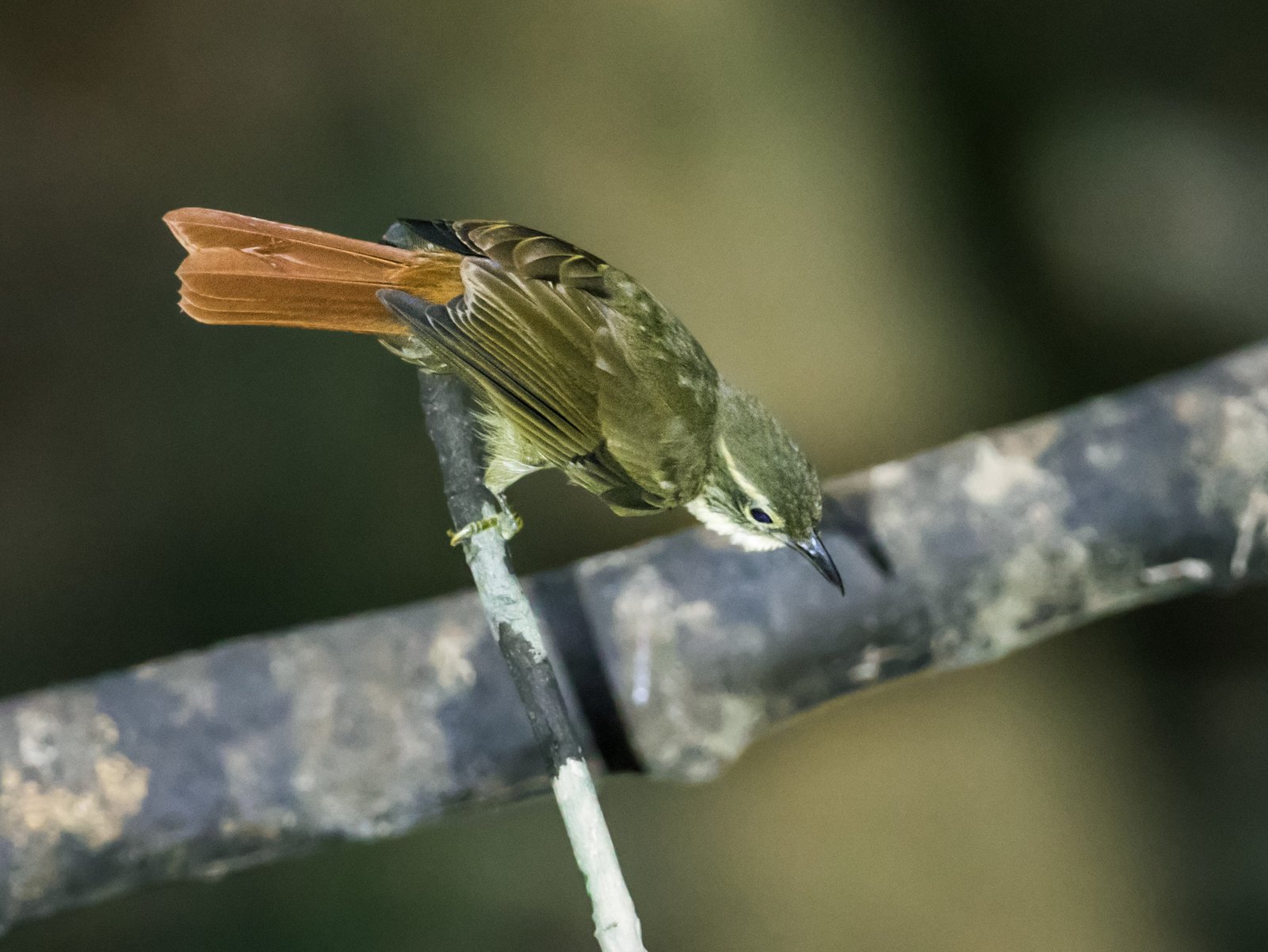
The Rufous-rumped Foliage-Gleaner is an olive-brown foliage-gleaner of Amazonian forest with a rufous rump and tail. It forages in the middle and upper levels of the forest, usually as a regular member of mixed flocks, and searches hanging dead leaves and epiphytes.
Voice
The song is a fast, dry, somewhat descending trill. The call is a short, sharp chik.
No recording with a suitable Creative Commons licence is available for this species yet.
Identification
16–17 cm, with a straight, fairly slender bill. The upperparts are olive-brown, the rump and tail bright rufous. A buff supercilium and a narrow pale eye-ring. The throat and underparts are pale ochre to buff, sometimes with faint olive spotting on the breast. The wings are olive-brown, without clear contrast. The sexes are alike.
Confusion species
Cinnamon-rumped Foliage-Gleaner Philydor pyrrhodes has dark slaty wings and bright cinnamon underparts and stays lower in dense cover. Rufous-tailed Foliage-Gleaner Anabacerthia ruficaudata is very similar, but has an olive rump and a more faintly streaked, greyer breast. Buff-fronted Foliage-Gleaner Dendroma rufa is larger, with a buff forehead and rufous wings.
Habitat
Humid lowland forest on terra firme and foothill forest on the eastern slope, also older secondary forest, up to about 1200 m. It forages in the middle and upper levels, almost always in mixed flocks, in hanging dead leaves, vines and epiphytes for insects and spiders. It nests in a cavity in a bank.
Where the bird is most at home, classified by the vegetation units of the Andes and the west coast.


Range and movements
Colombia: in the Amazonian south-east. Ecuador: in the eastern lowlands and foothills. Peru: in the Amazonian lowlands and foothills the length of the country. Bolivia: in the north and the foothills of the eastern slope. Absent west of the Andes and from the Galápagos. Outside the guide area in Amazonian Brazil and the Guianas, and in the Atlantic Forest of eastern Brazil.
How and when to look
Follow mixed flocks in terra firme forest and in the foothills and look at foliage-gleaners in the middle levels; the rufous rump shows mainly when the bird leans forward or flies off.
Conservation status
Least Concern. The species has a very large range, but is tied to undisturbed forest and disappears with deforestation.
Scientific name
Neophilydor erythrocercum | (Pelzeln, 1859)
Pelzeln described the species in 1859 as Anabates erythrocercus; because it was later moved to another genus, the author and year stand in brackets. The genus Neophilydor was introduced in 2023 by Sangster, Harvey, Gaudin & Claramunt. The genus name combines Greek neos, 'new', with Philydor, the genus in which both species were formerly placed; Sangster and colleagues named it in 2023. The species name erythrocercum combines Greek eruthros, 'red', and kerkos, 'tail': 'red-tailed'. The specimen the first description was based on came from Manaus, Brazil.