All species › Passerines › Wrens › Band-backed Wren
Band-backed Wren | Campylorhynchus zonatus
Tijgerwinterkoning | Matraca tropical | Garrinchão-de-dorso-barrado
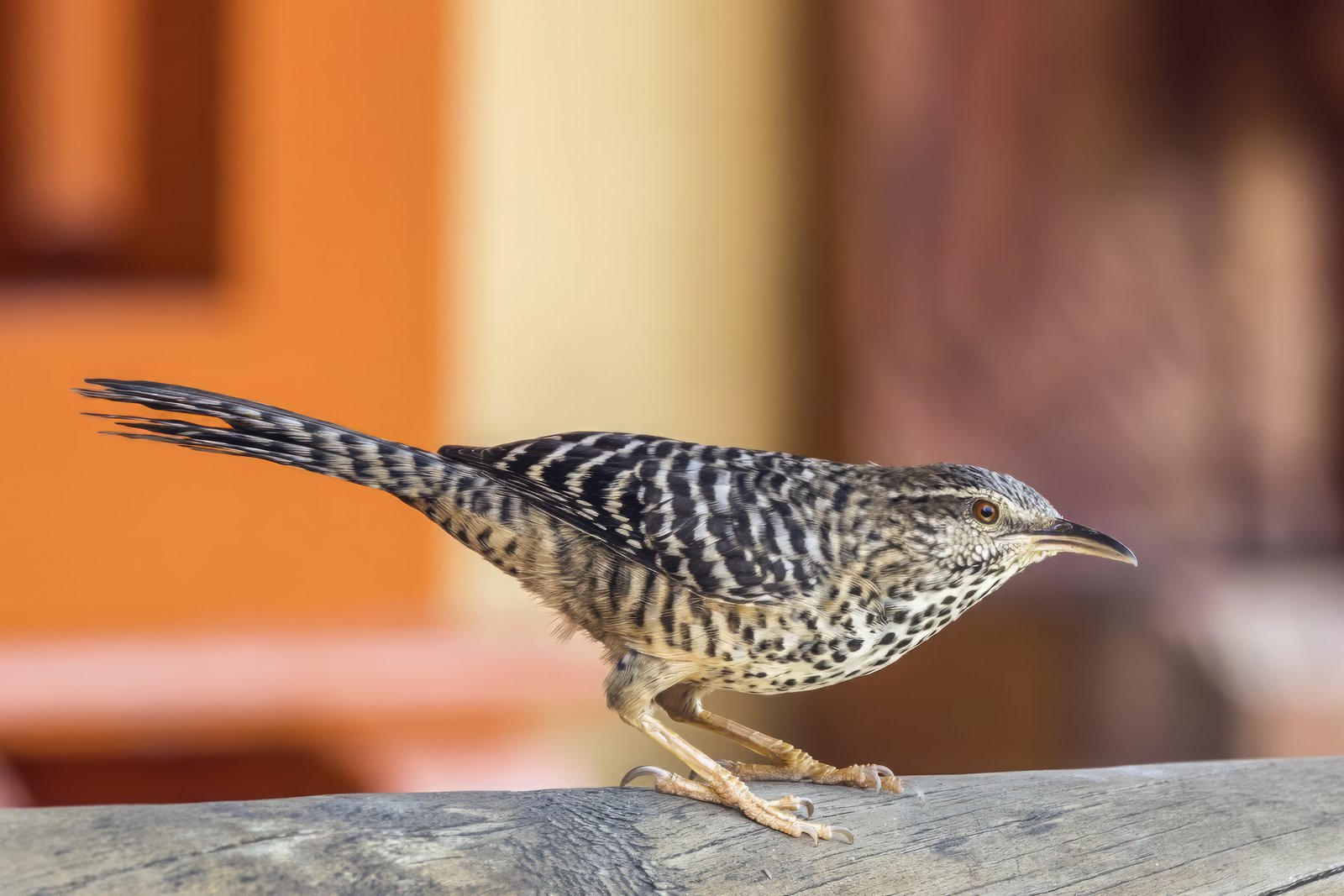
The Band-backed Wren is a large wren with a back boldly barred black, white and buff. Small groups move noisily through forest edges and orchards and sing dry, rattling songs together. In the guide area it lives in northern Colombia and in north-western Ecuador, in two widely separated areas.
Voice
Dry, rattling and spluttering songs with gurgling notes, often by the whole group at once; call a short, rasping note.
Recording: Juan Freile — CC BY-NC-SA 4.0 · xeno-canto
Identification
17–19 cm, with a fairly long, slightly decurved bill and a long tail. The crown is brownish grey, the nape black. The back, wings and tail are densely barred black, white and buffy brown. The throat and breast are white with large black spots; the belly and undertail coverts are cinnamon. The sexes are alike; young birds are duller above, with dingy white to buff, less spotted underparts.
Confusion species
Stripe-backed Wren Campylorhynchus nuchalis has a back streaked lengthwise rather than barred, a white supercilium and no cinnamon belly, and lives in drier, open country. Fasciated Wren Campylorhynchus fasciatus of dry south-western Ecuador is greyer, without buff on the back and without a cinnamon belly. White-headed Wren Campylorhynchus albobrunneus has a white head and underparts and a plain brown back.
Habitat
Forest edges, open and thinned forest, second growth, scrub, orchards, cacao plantations and trees around houses, in humid lowlands and hill country, from sea level to about 1700 m. Groups search for insects and other invertebrates among bromeliads, moss and bark in the canopy and middle storey. The nest is a large ball with a wide side entrance, 2–30 m up, often among bromeliads; the group also roosts together in a nest.
Where the bird is most at home, classified by the vegetation units of the Andes and the west coast.


Range and movements
In Colombia in the north, mainly in the Caribbean lowlands and the Magdalena valley. In Ecuador only in the north-west, mainly in Esmeraldas. Absent from Peru, Bolivia and the Galápagos. Outside the guide area from eastern Mexico to Panama, in several separate areas.
- Resident
- dark = core range, pale = thinly spread
How and when to look
Search forest edges, orchards and farmsteads in northern Colombia or in Esmeraldas; groups give themselves away by their rattling song from the treetops.
Conservation status
Least Concern. Tolerates disturbed and semi-open landscapes.
Scientific name
Campylorhynchus zonatus | (Lesson, 1832)
Lesson described the species in 1832 as Picolaptes zonatus; because it was later moved to another genus, the author and year stand in brackets. The genus Campylorhynchus was introduced in 1824 by Spix. The genus name comes from Greek kampulos, 'curved', and rhunkhos, 'bill'. The species name comes from Latin zonatus, 'banded', for the banded back. The specimen the first description was based on came from Orizaba, Veracruz, Mexico.