All species › Passerines › Wrens › Stripe-backed Wren
Stripe-backed Wren | Campylorhynchus nuchalis
Streeprugwinterkoning | Cucarachero chocorocoy | Garrinchão-de-dorso-listrado
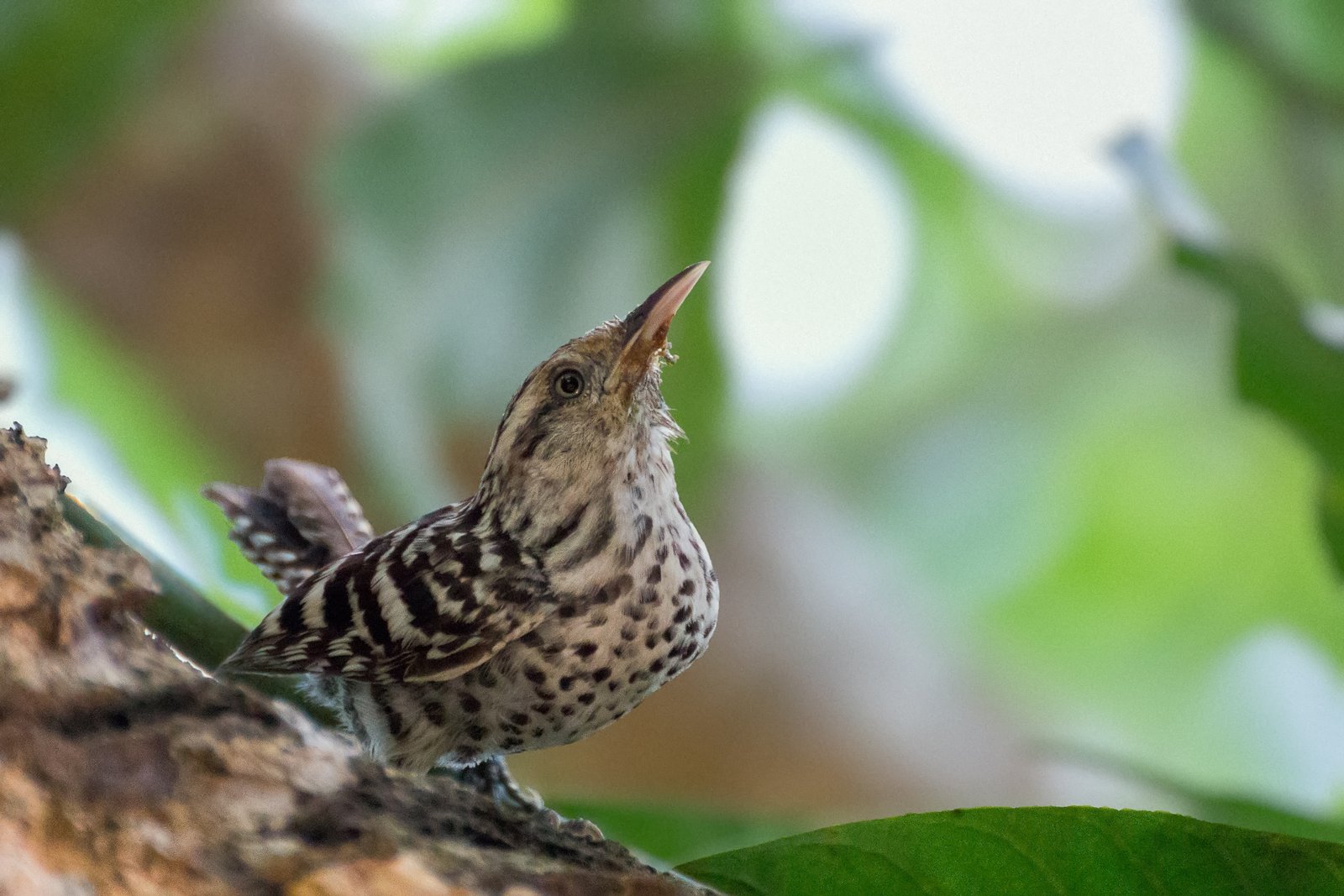
The Stripe-backed Wren is a large, black-and-white streaked wren of the savannas and dry woodlands of northern Colombia and Venezuela. It lives in family groups in which one pair breeds and the other birds help defend the territory and feed the young. Males usually stay in the group they were born in, while females move to a neighbouring group after one or two seasons.
Voice
Harsh, hoarse and rattling notes, sung by the group in duet or chorus; also repeated contact calls that keep group members together. Some calls differ between groups and are passed on from father to son.
Recording: Andres Angulo — CC BY-NC-SA 4.0 · xeno-canto
Identification
17–18 cm, with a fairly long, slightly decurved bill and a long, barred tail. The crown is dark brown, with a broad white supercilium and a dark eyestripe. The back is streaked lengthwise black and white. The underparts are white, with small black spots on the breast and flanks. The sexes are alike; young birds are duller, with fewer spots below.
Confusion species
Band-backed Wren Campylorhynchus zonatus has a back barred crosswise, larger black spots on the breast and a cinnamon belly, and lives in more humid forest. Bicolored Wren Campylorhynchus griseus is larger, with a plain brown back and unspotted white underparts, and occurs in the same landscape.
Habitat
Dry riparian woodland, gallery forest, open dry woodland, savanna with trees and ranchland with scattered trees and hedges, from sea level to about 800 m. Groups search for insects among bark, leaves and epiphytes. The nest is a grass ball with a side entrance, high in a tree; eggs are laid mainly at the start of the rainy season.
Where the bird is most at home, classified by the vegetation units of the Andes and the west coast.


Range and movements
In Colombia in the Caribbean lowlands and the lower Magdalena valley. Absent from Ecuador, Peru, Bolivia and the Galápagos. Outside the guide area in the llanos and northern Venezuela.
- Resident
- dark = core range, pale = thinly spread
How and when to look
Search gallery forest and farmsteads with tall trees in the Caribbean lowlands of Colombia; groups give their rattling chorus mainly in the morning.
Conservation status
Least Concern. Tolerates semi-open ranchland with trees.
Scientific name
Campylorhynchus nuchalis | Cabanis, 1847
Cabanis described the species in 1847 and placed it straight away in the genus where it still stands. The genus Campylorhynchus was introduced in 1824 by Spix. The genus name comes from Greek kampulos, 'curved', and rhunkhos, 'bill'. The species name comes from Medieval Latin nucha, 'nape', for the patterned nape. The specimen the first description was based on came from Cumaná, Sucre, Venezuela.