All species › Passerines › Wrens › Fasciated Wren
Fasciated Wren | Campylorhynchus fasciatus
Zebrawinterkoning | Cucarachero ondeado | Garrinchão-ondulado
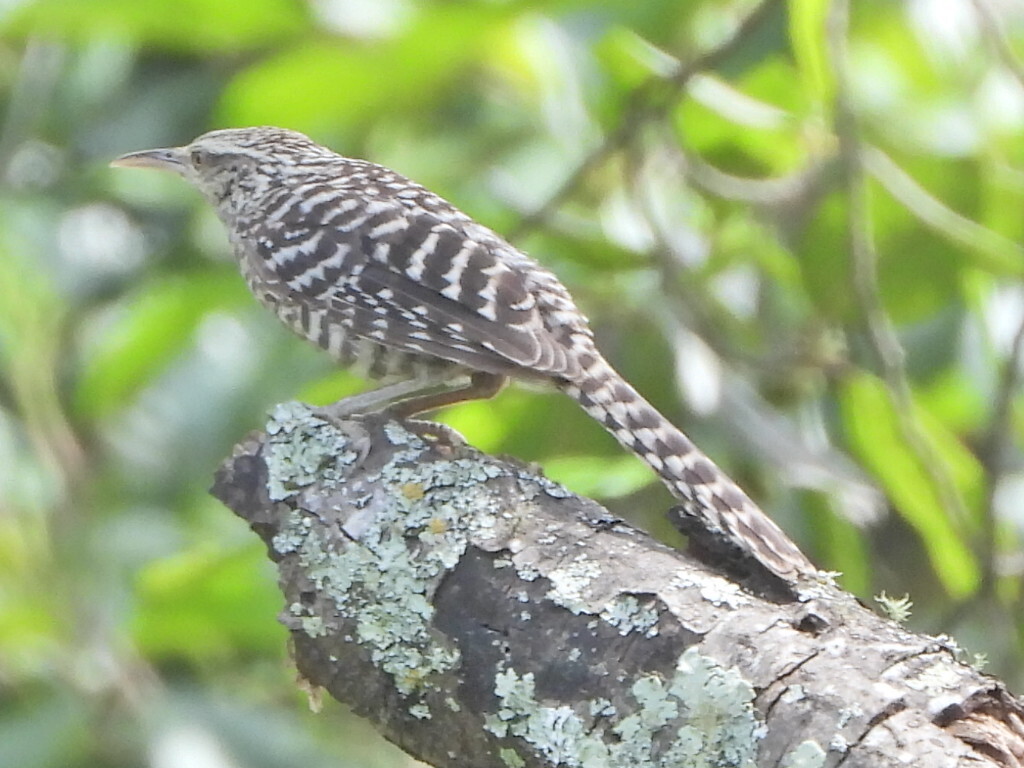
The Fasciated Wren is the large, grey-and-white barred wren of the dry Pacific side of Ecuador and Peru and of the Marañón valley. Groups of up to ten birds move noisily through thorn scrub, orchards and gardens and sing together in chorus. It often breeds in an old nest of a hornero.
Voice
Harsh, scratchy rattles mixed with gurgling notes, sung by pairs or groups in chorus; call a harsh, grating chrr.
Recording: Luis D. Montalvo — CC BY-NC-SA 4.0 · xeno-canto
Identification
19 cm, with a fairly long, slightly decurved bill and a long, barred tail. The crown is grey, with a greyish supercilium. The back and shoulders are dark grey, with whitish speckles and bars; the tail is barred off-white and blackish brown. The underparts are whitish, with large dark grey spots on the breast and belly and bars on the flanks. Birds in Ecuador and extreme north-western Peru are paler, with less distinct spotting. The sexes are alike; young birds are less sharply marked below.
Confusion species
Long-tailed Mockingbird Mimus longicaudatus lives in the same landscape, but is larger, with an unbarred back, a dark eyestripe and white tail tips. Speckle-breasted Wren Pheugopedius sclateri is smaller, with a plain brown back and a finely speckled breast, and stays in the undergrowth. Band-backed Wren Campylorhynchus zonatus of humid forest in north-western Ecuador has buff on the back and a cinnamon belly.
Habitat
Dry thorn scrub, dry and semi-evergreen deciduous forest, cactus scrub, orchards, field edges, gardens and villages; in Ecuador also in more humid deciduous forest. From sea level to about 1500 m, locally to 2500 m in the dry valleys. Groups search for insects among leaves and bark and on the ground. A dominant pair breeds, helped by the group; the nest is a dome of grass with a side entrance, in a thorn tree or cactus, or in an old mud nest of a hornero (Furnarius).
Where the bird is most at home, classified by the vegetation units of the Andes and the west coast.


Range and movements
In Ecuador in the dry west and south, from Manabí and the Guayaquil area to El Oro and Loja. In Peru along the coast of Tumbes and Piura south to Lima, and inland in the dry Marañón valley and adjacent valleys, from Cajamarca and Amazonas to Huánuco. Absent from Colombia, Bolivia and the Galápagos. Does not occur outside the guide area.
- Resident
- dark = core range, pale = thinly spread
How and when to look
At farms, in orchards and in gardens in dry north-western Peru and south-western Ecuador; in the morning groups sing in chorus from shrubs and trees.
Conservation status
Least Concern. Tolerates heavily altered land, such as orchards and villages.
Scientific name
Campylorhynchus fasciatus | (Swainson, 1838)
Swainson described the species in 1838 as Furnarius fasciatus; because it was later moved to another genus, the author and year stand in brackets. The genus Campylorhynchus was introduced in 1824 by Spix. The genus name comes from Greek kampulos, 'curved', and rhunkhos, 'bill'. The species name comes from Latin fasciatus, 'banded', for the barred plumage. The specimen the first description was based on came from Peru.