All species › Passerines › Wrens › Bicolored Wren
Bicolored Wren | Campylorhynchus griseus
Tweekleurige winterkoning | Cucarachero bicolor | Garrinchão-bicolor
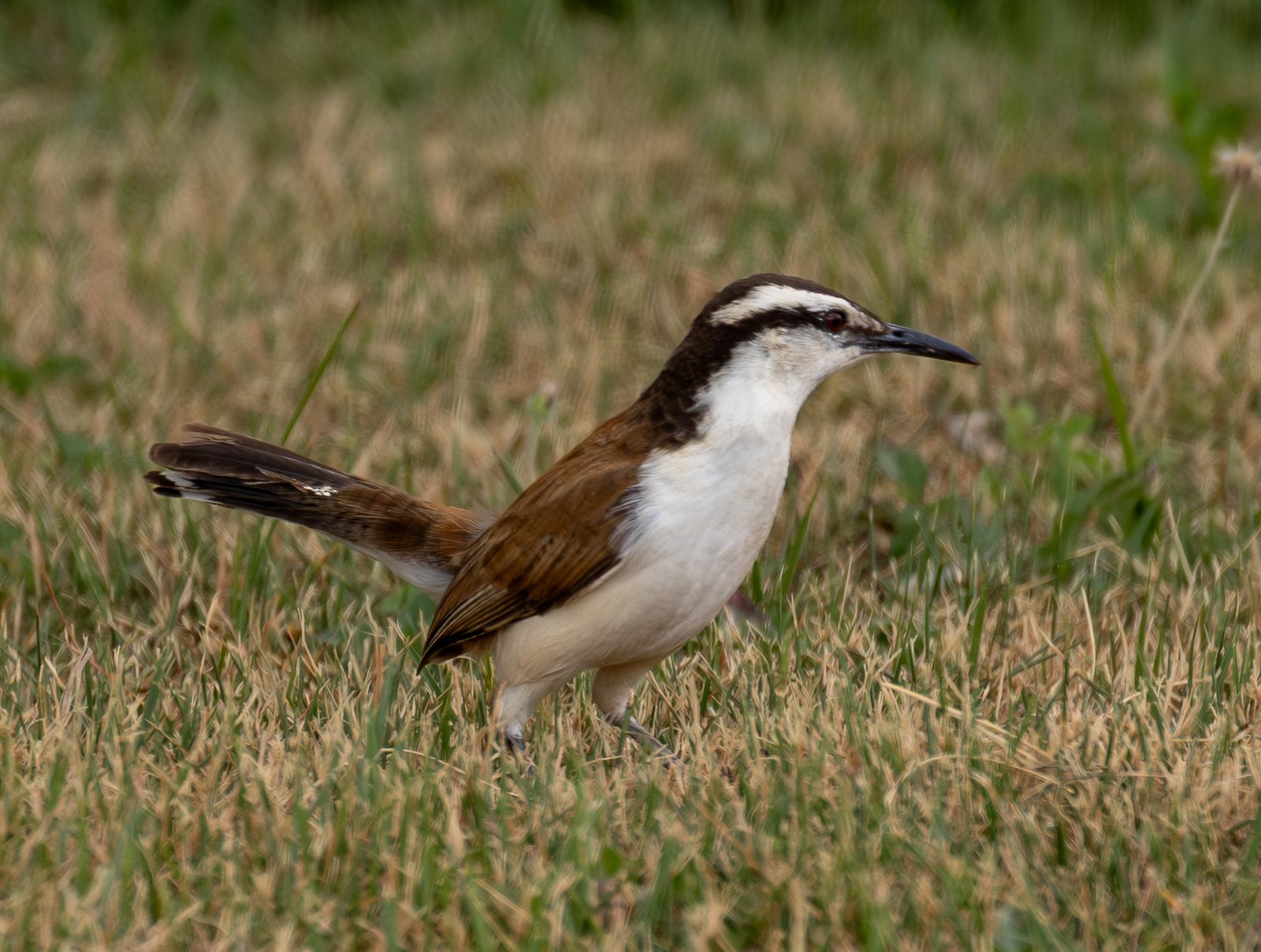
The Bicolored Wren is the largest wren in South America: brown above, white below, with a white supercilium. It lives in pairs or family groups in open country with scattered trees and shrubs in northern and eastern Colombia and sings loudly and gurglingly from treetops. Group members help the breeding pair defend the nest and feed the young.
Voice
Loud series of gurgling, chuckling notes from the male; the female sings similarly, adding a trill. Calls are harsh and grating.
Recording: Hugo Oliveros-Salas — CC BY-NC-SA 4.0 · xeno-canto
Identification
21–22 cm, with a stout, slightly decurved bill and a long tail. The crown and nape are dark chocolate brown, with a broad off-white supercilium and a dark eyestripe. The back and wings are brown, rustier in birds of the north and the Magdalena valley; birds in the llanos are smaller, with a blackish-brown nape. The underparts are white to off-white. The tail is dark, with white tips to all but the central pair of feathers. The sexes are alike; young birds are greyer.
Confusion species
Stripe-backed Wren Campylorhynchus nuchalis is smaller, with a black-and-white streaked back and small black spots below. Rufous-and-white Wren Thryophilus rufalbus is smaller and rufous-brown, with black-and-white striped sides to the head, and stays in dense undergrowth. Tropical Mockingbird Mimus gilvus is grey, with a dark eyestripe and a slimmer build.
Habitat
Open country with scattered trees and shrubs, dry thorn scrub, dry woodland, savanna with trees, ranchland, gardens and villages; avoids closed forest and fully open terrain. From sea level to about 2100 m in the dry valleys. It searches for insects and other invertebrates in trees and shrubs and on the ground. The nest is a dome of grass with a side entrance, high in a tree; sometimes it uses an old nest of another species.
Where the bird is most at home, classified by the vegetation units of the Andes and the west coast.


Range and movements
In Colombia in the Caribbean lowlands, including the Guajira and the base of the Sierra Nevada de Santa Marta, in the Magdalena valley to Tolima and Huila, on the western slope of the Eastern Andes and in the llanos east of the Andes. Absent from Ecuador, Peru, Bolivia and the Galápagos. Outside the guide area in Venezuela, Guyana and northern Brazil.
- Resident
- dark = core range, pale = thinly spread
How and when to look
Search the dry Caribbean lowlands of Colombia, around the Guajira and Santa Marta, or the dry upper Magdalena valley; the birds often perch in the open in treetops and call from there.
Conservation status
Least Concern. Common in semi-open country; tolerates ranching and settlement well.
Scientific name
Campylorhynchus griseus | (Swainson, 1838)
Swainson described the species in 1838 as Furnarius griseus; because it was later moved to another genus, the author and year stand in brackets. The genus Campylorhynchus was introduced in 1824 by Spix. The genus name comes from Greek kampulos, 'curved', and rhunkhos, 'bill'. The species name comes from Medieval Latin griseus, 'grey'. The specimen the first description was based on came from savannas of the Guianas.