All species › Passerines › Wrens › Thrush-like Wren
Thrush-like Wren | Campylorhynchus turdinus
Lijsterwinterkoning | Cucarachero turdino | Catatau
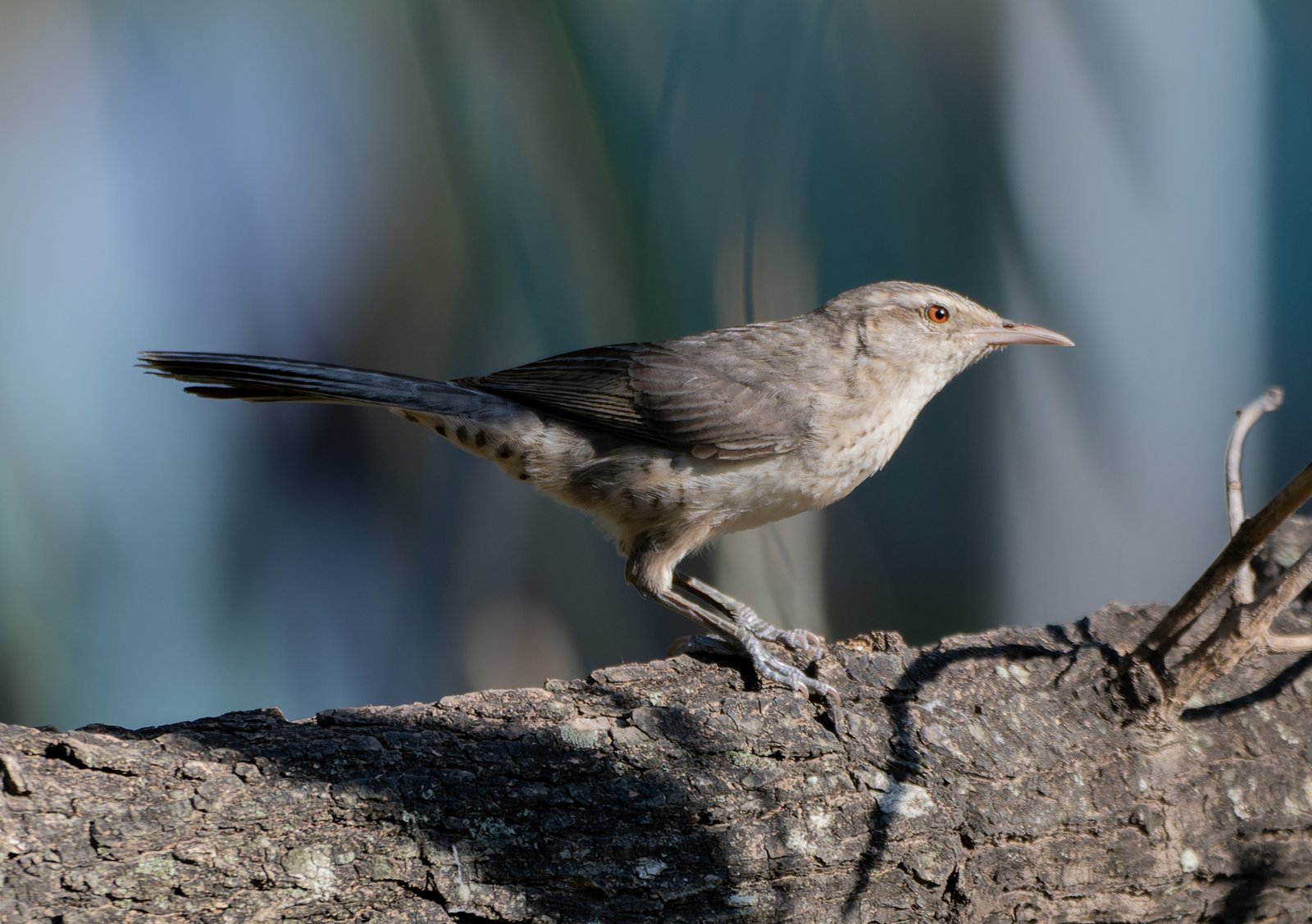
The Thrush-like Wren is a large, thrush-like wren of Amazonia that lives in groups high in the canopy. Its loud, rhythmic, gurgling duets carry far over rivers and clearings. In the north of its range it is densely spotted below, in the south almost plain.
Voice
Loud, rhythmic duets of hollow, gurgling and chuckling notes, such as chook-chook-chookoo-chook, often repeated at length; also harsh, rasping calls.
Recording: Juan Freile — CC BY-NC-SA 4.0 · xeno-canto
Identification
20–21 cm, with a stout, slightly decurved bill and a fairly long tail. Birds in Colombia, Ecuador and most of Peru are greyish brown above, with a greyer head and a faint pale supercilium, and white below with dense, dark drop-shaped spots. Birds in Bolivia are plainer: greyish brown above and off-white to greyish below, with few or no spots. The sexes are alike; young birds are duller, with fewer spots.
Confusion species
Other Amazonian wrens are much smaller and live in the undergrowth, such as Moustached Wren Pheugopedius genibarbis and Coraya Wren Pheugopedius coraya, which are rufous-brown with black-and-white striped sides to the head. Thrushes (Turdus) have a straighter bill and a plain back, and do not live in noisy groups in the canopy.
Habitat
The canopy and middle storey of várzea forest, forest edges, older secondary forest, clearings with tall trees, riverbanks and the surroundings of villages in the Amazonian lowlands, mostly below 1000 m. Groups search for insects among leaves, vines and dead leaves in the canopy. The nest is a ball with a side entrance, in a vine tangle or in a tree.
Where the bird is most at home, classified by the vegetation units of the Andes and the west coast.


Range and movements
In Colombia in the Amazonian lowlands of the south-east. In Ecuador and Peru throughout the Amazonian lowlands. In Bolivia in the northern and eastern lowlands, from Pando and Beni to Santa Cruz. Absent west of the Andes and from the Galápagos. Outside the guide area in western and central Amazonian Brazil, the Pantanal and northern Paraguay.
- Resident
- dark = core range, pale = thinly spread
How and when to look
Listen along riverbanks, at lodges and villages and along forest edges in the Amazonian lowlands for the gurgling duets from the treetops; from a canoe or a canopy tower the groups can be followed in the canopy.
Conservation status
Least Concern. Common; benefits from forest edges and clearings.
Scientific name
Campylorhynchus turdinus | (Wied-Neuwied, 1821)
Wied-Neuwied described the species in 1821 as Opetiorhynchos turdinus; because it was later moved to another genus, the author and year stand in brackets. The genus Campylorhynchus was introduced in 1824 by Spix. The genus name comes from Greek kampulos, 'curved', and rhunkhos, 'bill'. The species name comes from Latin turdus, 'thrush', and means 'thrush-like'. The specimen the first description was based on came from Rio Catolé, Bahia, Brazil.