All species › Swifts › Swifts › Band-rumped Swift
Band-rumped Swift | Chaetura spinicaudus
Witbandgierzwaluw | Vencejo lomibandeado | Andorinhão-de-sobre-branco
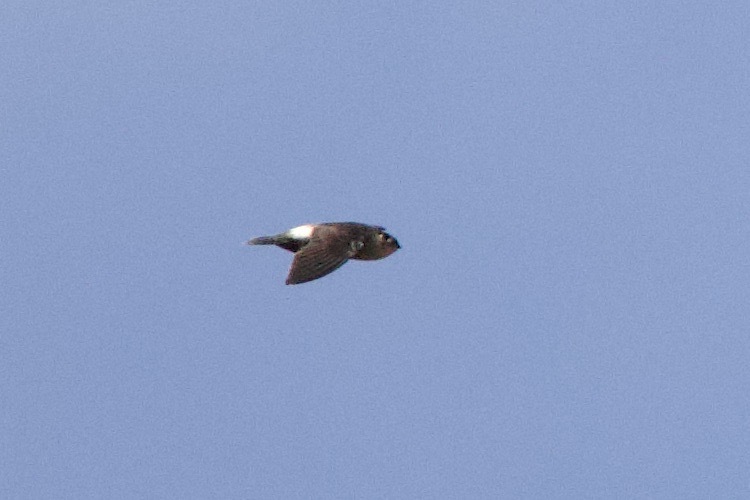
The Band-rumped Swift is a small, very dark swift with a narrow, whitish band across the rump. In the guide area it lives mainly in the wet Chocó lowlands of western Colombia and north-western Ecuador. Small groups hunt low over forest, clearings and rivers, often with other swifts.
Voice
A rapid, high, somewhat buzzy twitter, tsi-tsi-tsir, and dry, chattering series from groups in flight.
Recording: rudy gelis — CC BY-NC-SA 4.0 · xeno-canto
Identification
10–11 cm, small, with a short tail with projecting shaft tips. Upperparts black with little gloss, with a narrow, sharply defined, whitish to pale grey band across the rump; the uppertail coverts are dark again. Underparts dark greyish brown, the throat slightly paler grey. The sexes are alike.
Confusion species
Grey-rumped Swift Chaetura cinereiventris has a broader grey rump that extends to the tail, and clearly greyer underparts. Short-tailed Swift Chaetura brachyura has a very short tail and a pale rump and undertail forming one area. Chapman's Swift Chaetura chapmani is larger and lacks the pale band. Lesser Swallow-tailed Swift Panyptila cayennensis has a white throat and flanks and a long, forked tail.
Habitat
Over humid lowland forest and rainforest, clearings, forest edges, rivers and villages in forested areas, mostly below 800 m. It hunts small flying insects, often fairly low. It nests in hollow trees; the nest is a half-cup of twigs glued with saliva.
Where the bird is most at home, classified by the vegetation units of the Andes and the west coast.


Range and movements
In Colombia in the Pacific lowlands, in the north-west (Urabá and the lowlands of the Cauca and Magdalena) and locally in the east on the borders with Venezuela and Brazil. In Ecuador in the north-west, mainly in Esmeraldas. Absent from Peru, Bolivia and the Galápagos. Outside the guide area in Costa Rica and Panama, in Venezuela, the Guianas, on Trinidad and in northern Brazil.
- Resident
- dark = core range, pale = thinly spread
How and when to look
In the Chocó lowlands, for example around Buenaventura or in Esmeraldas, watch for groups of swifts over rivers and clearings. Seen from above or from the side, the narrow white rump band is the best feature.
Conservation status
Least Concern. The species has a large range; deforestation in the Chocó may reduce numbers locally.
Scientific name
Chaetura spinicaudus | (Temminck, 1839)
Temminck described the species in 1839 as Cypselus spinicaudus; because it was later moved to another genus, the author and year stand in brackets. The genus Chaetura was introduced in 1826 by Stephens. The genus name comes from Greek khaitē, 'long hair, bristle', and oura, 'tail', after the spiny tips of the tail feathers. The species name spinicaudus comes from Latin spina, 'spine', and cauda, 'tail'. The specimen the first description was based on came from Cayenne, French Guiana.