All species › Swifts › Swifts › Pale-rumped Swift
Pale-rumped Swift | Chaetura egregia
Todds gierzwaluw | Vencejo lomipálido | Andorinhão-de-sobre-pálido
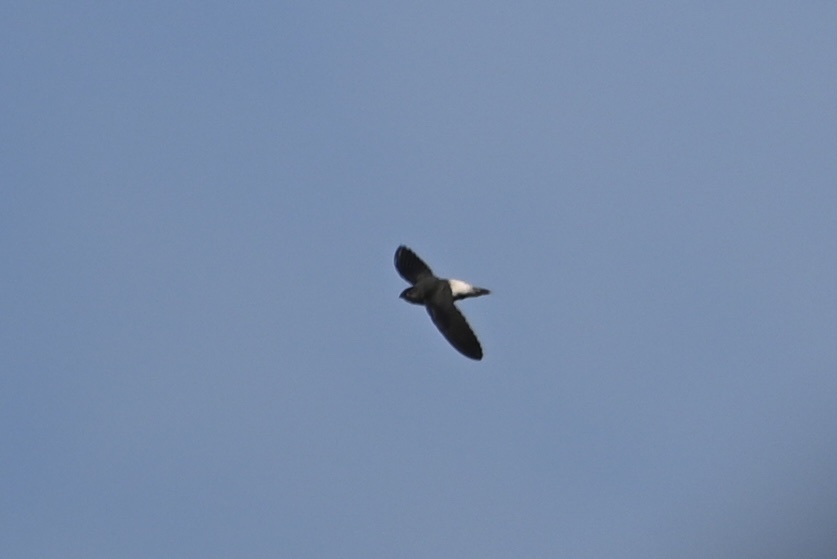
The Pale-rumped Swift is a medium-sized Chaetura swift of western Amazonia, with a pale, almost white, strongly contrasting rump. It lives over lowland forest and rivers, often in mixed flocks with other swifts. Little is known of its breeding biology.
Voice
Rapid, dry, chattering series, similar to those of other Chaetura species; the voice is poorly described.
Recording: Jacob Wijpkema — CC BY-NC-SA 4.0 · xeno-canto
Identification
13 cm, larger and longer-winged than Grey-rumped Swift, with a short tail with projecting shaft tips. Upperparts blackish brown, with a broad, pale greyish-white to buffy rump and uppertail coverts that contrast strongly. Throat pale grey, rest of underparts dark greyish brown. The sexes are alike.
Confusion species
Grey-rumped Swift Chaetura cinereiventris is smaller, with a greyer, less white rump and greyer underparts. Short-tailed Swift Chaetura brachyura has a very short tail and a pale undertail that merges with the pale rump. Chapman's Swift Chaetura chapmani and Chimney Swift Chaetura pelagica have a dark rump that barely contrasts. Sick's Swift Chaetura meridionalis is browner, with a less contrasting, greyish-brown rump.
Habitat
Over humid terra firme and várzea forest in the lowlands, along rivers and over clearings, up to about 1000 m in the foothills. It hunts flying insects, often high. The nest is hardly described; it presumably nests in hollow trees like related species.
Where the bird is most at home, classified by the vegetation units of the Andes and the west coast.


Range and movements
In Ecuador scarce in the eastern lowlands. In Peru in the eastern lowlands, mainly in the centre and south. In Bolivia in the lowlands of the north. Absent from Colombia and the Galápagos. Outside the guide area in western Amazonian Brazil.
- Resident
- dark = core range, pale = thinly spread
How and when to look
Search over rivers and forest edges in the lowlands of Madre de Dios and Pando, where mixed swift flocks often feed low. Look for a rump paler than on any other Chaetura in the flock.
Conservation status
Least Concern. The species has a large range in largely intact Amazonian forest, but is poorly studied.
Scientific name
Chaetura egregia | Todd, 1916
Todd described the species in 1916 and placed it straight away in the genus where it still stands. The genus Chaetura was introduced in 1826 by Stephens. The genus name comes from Greek khaitē, 'long hair, bristle', and oura, 'tail', after the spiny tips of the tail feathers. The species name egregia is Latin for 'exceptional, outstanding'. The specimen the first description was based on came from Río Surutú, Bolivia.