All species › Swifts › Swifts › Chimney Swift
Chimney Swift | Chaetura pelagica
Schoorsteengierzwaluw | Vencejo de chimenea | Andorinhão-migrante
The Chimney Swift breeds in eastern North America, mainly in chimneys, and winters in western Amazonia. The guide area therefore lies at the heart of its wintering grounds and on its migration route. During migration birds sometimes roost together in large numbers in chimneys or hollow trees.
Voice
A rapid, high, chattering twitter of short chip notes, often accelerating into a dry rattle; groups are heard mainly at roosts.
Recording: Stanislas Wroza — CC BY-NC-SA 4.0 · xeno-canto
Identification
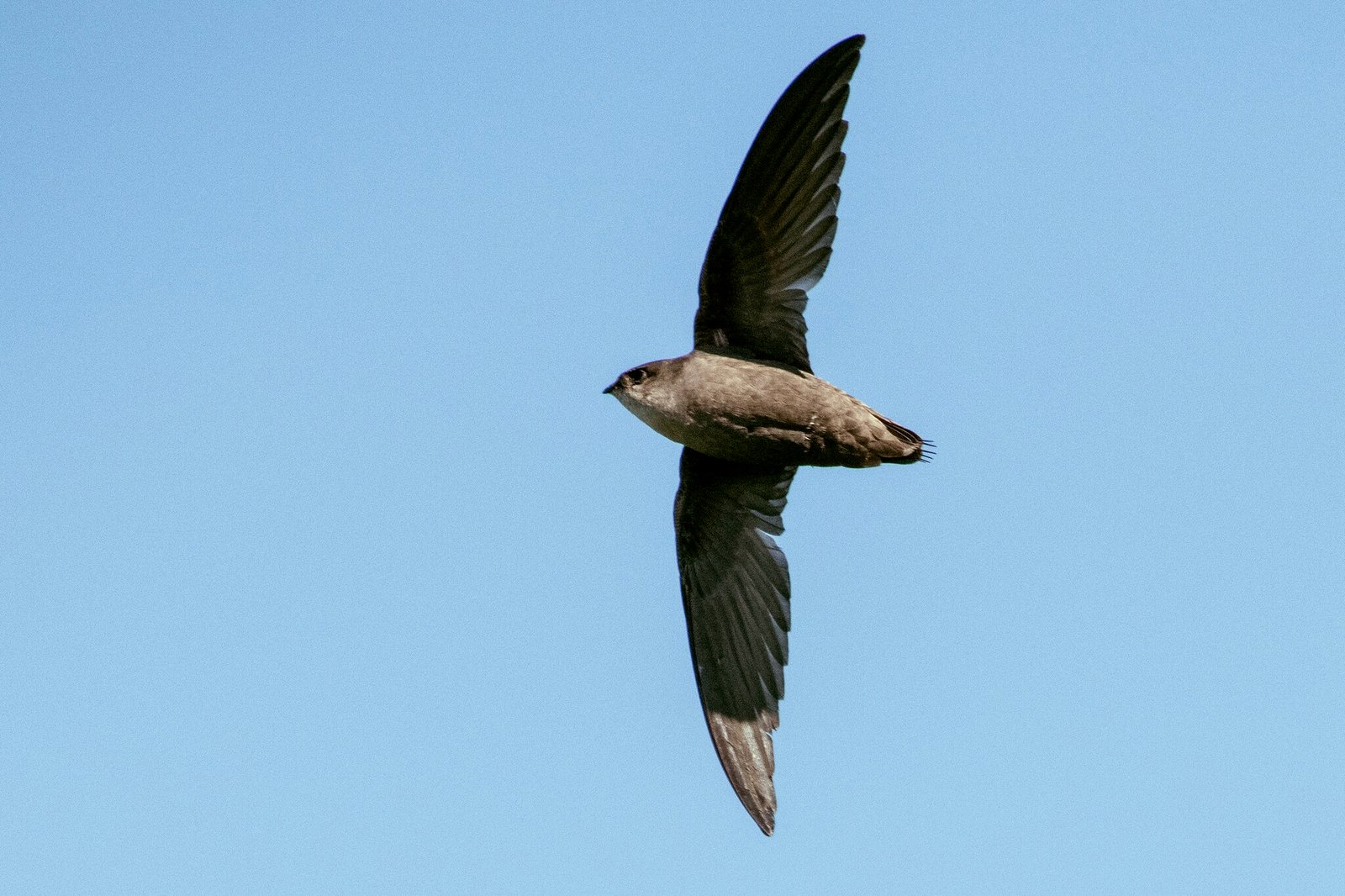
12–13 cm, cigar-shaped, with narrow, curved wings and a short tail with projecting shaft tips. Almost uniformly dark greyish brown, the throat and upper breast paler grey; the rump is barely paler than the back. The sexes are alike.
Confusion species
Chapman's Swift Chaetura chapmani is slightly larger and darker, with a glossier back and a darker throat; outside migration periods a uniformly dark Chaetura in the lowlands is more likely to be that species. Sick's Swift Chaetura meridionalis is very similar, but has a slightly paler, greyish-brown rump and is present in the austral winter. Grey-rumped Swift Chaetura cinereiventris and Pale-rumped Swift Chaetura egregia have a clearly pale rump.
Habitat
Over lowland forest, rivers, open country, towns and cities; on migration also over Andean valleys. It hunts small flying insects, often high. It roosts in chimneys, hollow trees and other cavities. It does not breed in the guide area; in North America the nest, a half-cup of twigs, is glued with saliva to the inner wall of a chimney.
Where the bird is most at home, classified by the vegetation units of the Andes and the west coast.


Range and movements
In Colombia a passage migrant, mainly along the Caribbean coast, in the Andean valleys and in the eastern lowlands. In Ecuador a passage migrant and winter visitor, mainly in the east. In Peru it winters mainly in the eastern lowlands, with records along the coast. In Bolivia scarce in the north. Absent from the Galápagos. Outside the guide area it breeds in eastern North America; it also winters in western Amazonian Brazil.
- Winter visitor (c. Oct–Mar)
- Passage (Mar–Apr, Oct–Nov)
- dark = core range, pale = thinly spread
How and when to look
In October–November and March–April, watch for swift flocks over towns and rivers in the Amazonian lowlands of Peru and Ecuador, for example around Iquitos. Roosts in chimneys or hollow trees attract large numbers at dusk.
Conservation status
Vulnerable. The breeding population in North America has declined steeply over a few decades, probably owing to fewer flying insects and the loss of suitable chimneys. Little is known about threats on the wintering grounds.
Scientific name
Chaetura pelagica | (Linnaeus, 1758)
Linnaeus described the species in 1758 as Hirundo Pelagica; because it was later moved to another genus, the author and year stand in brackets. The genus Chaetura was introduced in 1826 by Stephens. The genus name comes from Greek khaitē, 'long hair, bristle', and oura, 'tail', after the spiny tips of the tail feathers. The species name pelagica comes from Greek pelagikos, 'of the sea'. It probably refers to the wandering lifestyle rather than to the sea. The specimen the first description was based on came from South Carolina, United States.