All species › Swifts › Swifts › Chapman's Swift
Chapman's Swift | Chaetura chapmani
Chapmans gierzwaluw | Vencejo de Chapman | Andorinhão-de-chapman
Chapman's Swift is a fairly large, uniformly dark Chaetura swift of the lowlands east of the Andes and of northern Colombia. The Amazonian form, viridipennis, was formerly treated as a separate species. Southern birds partly move north after breeding, but the movements are poorly known.
Voice
Dry, chattering series and rapid chip notes, similar to those of other Chaetura species, but poorly described.
Recording: JAYRSON ARAUJO DE OLIVEIRA — CC BY-NC-SA 4.0 · xeno-canto
Identification
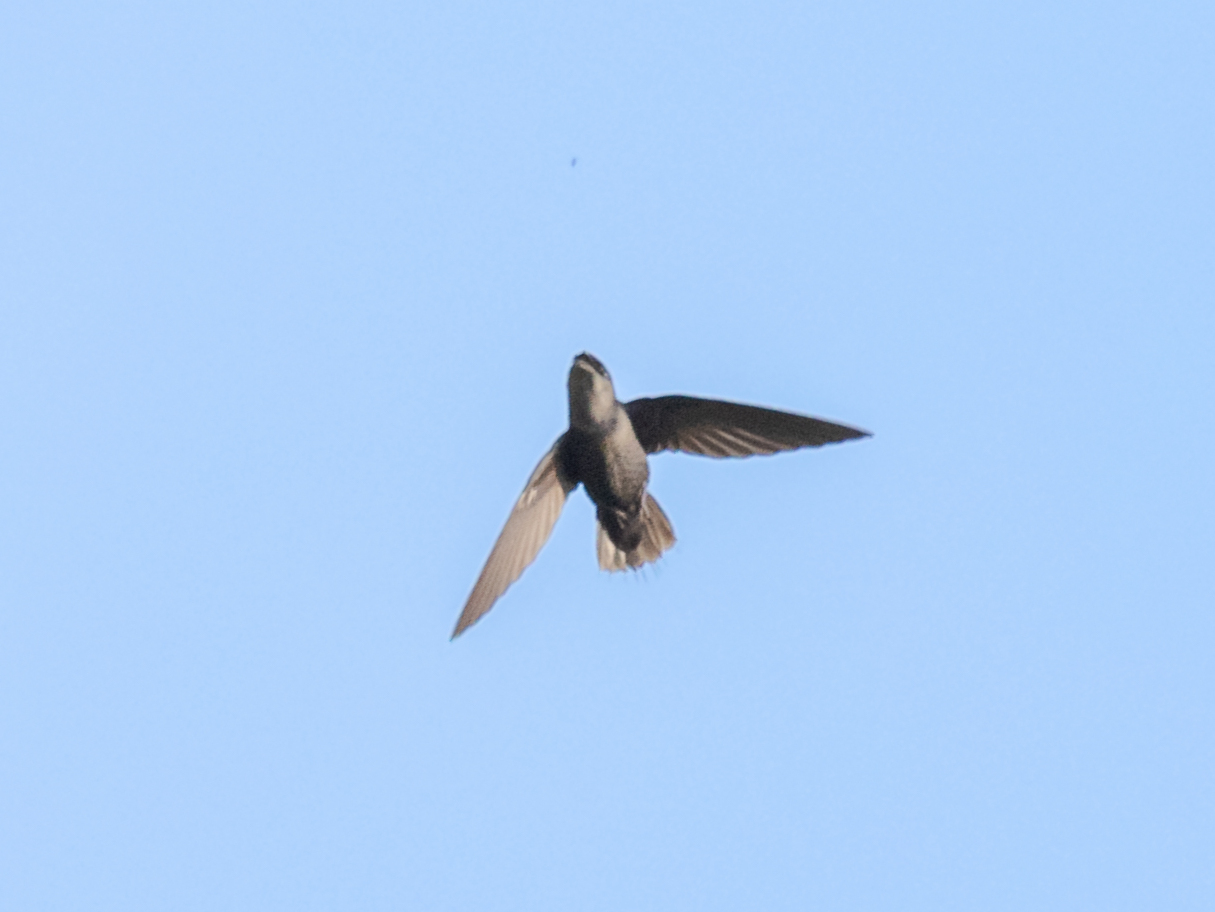
13–14 cm, large for a Chaetura, with long wings and a short tail with projecting shaft tips. Upperparts glossy blackish, in viridipennis with a greenish gloss on the wings; the rump and uppertail coverts are dark greyish brown and contrast little. Underparts uniformly dark sooty brown, the throat barely paler. The sexes are alike.
Confusion species
Chimney Swift Chaetura pelagica is slightly smaller and browner, with a clearly paler throat, and is present only from September to May. Sick's Swift Chaetura meridionalis is browner, with a paler throat and a slightly paler rump. Grey-rumped Swift Chaetura cinereiventris and Pale-rumped Swift Chaetura egregia have a clearly pale rump, Short-tailed Swift Chaetura brachyura a pale rump and undertail.
Habitat
Over humid lowland forest, várzea, rivers, savannas with woodland patches and clearings, mostly below 1000 m. It hunts flying insects, often high and in mixed flocks. The nest is built in hollow trees or similar cavities, as in related species.
Where the bird is most at home, classified by the vegetation units of the Andes and the west coast.


Range and movements
In Colombia in the Caribbean lowlands and the Magdalena Valley and in the lowlands east of the Andes. In Ecuador scarce in the eastern lowlands. In Peru in the eastern lowlands, where mainly non-breeding birds probably occur. In Bolivia in the lowlands of the north and east, where it also breeds. Absent from the Galápagos. Outside the guide area in Panama, Venezuela, the Guianas, on Trinidad and in Amazonian Brazil.
- Resident
- dark = core range, pale = thinly spread
How and when to look
Check swift flocks over rivers and forest edges in the lowlands; this species stands out as the largest and most uniformly dark Chaetura in the flock. A comparison with Chimney Swift is needed only between September and May.
Conservation status
Least Concern. The species has a large range, but its numbers and movements are poorly known.
Scientific name
Chaetura chapmani | Hellmayr, 1907
Hellmayr described the species in 1907 and placed it straight away in the genus where it still stands. The genus Chaetura was introduced in 1826 by Stephens. The genus name comes from Greek khaitē, 'long hair, bristle', and oura, 'tail', after the spiny tips of the tail feathers. The species name chapmani honours Frank Michler Chapman (1864–1945), American ornithologist at the American Museum of Natural History, who also wrote on the birds of Trinidad. The specimen the first description was based on came from Caparo, Trinidad.