All species › Swifts › Swifts › Sick's Swift
Sick's Swift | Chaetura meridionalis
Sicks gierzwaluw | Vencejo de Sick | Andorinhão-do-temporal
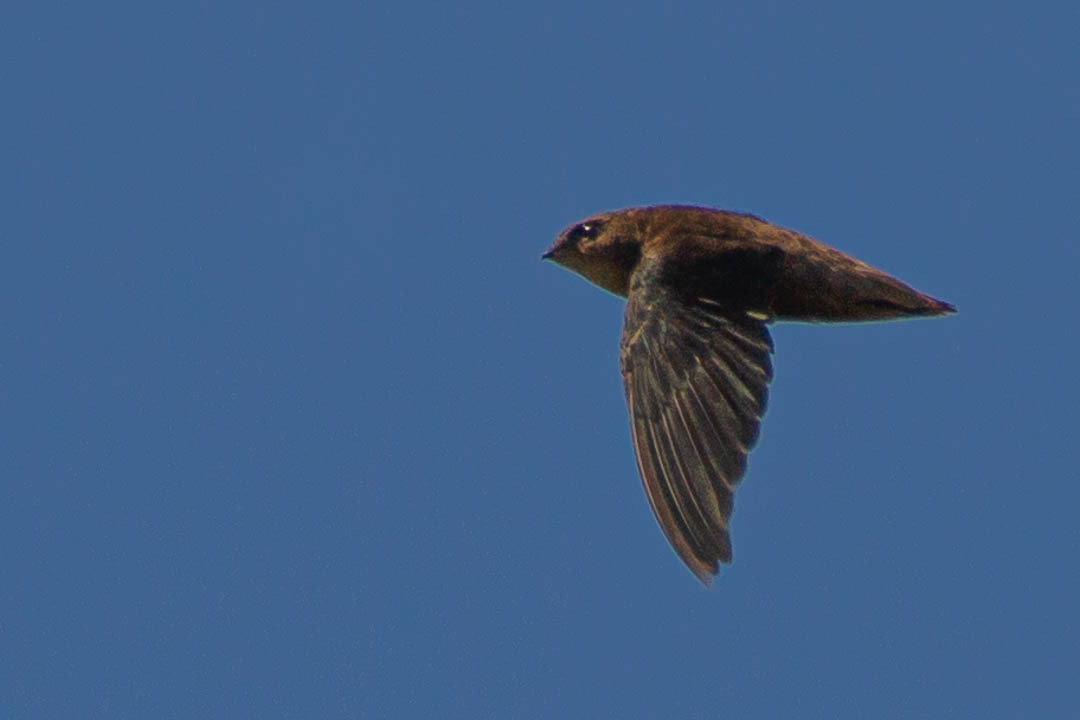
Sick's Swift is a fairly large, dark swift of the genus Chaetura that breeds in southern South America and migrates north in the austral winter. In the guide area it is a winter visitor and passage migrant, often hunting with other swifts high above lowland forest and rivers. It was formerly treated as a subspecies of Ashy-tailed Swift and is named after the ornithologist Helmut Sick, who described the birds of Brazil.
Voice
A dry, rapid twittering of short chip notes in flight, often by several birds at once. Similar to the calls of other Chaetura species.
Recording: JAYRSON ARAUJO DE OLIVEIRA — CC BY-NC-SA 4.0 · xeno-canto
Identification
13–14 cm, with long, narrow wings and a short, square tail whose shafts project as spines. The upperparts are dark sooty brown, with a slightly paler, greyish-brown rump and uppertail coverts that contrast little. The throat is paler grey and grades into the dark grey breast and belly. The undertail coverts are dark. The sexes are alike, and young birds resemble adults.
Confusion species
Chimney Swift Chaetura pelagica, a winter visitor from North America, is very similar and often cannot be separated with certainty in the field; it averages slightly smaller and is present in the guide area mainly from October to April. Chapman's Swift Chaetura chapmani is more uniformly blackish, with a barely paler rump and a darker throat. Ashy-tailed Swift Chaetura andrei has a paler, ash-grey rump and tail. Short-tailed Swift Chaetura brachyura is smaller, with an obviously pale rump, a very short tail and broadened inner secondaries.
Habitat
It hunts in the air above humid lowland forest, rivers, forest edges, open country and villages; in the guide area mainly in the lowlands and foothills. It takes small flying insects, often in mixed flocks with other swifts. It breeds outside the guide area in hollow trees, chimneys and buildings, with a nest of twigs glued to the wall with saliva.
Where the bird is most at home, classified by the vegetation units of the Andes and the west coast.


Range and movements
In the guide area a winter visitor from the south, spending the austral winter in Amazonian Bolivia, Peru, Ecuador and southern Colombia; in Bolivia also a passage migrant. Its exact winter distribution is poorly known, because in the field the species can hardly be told from related species. Possibly also breeds in south-eastern Bolivia. Absent from the high Andes, the west coast and the Galápagos. Outside the guide area it breeds in southern Brazil, Paraguay and northern Argentina and migrates north as far as Venezuela.
- Winter visitor (c. Oct–Mar)
- Passage (Mar–Apr, Oct–Nov)
- dark = core range, pale = thinly spread
How and when to look
In the austral winter (about May–September), look for flocks of swifts over rivers and forest edges in the Amazonian lowlands. Watch for a fairly large Chaetura with a pale throat and little contrast on the rump; good photographs of the bird in flight help with identification.
Conservation status
Least Concern. The species is widespread and in its breeding range also uses buildings and chimneys as nest sites.
Scientific name
Chaetura meridionalis | Hellmayr, 1907
Hellmayr described the species in 1907 and placed it straight away in the genus where it still stands. The genus Chaetura was introduced in 1826 by Stephens. The genus name comes from Greek khaitē, 'long hair, bristle', and oura, 'tail', after the spiny tips of the tail feathers. The species name meridionalis is Latin for 'southern', after the southern range. The specimen the first description was based on came from Santiago del Estero, Argentina.