All species › Swifts › Swifts › Short-tailed Swift
Short-tailed Swift | Chaetura brachyura
Kortstaartgierzwaluw | Vencejo colicorto | Andorinhão-de-rabo-curto
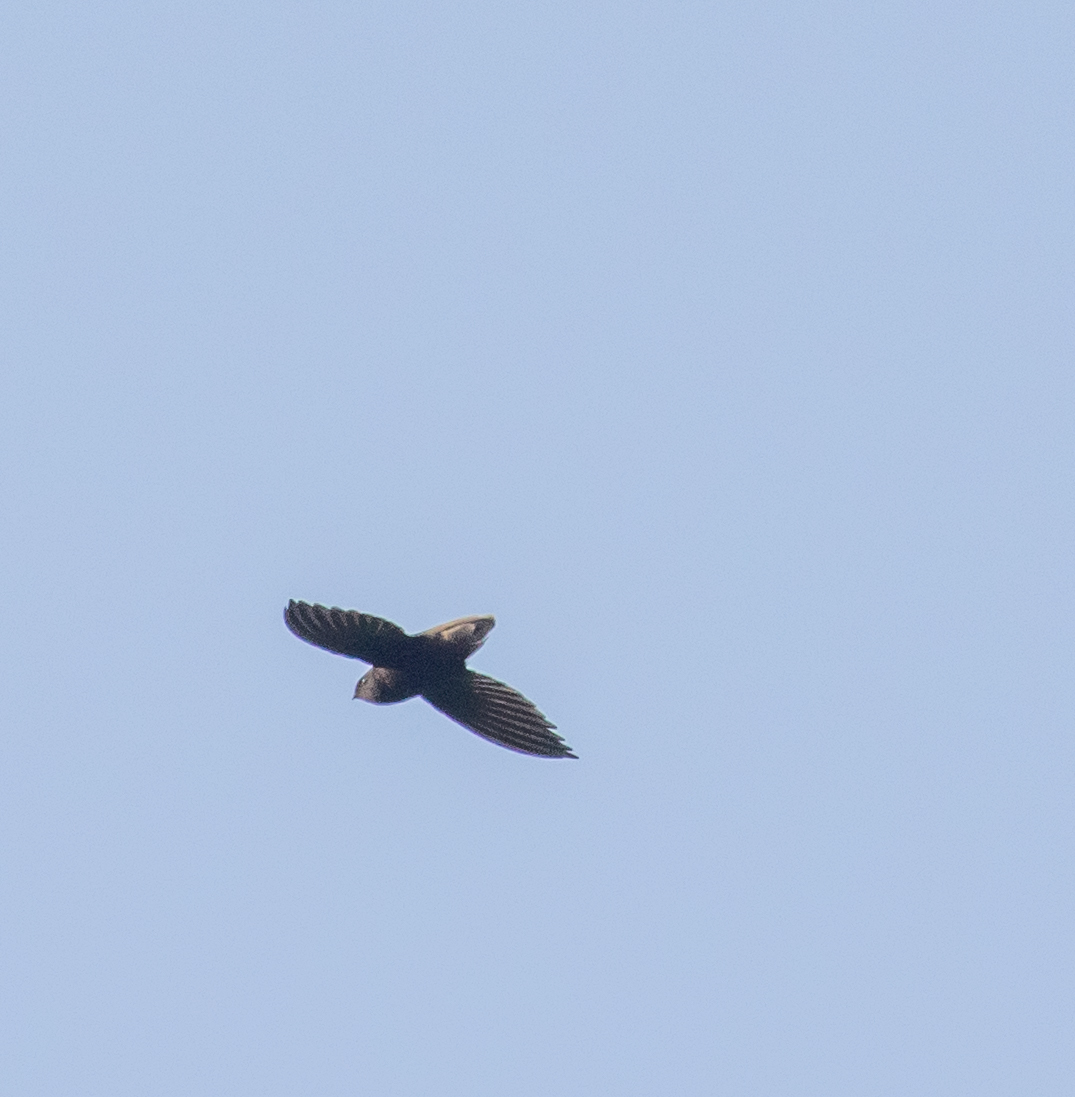
The Short-tailed Swift is a stocky, blackish swift with pale rear parts and a tail so short that the bird looks tailless in flight. Its broadened inner secondaries give the wings a paddle-shaped outline. It is one of the most widespread lowland swifts, both east of the Andes and in the dry west of Ecuador and Peru.
Voice
A rapid, buzzy twittering and high, dry chirps, often repeated by small groups in flight.
Recording: JAYRSON ARAUJO DE OLIVEIRA — CC BY-NC-SA 4.0 · xeno-canto
Identification
10–11 cm, with a short, broad body, wings that are narrow at the base and broadened in the middle, and a very short tail. The body and wings are sooty black. The rump, uppertail coverts, tail and undertail coverts are pale greyish brown and contrast clearly. The throat is slightly paler grey. The sexes are alike, and young birds resemble adults.
Confusion species
Grey-rumped Swift Chaetura cinereiventris has a longer tail, a grey rump and wings without broadened secondaries, and lives more in the foothills. Band-rumped Swift Chaetura spinicaudus is slimmer, with a narrow, whitish band across the rump and a longer, dark tail. Pale-rumped Swift Chaetura egregia has a whitish rump, but a longer tail and dark undertail coverts. Sick's Swift Chaetura meridionalis and Chimney Swift Chaetura pelagica are larger, with a longer tail and little contrast on the rump.
Habitat
It hunts in the air over forest edges, rivers, clearings, fields, dry forest, villages and towns in the lowlands, mostly below about 1000 m, sometimes higher. It takes small flying insects, often in small groups and together with other swifts and swallows. It nests in hollow trees, wells, chimneys and buildings, with a nest of twigs glued to the wall with saliva.
Where the bird is most at home, classified by the vegetation units of the Andes and the west coast.


Range and movements
In Colombia in the northern lowlands, the Magdalena valley, the Llanos and Amazonia. In Ecuador in the eastern lowlands and the dry south-west. In Peru in the eastern lowlands and the dry north-west (Tumbes and Piura). In Bolivia in the lowlands of the north and east. Absent from the high Andes and the Galápagos. Outside the guide area from eastern Panama through Venezuela and the Guianas to Amazonian Brazil, and on Trinidad and Tobago.
- Resident
- dark = core range, pale = thinly spread
How and when to look
Watch over rivers, forest edges and villages in the lowlands, especially in the morning and before thunderstorms, when small groups fly low. Note the silhouette: a very short tail, pale rear parts and wings that are broader in the middle.
Conservation status
Least Concern. The species is widespread and locally benefits from buildings and open, man-made landscapes.
Scientific name
Chaetura brachyura | (Jardine, 1846)
Jardine described the species in 1846 as Acanthylis brachyura; because it was later moved to another genus, the author and year stand in brackets. The genus Chaetura was introduced in 1826 by Stephens. The genus name comes from Greek khaitē, 'long hair, bristle', and oura, 'tail', after the spiny tips of the tail feathers. The species name brachyura comes from Greek brakhus, 'short', and oura, 'tail'. The specimen the first description was based on came from Tobago.