All species › Swifts › Swifts › White-tipped Swift
White-tipped Swift | Aeronautes montivagus
Kleine andesgierzwaluw | Vencejo filipunteado | Andorinhão-serrano
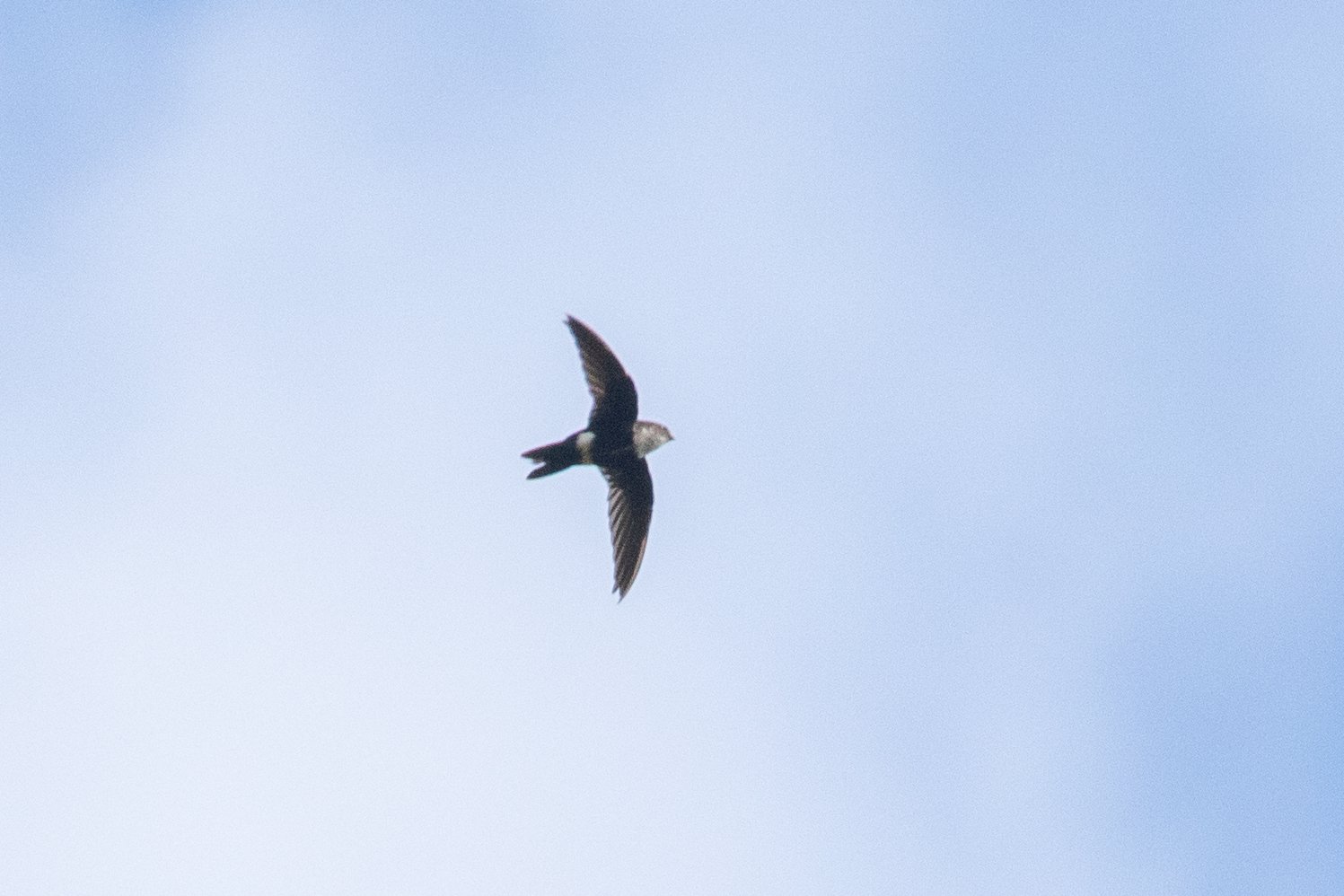
The White-tipped Swift is a medium-sized, black-and-white swift of montane forest, gorges and cliffs on the slopes of the Andes. It flies fast and agilely, often in small groups along steep slopes. The English and Spanish names refer to the white tail tip of the male.
Voice
A rapid, dry, shrill trill, often repeated by small groups flying along cliffs.
Recording: Joe Klaiber — CC BY-NC-SA 4.0 · xeno-canto
Identification
12–13 cm, with narrow wings and a slightly forked tail. The plumage is sooty black, with a white throat that extends as a narrow point down the centre of the breast and a white patch on the rear flanks, visible in flight as a white smudge beside the rump. The male has white tips to the tail feathers; in the female these are greyish or absent.
Confusion species
Andean Swift Aeronautes andecolus is paler greyish brown, with a white collar, a white rump, white underparts and a more deeply forked tail; it lives in the dry valleys of Peru and Bolivia. Lesser Swallow-tailed Swift Panyptila cayennensis has a white collar and a long, usually closed, pointed tail, and lives lower, in lowland forest. White-collared Swift Streptoprocne zonaris is much larger, with a complete white collar. Swifts of the genus Chaetura have a short, square tail and no white on the throat and flanks.
Habitat
Montane forest, forest edges, open slopes and especially gorges, ravines and cliffs in the Andes, mostly between about 1000 and 2500 m, locally higher or lower. It hunts flying insects in the air, often in small groups and sometimes with other swifts. It nests in crevices in cliffs and sometimes in buildings.
Where the bird is most at home, classified by the vegetation units of the Andes and the west coast.


Range and movements
In Colombia on the slopes of all three Andean ranges. In Ecuador on both slopes of the Andes and locally in the valleys between them. In Peru mainly along the eastern slope, locally also on the western slope and in the inter-Andean valleys. In Bolivia on the eastern slope of the Andes. Absent from the lowlands, the coastal desert and the Galápagos. Outside the guide area in the mountains of Venezuela and on the tepuis of Venezuela and extreme northern Brazil.
- Resident
- dark = core range, pale = thinly spread
How and when to look
Watch from a viewpoint in a mountain valley or near a gorge with cliffs, especially in the morning; small groups then fly fast along the rock faces and give their trills.
Conservation status
Least Concern. The species is widespread in the Andes and depends less on closed forest than many other montane birds.
Scientific name
Aeronautes montivagus | (d'Orbigny, ACVMD & de Lafresnaye, 1837)
D'Orbigny, ACVMD & de Lafresnaye described the species in 1837 as Cypselus montivagus; because it was later moved to another genus, the author and year stand in brackets. The genus Aeronautes was introduced in 1892 by Hartert. The genus name comes from Greek aēr, 'air', and nautēs, 'sailor', so 'air sailor'. The species name montivagus comes from Latin mons, 'mountain', and vagus, 'wandering', so 'mountain-wandering'. The specimen the first description was based on came from Samaipata – Santa Cruz de la Sierra, Bolivia.