All species › Swifts › Swifts › Andean Swift
Andean Swift | Aeronautes andecolus
Andesgierzwaluw | Vencejo andino | Andorinhão-andino
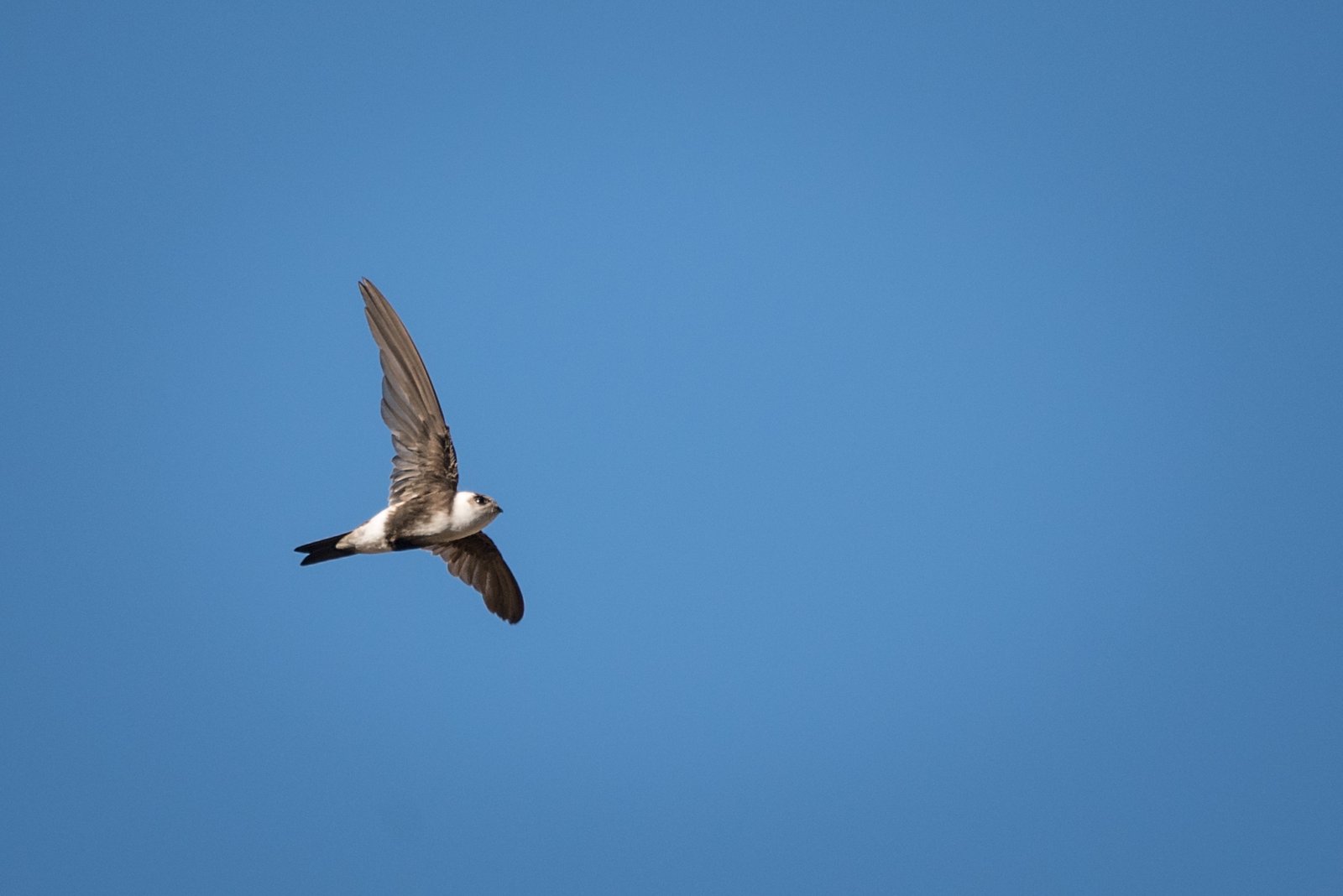
The Andean Swift is a pale, brown-and-white swift with a deeply forked tail that lives in the dry Andean valleys of Peru and Bolivia. Small groups hunt along cliffs, gorges and villages, often low over the ground. With its white collar, rump and underparts it differs from most other swifts in the guide area.
Voice
A high, shrill chirping and rapid trills, often by small groups in flight.
Recording: Fabrice Schmitt — CC BY-NC-SA 4.0 · xeno-canto
Identification
14–15 cm, slender, with long, narrow wings and a long, deeply forked tail that is often held closed in a point. The crown, mantle, wings and tail are greyish brown. A broad white collar crosses the nape, and the rump is white. The underparts are white, with greyish-brown flanks. The sexes are alike.
Confusion species
White-tipped Swift Aeronautes montivagus is darker, blackish, with only a white throat and white flank patches, no collar and no white rump, and a less deeply forked tail; it lives more in humid montane forest. White-collared Swift Streptoprocne zonaris is much larger and black, with a narrow white collar and a short tail. Swallows in the same area have broader wings, a more fluttering flight and usually no white collar.
Habitat
Dry, open Andean valleys with cliffs, gorges, steep banks, cacti and scrub, also around villages and fields, roughly between 1500 and 4000 m, locally lower. It hunts flying insects in the air, often in small groups. It nests in crevices in cliffs and steep banks and sometimes in buildings.
Where the bird is most at home, classified by the vegetation units of the Andes and the west coast.


Range and movements
In Peru on the western slope of the Andes and in the dry inter-Andean valleys, mainly in the centre and south of the country. In Bolivia in the dry Andean valleys and on the altiplano. Absent from Colombia, Ecuador and the Galápagos. Outside the guide area in western and north-western Argentina and rarely in northern Chile.
- Resident
- dark = core range, pale = thinly spread
How and when to look
Search dry valleys with cliffs and gorges, for example around Arequipa and in the valleys near Cochabamba, where small groups hunt low along the rock faces.
Conservation status
Least Concern. The species tolerates small-scale farmland and sometimes nests in buildings.
Scientific name
Aeronautes andecolus | (d'Orbigny, ACVMD & de Lafresnaye, 1837)
D'Orbigny, ACVMD & de Lafresnaye described the species in 1837 as Cypselus andecolus; because it was later moved to another genus, the author and year stand in brackets. The genus Aeronautes was introduced in 1892 by Hartert. The genus name comes from Greek aēr, 'air', and nautēs, 'sailor', so 'air sailor'. The species name andecolus comes from the Andes and Latin -cola, 'dweller', so 'Andes dweller'. The specimen the first description was based on came from La Paz, Bolivia.