All species › Gamebirds › Guans, curassows and chachalacas › Band-tailed Guan
Band-tailed Guan | Penelope argyrotis
Bandstaartsjakohoen | Pava canosa | Jacu-de-cauda-barrada
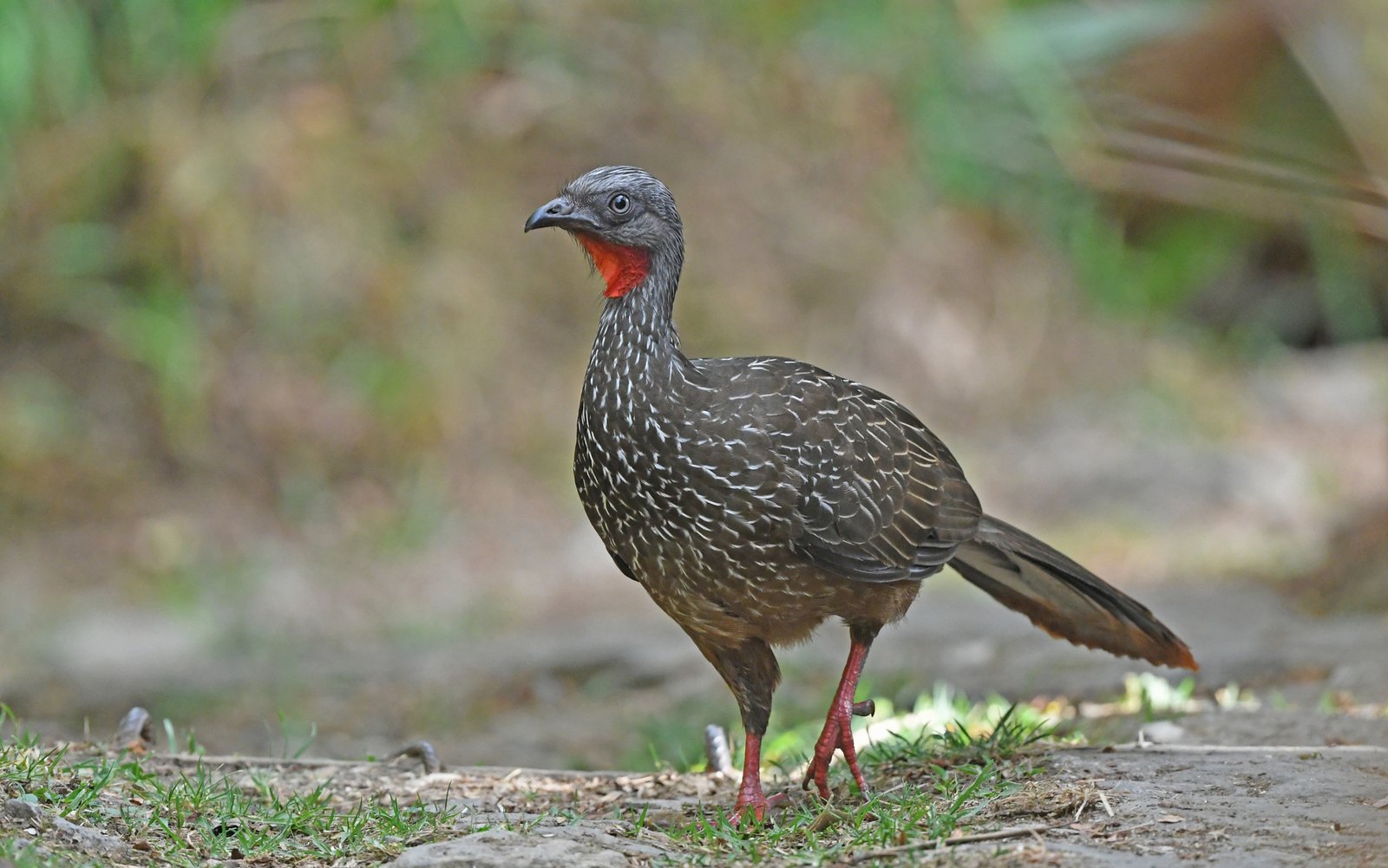
The Band-tailed Guan is a medium-sized, brown guan of the montane forests of northern Colombia and Venezuela. It owes its name to the pale terminal band of the tail, which stands out especially in a bird in flight or seen from behind. The head and breast are silvery-frosted and scaled white.
Voice
Loud, honking and cackling calls, often repeated, mainly in the early morning and in the evening. At dusk and dawn it makes a rattling wing sound during display flights.
Recording: Bobby Wilcox — CC BY-NC-SA 4.0 · xeno-canto
Identification
55–61 cm, with a long tail, a small red dewlap and red legs. The upperparts are olive-brown with a bronze gloss. The crown, eyebrow and sides of the head are frosted silver-grey; the bare skin around the eye is bluish grey. The foreneck and breast are brown with prominent white feather edges, giving a scaled look. The belly is rufous-brown. The tail feathers have a broad, pale, ochre to rufous terminal band. The sexes are alike.
Confusion species
Andean Guan Penelope montagnii is smaller and greyer, without a pale tail band, and usually lives higher. Sickle-winged Guan Chamaepetes goudotii has a plain rufous belly, a blue face and no dewlap. Crested Guan Penelope purpurascens is larger, with a larger red dewlap and a crest, and lives lower. Bearded Guan Penelope barbata is very similar, but occurs only in southern Ecuador and northern Peru.
Habitat
Humid montane forest and cloud forest, also forest edge and tall secondary forest, roughly between 900 and 2500 m. It lives in pairs or small groups in the middle and upper levels of the forest and eats fruit, berries and leaves. The nest is a platform of twigs in a tree.
Where the bird is most at home, classified by the vegetation units of the Andes and the west coast.


Range and movements
In Colombia only in the north: in the Sierra Nevada de Santa Marta, the Serranía de Perijá and the northern part of the Eastern Andes. Absent from Ecuador, Peru, Bolivia and the Galápagos. Outside the guide area in the Andes and the coastal mountains of Venezuela.
- Resident
- dark = core range, pale = thinly spread
How and when to look
In the early morning, search fruiting trees along the road through the montane forest of the Sierra Nevada de Santa Marta, for example around El Dorado. Birds often perch in the open on a branch at the forest edge.
Conservation status
Least Concern. Still fairly common locally, but sensitive to hunting and to clearing of montane forest for agriculture.
Scientific name
Penelope argyrotis | (Bonaparte, 1856)
Bonaparte described the species in 1856 as Pipile argyrotis; because it was later moved to another genus, the author and year stand in brackets. The genus Penelope was introduced in 1786 by Merrem. The genus name comes from Greek mythology: Penelope was the daughter of the Spartan king Icarius and the wife of Odysseus. The species name comes from Greek arguros, 'silver', and ous (ōtos), 'ear', for the silvery ear region. The specimen the first description was based on came from Caracas, Venezuela.