All species › Gamebirds › Guans, curassows and chachalacas › Bearded Guan
Bearded Guan | Penelope barbata
Baardsjakohoen | Pava barbuda | Jacu-barbudo
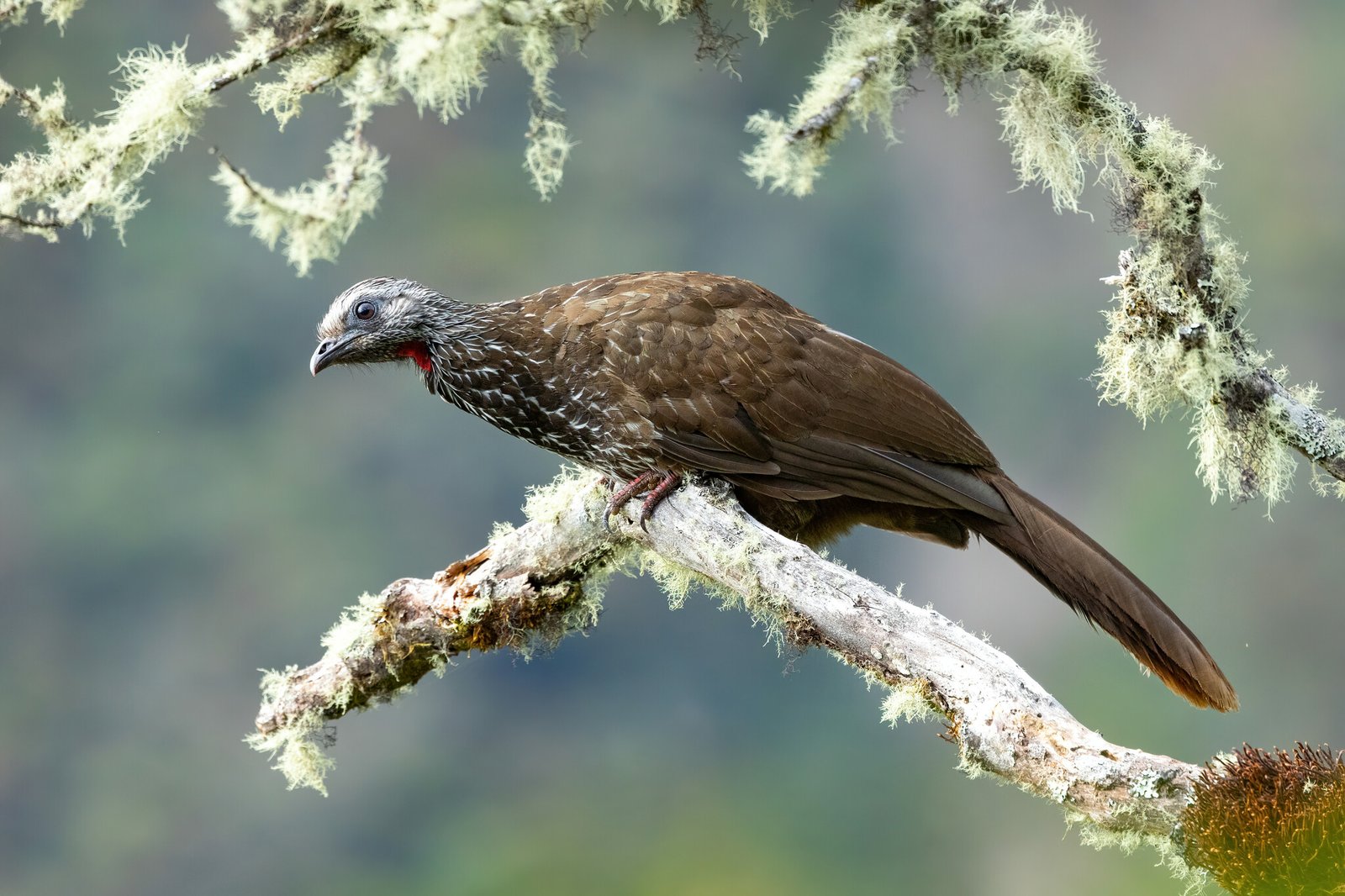
The Bearded Guan is a brown, grey-frosted guan with a small range in the Andes of southern Ecuador and northern Peru. It was formerly included in Band-tailed Guan and likewise has a pale terminal tail band. The name refers to the dark-feathered throat, which leaves only a small red dewlap exposed.
Voice
Loud, honking and cackling calls, mainly in the early morning. At dusk and dawn it makes a rattling wing sound during display flights.
Recording: Paul Coopmans — CC BY-NC-SA 4.0 · xeno-canto
Identification
55–60 cm, with a long tail and red to orange-red legs. The upperparts are olive-brown. The head and neck are frosted grey, with a pale eyebrow; the bare skin around the eye is bluish grey. The throat is largely feathered, so that only a small red dewlap shows. The foreneck and breast have white feather edges. The belly is rufous-brown. The tail has a rufous terminal band. The sexes are alike.
Confusion species
Andean Guan Penelope montagnii lacks the rufous tail band and has a slightly larger dewlap; it overlaps locally in southern Ecuador. White-winged Guan Penelope albipennis is larger, with white primaries, and lives lower, in dry forest in north-western Peru. Crested Guan Penelope purpurascens is larger, with a large red dewlap, and lives in the lowlands. Sickle-winged Guan Chamaepetes goudotii has a blue face, no dewlap and a plain rufous belly.
Habitat
Humid and semi-humid montane forest, cloud forest and higher forest up to near the treeline, also forest fragments and edges, roughly between 1200 and 3000 m. It lives in pairs or small groups in the tree layers and eats fruit, berries and leaves. The nest is a platform of twigs in a tree.
Where the bird is most at home, classified by the vegetation units of the Andes and the west coast.


Range and movements
In Ecuador in the Andes of the south, in Azuay, El Oro, Loja and western Zamora-Chinchipe. In Peru in the north-west, in Piura, Cajamarca and Lambayeque. Absent from Colombia, Bolivia and the Galápagos. It does not occur outside the guide area.
- Resident
- dark = core range, pale = thinly spread
How and when to look
In the early morning, search the montane forest of southern Ecuador, for example in Podocarpus National Park and the Tapichalaca reserve, at fruiting trees along trails.
Conservation status
Near Threatened. Its small range is heavily fragmented by clearance for farming and cattle ranching, and the species is hunted.
Scientific name
Penelope barbata | Chapman, 1921
Chapman described the species in 1921 and placed it straight away in the genus where it still stands. The genus Penelope was introduced in 1786 by Merrem. The genus name comes from Greek mythology: Penelope was the daughter of the Spartan king Icarius and the wife of Odysseus. The species name comes from Latin barbatus, 'bearded', for the beard-like throat feathers. The specimen the first description was based on came from Taraguacocha, Cordillera de Chilla, El Oro, Ecuador.