All species › Gamebirds › Guans, curassows and chachalacas › Baudo Guan
Baudo Guan | Penelope ortoni
Ortons sjakohoen | Pava del Baudó | Jacu-do-baudó
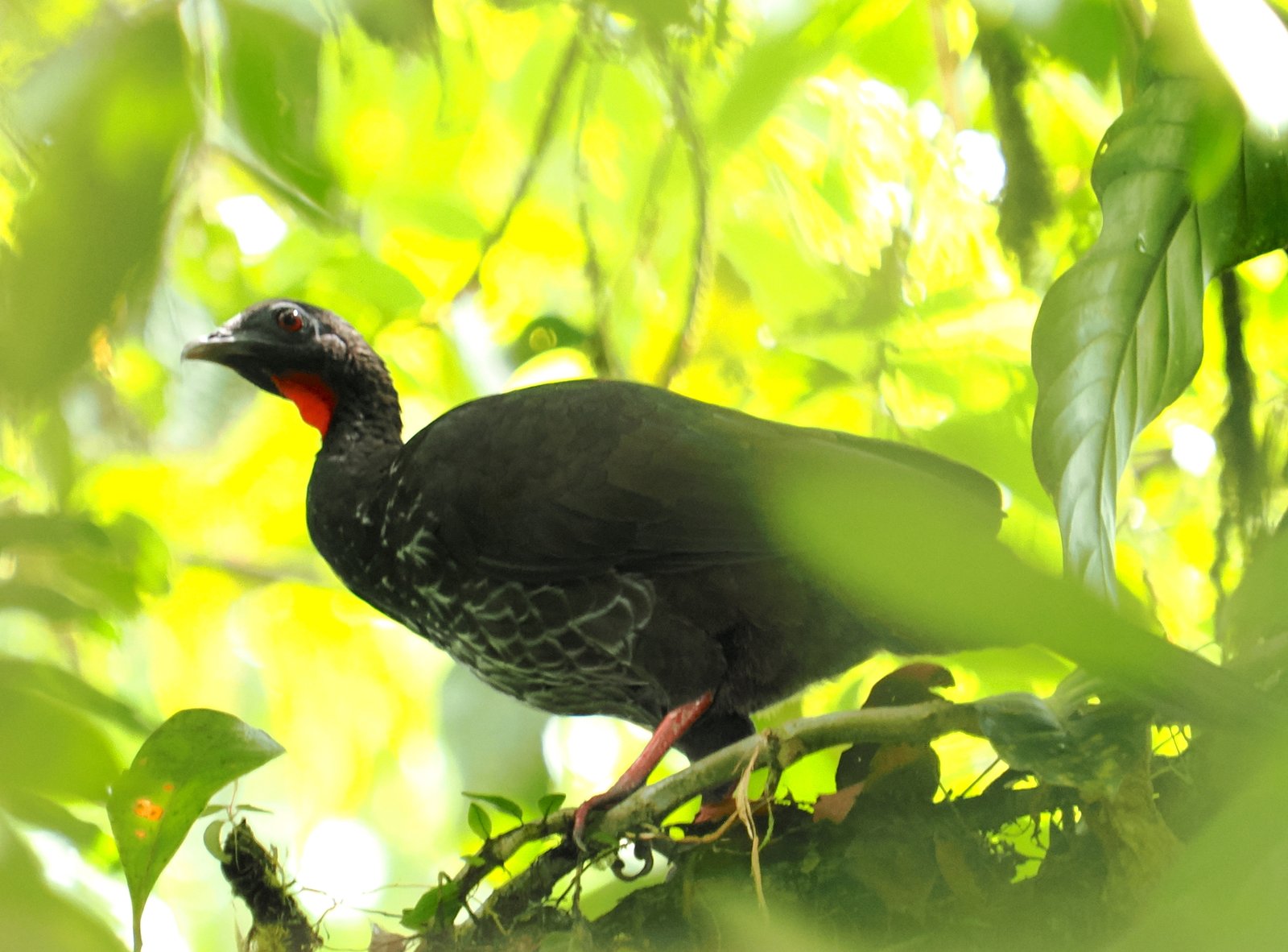
The Baudo Guan is a rather small, dark and plain guan of the Chocó rainforest on the Pacific side of Colombia and Ecuador. Its English name refers to the Serranía de Baudó in western Colombia. It is one of the least known gamebirds of the guide area and is threatened by deforestation and hunting.
Voice
Poorly documented. Gives loud, honking and cackling notes like other Penelope guans, mainly in the early morning; at dusk and dawn a rattling wing sound during display flights.
Recording: Patricio Mena Valenzuela — CC BY-NC-SA 4.0 · xeno-canto
Identification
58–63 cm, slender, with a long tail and red legs. The plumage is fairly uniform dark olive-brown with a slight green gloss, with at most a few narrow pale edges on the foreneck. There is no obvious crest. The bare skin around the eye is bluish grey, and the dewlap is small and red. The sexes are alike.
Confusion species
Crested Guan Penelope purpurascens is larger, with a short crest, clearly white-edged breast feathers and a larger red dewlap; it overlaps in the lowlands. Sickle-winged Guan Chamaepetes goudotii has a rufous belly, a blue face and no dewlap, and lives higher. Wattled Guan Aburria aburri is larger and glossy black, with a yellow wattle. Andean Guan Penelope montagnii is frosted grey and lives much higher.
Habitat
Humid and very wet lowland and foothill forest of the Chocó, especially undisturbed forest with tall trees, mostly below 1000 m and locally to about 1800 m. It lives singly or in pairs in the treetops and eats fruit and leaves. Little is known about its breeding.
Where the bird is most at home, classified by the vegetation units of the Andes and the west coast.


Range and movements
In Colombia on the Pacific slope and in the Chocó lowlands, from Antioquia and Chocó south through Valle del Cauca and Cauca to Nariño. In Ecuador in the north-west, mainly in Esmeraldas and adjacent parts of Carchi, Imbabura and Pichincha. Absent from Peru, Bolivia and the Galápagos. It does not occur outside the guide area.
- Resident
- dark = core range, pale = thinly spread
How and when to look
Search large, undisturbed forest tracts in north-western Ecuador, for example the Playa de Oro reserve and the Cotacachi-Cayapas area, or the lower parts of the La Planada Nature Reserve and the Río Ñambí area in Nariño. In the early morning, watch for birds in fruiting trees.
Conservation status
Endangered. The population is small and declining through clearance of Chocó forest for timber, oil palm and agriculture and through hunting; the species disappears almost everywhere people settle.
Scientific name
Penelope ortoni | Salvin, 1874
Salvin described the species in 1874 and placed it straight away in the genus where it still stands. The genus Penelope was introduced in 1786 by Merrem. The genus name comes from Greek mythology: Penelope was the daughter of the Spartan king Icarius and the wife of Odysseus. The species name honours James Orton (1830–1877), American naturalist who travelled in Ecuador and the Amazon. The specimen the first description was based on came from Mindo, Pichincha, Ecuador.