All species › Gamebirds › Guans, curassows and chachalacas › Andean Guan
Andean Guan | Penelope montagnii
Andessjakohoen | Pava andina | Jacu-andino
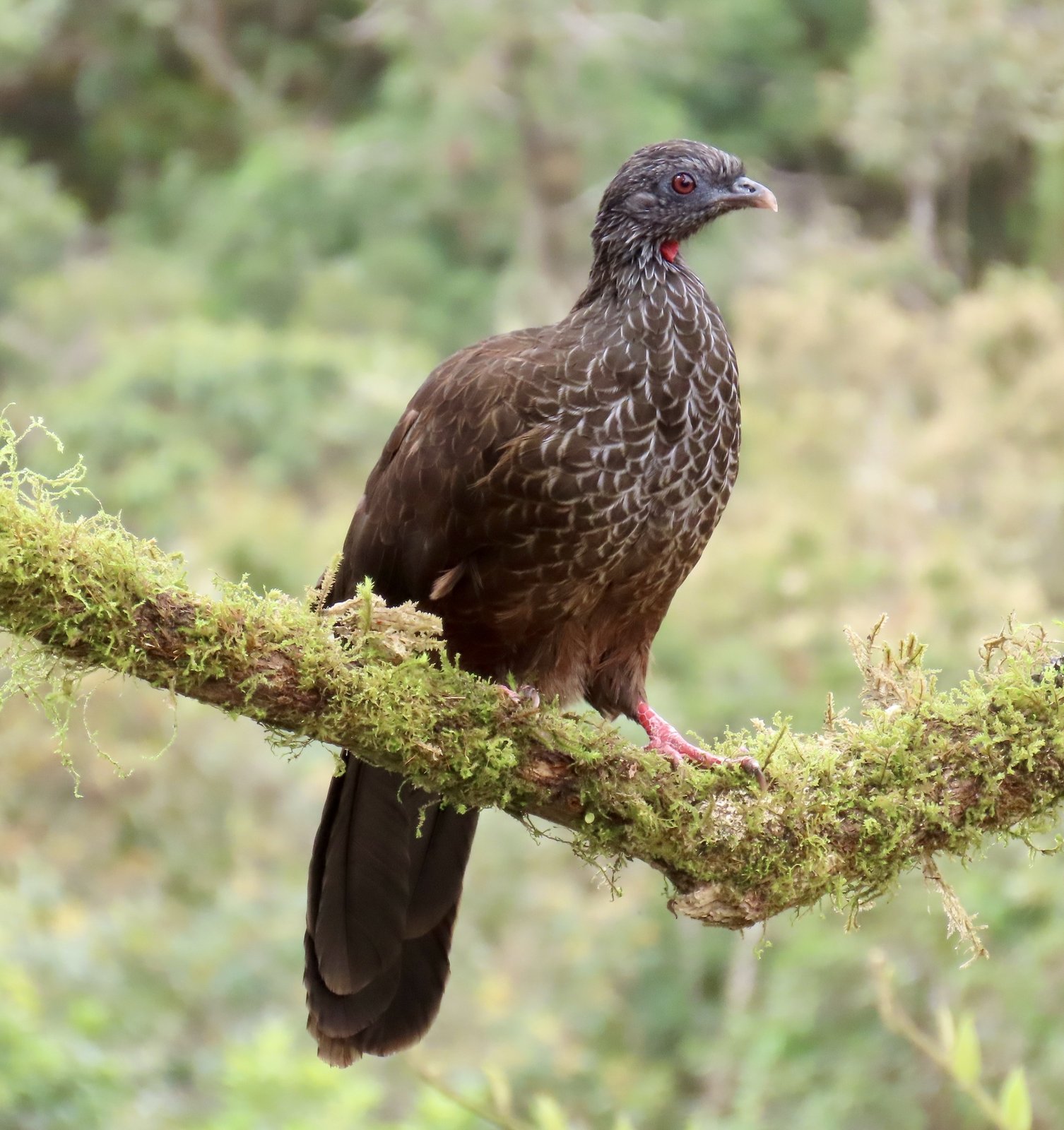
The Andean Guan is the smallest and most widespread guan of higher montane forest in the Andes, from Venezuela to Argentina. It lives up to near the treeline, higher than most other gamebirds of the guide area. The head and neck are frosted grey and the red dewlap is small.
Voice
Short, honking and cackling calls and a soft, plaintive whistle, mainly in the early morning and the evening. At dusk and dawn it makes a rattling wing sound during display flights.
Recording: Sue Riffe — CC BY-NC-SA 4.0 · xeno-canto
Identification
51–61 cm, rather small and slender for a guan, with a long tail and red legs. The upperparts are brown with an olive gloss. The head and neck are frosted grey; the bare skin around the eye is grey to bluish grey. The foreneck and breast have narrow, whitish feather edges. The rump, belly and undertail coverts are rufous-brown. The dewlap is small, red and sometimes barely visible. The sexes are alike.
Confusion species
Sickle-winged Guan Chamaepetes goudotii has a blue face, no dewlap and no grey frosting. Bearded Guan Penelope barbata has a rufous terminal tail band and lives in southern Ecuador and north-western Peru. Band-tailed Guan Penelope argyrotis has a pale tail band and lives in northern Colombia. Spix's Guan Penelope jacquacu is larger and lives in the lowlands. In Bolivia, Yungas Guan Penelope bridgesi and Red-faced Guan Penelope dabbenei are larger, with dark legs or a red face.
Habitat
Humid montane forest, cloud forest, elfin forest and Polylepis woodland up to near the treeline, also forest edge and scrub with trees, roughly between 1500 and 3500 m, locally higher. It lives in pairs or small groups in the tree layers and eats fruit, berries, flowers and leaves; it sometimes comes to the ground. The nest is a platform of twigs in a tree.
Where the bird is most at home, classified by the vegetation units of the Andes and the west coast.


Range and movements
In Colombia in all three Andean ranges. In Ecuador on both slopes of the Andes and in the higher inter-Andean valleys. In Peru mainly on the eastern slope along the whole length of the country, in the north also on the western slope. In Bolivia in the Yungas and higher montane forest of La Paz, Cochabamba and Santa Cruz. Absent from the Galápagos. Outside the guide area in the Andes of Venezuela and north-western Argentina.
- Resident
- dark = core range, pale = thinly spread
How and when to look
In the early morning, search fruiting trees and shrubs along roads through higher cloud forest, for example at Yanacocha in Ecuador or along the upper parts of the Manu road in Peru.
Conservation status
Least Concern. Widespread and locally common; declining where higher montane forest is cleared and where hunting is intense.
Scientific name
Penelope montagnii | (Bonaparte, 1856)
Bonaparte described the species in 1856 as Ortalida montagnii; because it was later moved to another genus, the author and year stand in brackets. The genus Penelope was introduced in 1786 by Merrem. The genus name comes from Greek mythology: Penelope was the daughter of the Spartan king Icarius and the wife of Odysseus. The species name honours Jean Pierre François Camille Montagne (1784–1866), French surgeon and botanist. The specimen the first description was based on came from El Piñón near Fusagasugá, Cundinamarca, Colombia.