All species › Gamebirds › Guans, curassows and chachalacas › Rusty-margined Guan
Rusty-margined Guan | Penelope superciliaris
Witvoorhoofdsjakohoen | Pava yacupemba | Jacupemba
The Rusty-margined Guan is a medium-sized guan of the forests south of the Amazon basin and of the Atlantic Forest. Its name refers to the rufous edges of the wing coverts, the clearest feature of the species. In the guide area it occurs only in the far east of Bolivia, at the edge of a large range in Brazil.
Voice
Loud, harsh, honking calls, often at dusk, and a raucous cackle when alarmed. At dawn it makes a rattling sound with its wings in flight.
Recording: Fernando Igor de Godoy — CC BY-NC-SA 4.0 · xeno-canto
Identification
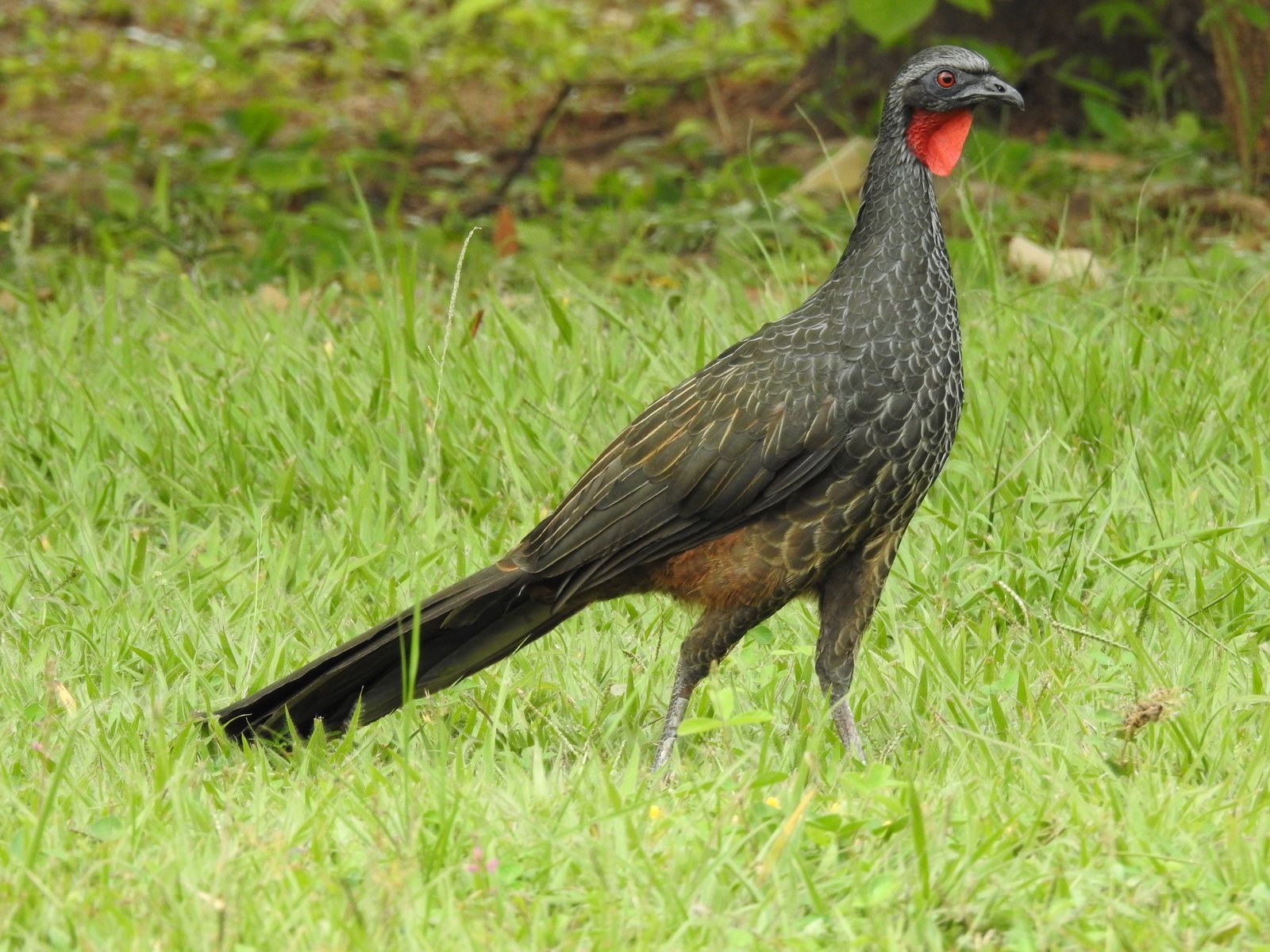
60–70 cm, a slender guan with a long tail and a small, shaggy crest. The plumage is dark olive-brown, with a greenish gloss on the back and tail. The wing coverts and mantle feathers have broad rufous edges, giving a scaled pattern. A pale grey to whitish supercilium runs back above the eye; the bare skin around the eye is grey. The breast is greyish brown with pale feather edges. The small dewlap is red. The legs are reddish. The sexes are alike.
Confusion species
Spix's Guan Penelope jacquacu is larger and darker, without rufous edges on the wing, and lives in the Amazonian lowlands. Speckled Chachalaca Ortalis guttata is smaller, with a smaller head, a spotted neck and rufous outer tail feathers. Red-faced Guan Penelope dabbenei has red bare facial skin and lives in montane forest in southern Bolivia.
Habitat
Semi-deciduous and dry forest, gallery forest along rivers and forest edges in the transition to cerrado, in the guide area in the lowlands and on low hills. It eats fruit, berries, leaves and flowers, both in trees and on the ground. The nest is a platform of twigs in a tree or shrub.
Where the bird is most at home, classified by the vegetation units of the Andes and the west coast.


Range and movements
In Bolivia only in the far east of Santa Cruz department, in forest along the border with Brazil. Absent from Colombia, Ecuador and the Galápagos; a few reports from Peru are probably misidentifications. Outside the guide area in much of Brazil south of the Amazon, in eastern Paraguay and in north-eastern Argentina.
- Resident
- dark = core range, pale = thinly spread
How and when to look
Search gallery forest and forest edges in eastern Santa Cruz early in the morning, when birds often sit in fruiting trees and call.
Conservation status
Least Concern. The species tolerates some forest disturbance, but is disappearing from large parts of its range through logging and hunting.
Scientific name
Penelope superciliaris | Temminck, 1815
Temminck described the species in 1815 and placed it straight away in the genus where it still stands. The genus Penelope was introduced in 1786 by Merrem. The genus name comes from Greek mythology: Penelope was the daughter of the Spartan king Icarius and the wife of Odysseus. The species name comes from Latin supercilium, 'eyebrow', for the pale eyebrow stripe. The specimen the first description was based on came from Pará, Brazil.