All species › Passerines › Wrens › Bar-winged Wood Wren
Bar-winged Wood Wren | Henicorhina leucoptera
Peruaanse boswinterkoning | Cucarachero montés alibandeado | Corruíra-de-asa-listrada
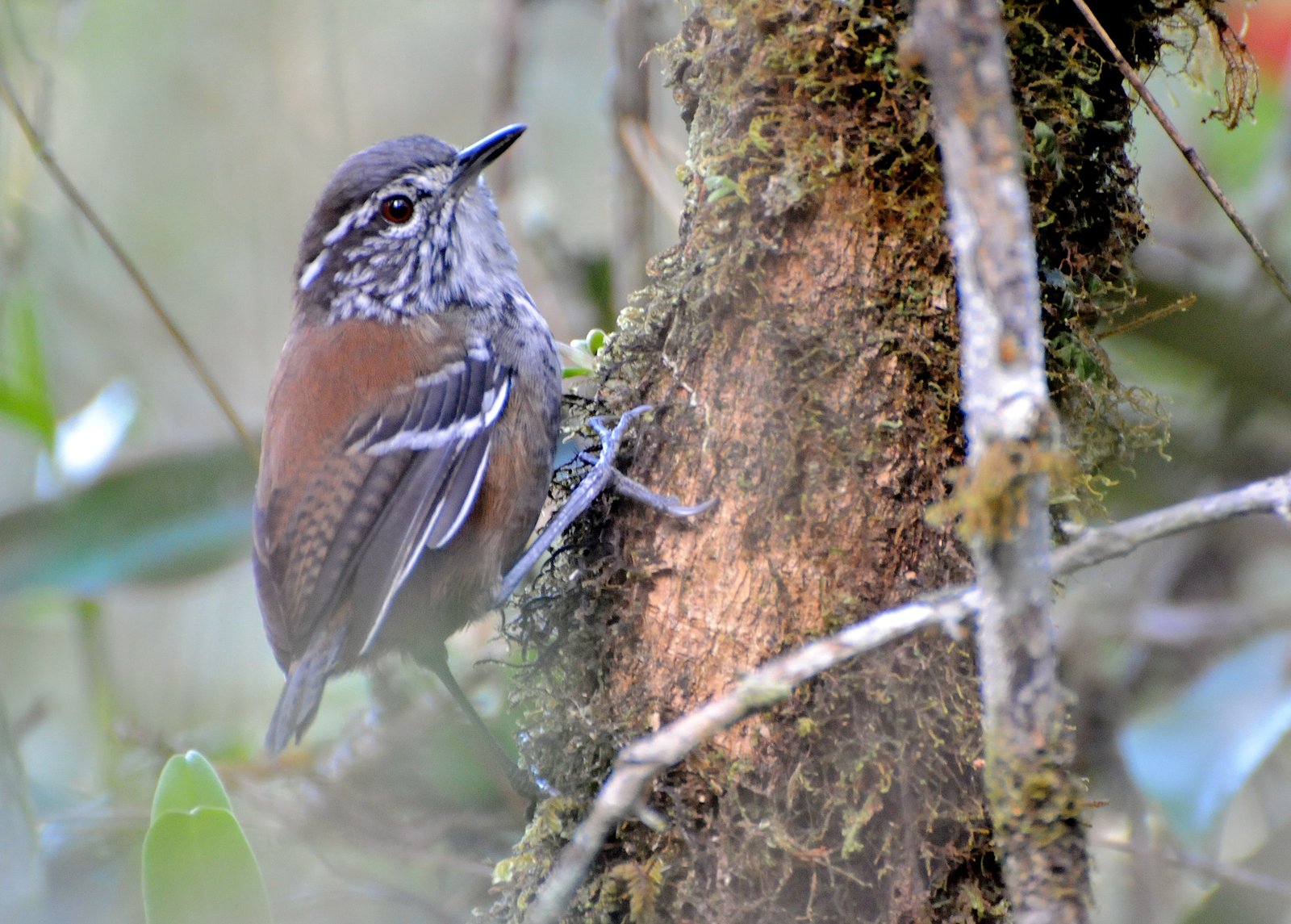
The Bar-winged Wood Wren is a small wood wren with two white wing bars, described only in 1977. It lives in low, dense, mossy montane forest on ridges and sandstone crests in northern Peru and south-eastern Ecuador. Its elevational zone often lies between those of Grey-breasted Wood Wren, which occupies the wetter, taller forest on the slopes.
Voice
Clear, repeated whistled phrases, similar to those of Grey-breasted Wood Wren but slightly different in rhythm; also duets and dry, rattling alarm calls.
Recording: Lelis Navarrete — CC BY-NC-SA 4.0 · xeno-canto
Identification
10–11 cm, with a short, often cocked tail. The crown is brown to grey-brown, with a white supercilium; the sides of the head are streaked black and white. The upperparts are warm brown, the tail barred black. Two narrow white wing bars stand out on the wing. The throat and breast are greyish white, the flanks and lower belly brown. The sexes are alike; young birds are duller, with less distinct head markings.
Confusion species
Grey-breasted Wood Wren Henicorhina leucophrys is very similar, but lacks white wing bars and has a darker grey breast. White-breasted Wood Wren Henicorhina leucosticta has a bright white breast, no wing bars and lives lower, in the lowlands and foothills.
Habitat
Low, dense, mossy montane forest and elfin forest on ridges, often on poor sandstone soils, roughly between 1350 and 2450 m. In pairs it searches moss, dead leaves and low vegetation for insects and spiders. Little is known of its nesting; presumably a globular nest as in related species.
Where the bird is most at home, classified by the vegetation units of the Andes and the west coast.


Range and movements
In Ecuador in the south-east, in the Cordillera del Cóndor (Zamora-Chinchipe and Morona-Santiago). In Peru in the north and centre, mainly in Amazonas and San Martín, with a few sites in Cajamarca, Loreto and Huánuco. Absent from Colombia, Bolivia and the Galápagos. Does not occur outside the guide area.
- Resident
- dark = core range, pale = thinly spread
How and when to look
In elfin forest on ridges in the Cordillera del Cóndor and in northern Peru, for example along roads crossing the ridges in Amazonas and San Martín; the birds keep low in dense vegetation and are mostly detected by voice.
Conservation status
Least Concern. Its habitat is small and fragmented, and locally lies in areas with mining and clearance.
Scientific name
Henicorhina leucoptera | Fitzpatrick, Terborgh & Willard, 1977
Fitzpatrick, Terborgh & Willard described the species in 1977 and placed it straight away in the genus where it still stands. The genus Henicorhina was introduced in 1868 by Sclater & Salvin. The genus name comes from Greek henikos, 'singular', and rhis, rhinos, 'nostrils'. It replaced Baird's name Heterorhina, which was already in use for a beetle genus. The species name comes from Greek leukos, 'white', and pteron, 'wing', for the white wing bars. The specimen the first description was based on came from Peru.