All species › Passerines › Wrens › White-breasted Wood Wren
White-breasted Wood Wren | Henicorhina leucosticta
Witborstboswinterkoning | Chivirín pecho blanco | Uirapuru-de-peito-branco
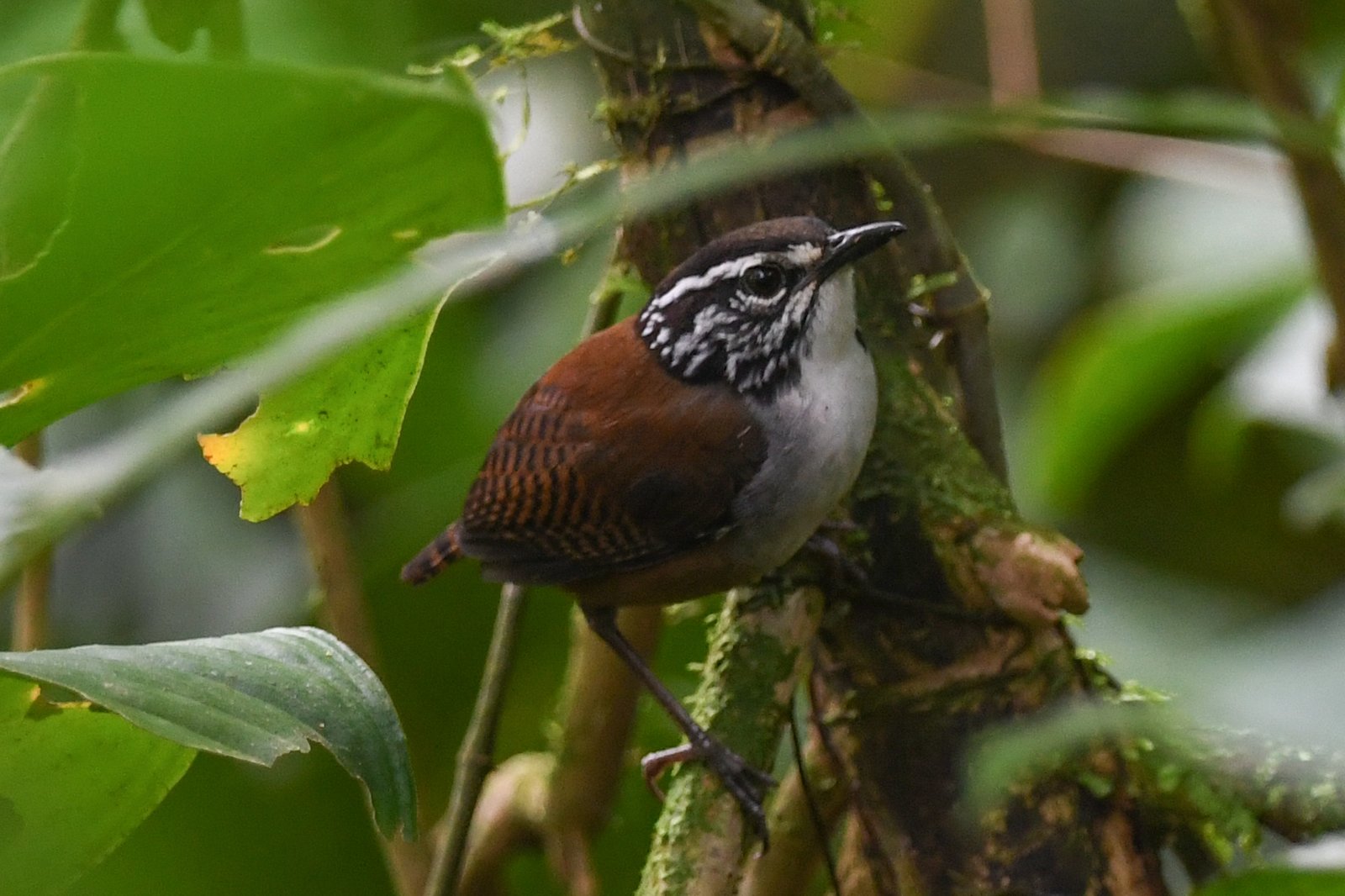
The White-breasted Wood Wren is a small, compact wren with a short, often cocked tail and a white throat and breast, found on the forest floor and in the undergrowth of humid lowland and foothill forest. It hops hidden through the leaf litter and low shrubs, but its loud, clear song carries far through the forest. Higher up the slopes it is replaced by Grey-breasted Wood Wren.
Voice
Loud, rich whistled phrases of a few notes, repeated and varying between individuals, such as chee-roo-wee or wee-choo-wee; also in duet. The alarm is a dry, grating rattle.
Recording: Juan Freile — CC BY-NC-SA 4.0 · xeno-canto
Identification
10–11 cm, with a short tail that is often held upright. The crown is black to dark brown, with a white supercilium; the sides of the head are streaked black and white. The back and rump are warm chestnut-brown, the wings and short tail barred black. The throat and breast are bright white, the flanks and lower belly rufous-brown. The sexes are alike; young birds have a greyish breast and less distinct head markings.
Confusion species
Grey-breasted Wood Wren Henicorhina leucophrys has a grey throat and breast and usually lives higher, in montane forest above about 1000 m; the two overlap in a narrow zone. Bar-winged Wood Wren Henicorhina leucoptera has two white wing bars and a greyish-white breast and lives in stunted montane forest on ridges. Southern Nightingale-Wren Microcerculus marginatus has a long bill, an almost tailless look and a dark brown, scaly belly.
Habitat
Undergrowth, fallen trees and the floor of humid rainforest, foothill forest and lower montane forest, also old secondary forest; from sea level to about 1800 m. It searches leaf litter and low vegetation for insects and spiders, usually in pairs. The nest is a globular structure of moss and plant fibres with a side entrance, low in a shrub.
Where the bird is most at home, classified by the vegetation units of the Andes and the west coast.


Range and movements
In Colombia in the Pacific lowlands, the north and the lowlands and foothills east of the Andes. In Ecuador both west of the Andes, in the Chocó belt of the north-west, and in the eastern lowlands and foothills. In Peru east of the Andes in the north and centre, south to Pasco and Junín. Absent from Bolivia and the Galápagos. Outside the guide area from Mexico through Central America to Venezuela, the Guianas and northern Brazil.
- Resident
- dark = core range, pale = thinly spread
How and when to look
Along forest trails in humid lowland and foothill forest, in the early morning; the birds often sing from dense, low vegetation a few metres away and sometimes come forward in response to sound.
Conservation status
Least Concern. Widespread and common in continuous forest, but dependent on forest with a dense understorey.
Scientific name
Henicorhina leucosticta | (Cabanis, 1847)
Cabanis described the species in 1847 as Cyphorhinus leucosticta; because it was later moved to another genus, the author and year stand in brackets. The genus Henicorhina was introduced in 1868 by Sclater & Salvin. The genus name comes from Greek henikos, 'singular', and rhis, rhinos, 'nostrils'. It replaced Baird's name Heterorhina, which was already in use for a beetle genus. The species name comes from Greek leukos, 'white', and stiktos, 'spotted'. The specimen the first description was based on came from the Guianas.