All species › Passerines › Wrens › Fawn-breasted Wren
Fawn-breasted Wren | Cantorchilus guarayanus
Guarayoswinterkoning | Cucarachero de Guarayos | Garrincha-do-oeste
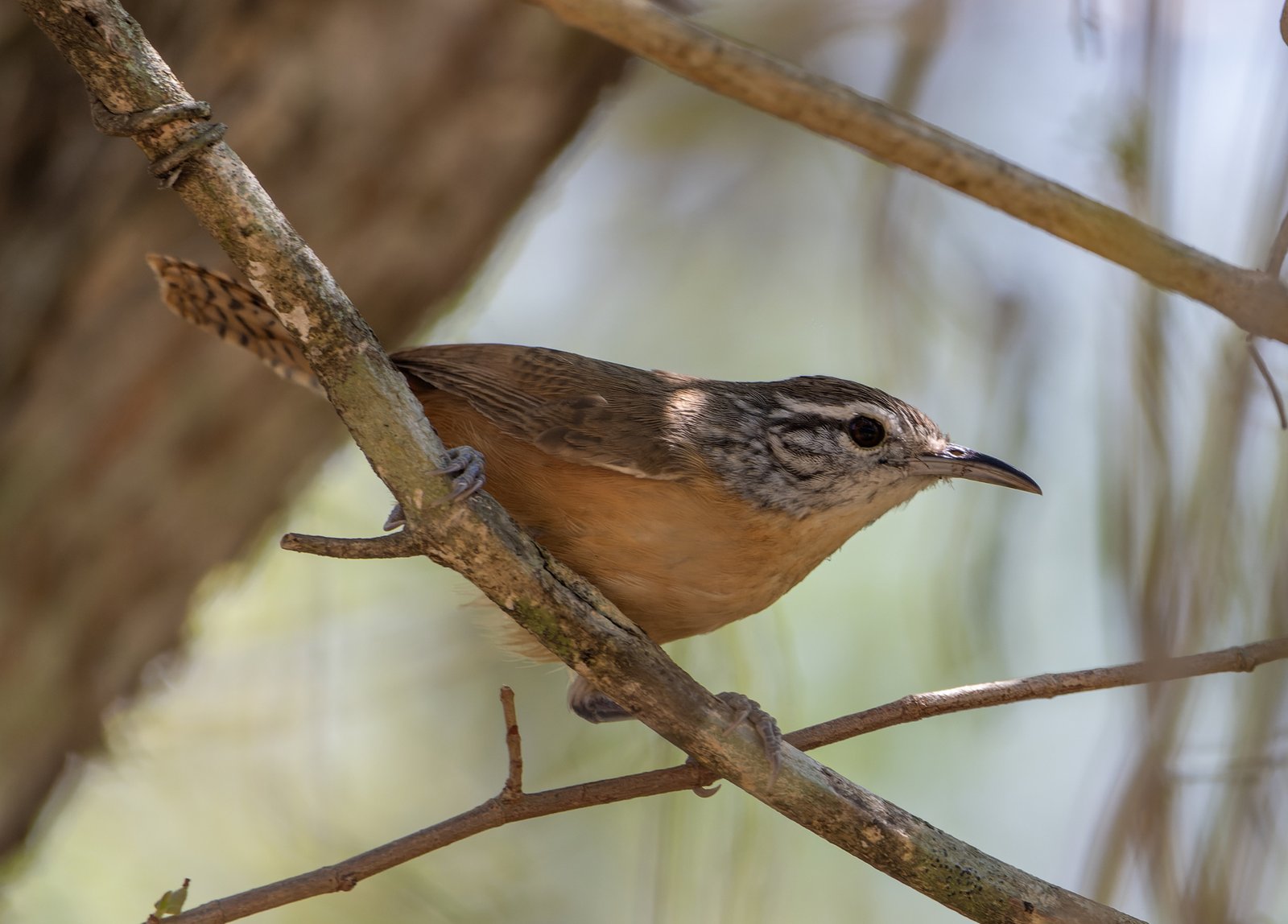
The Fawn-breasted Wren is a small brown wren with a white supercilium and fawn-brown underparts, found at forest edges and in gallery forest in eastern Bolivia and adjacent parts of Brazil and Paraguay. Pairs live in dense vegetation and sing in duet. The name refers to Guarayos in the department of Santa Cruz in Bolivia.
Voice
Fast, clear whistled phrases, repeated by the pair in duet; also dry, rattling calls.
Recording: Richard E. Webster — CC BY-NC-SA 4.0 · xeno-canto
Identification
12–13 cm. The upperparts are warm brown, the wings and tail narrowly barred black. The crown is brown, the supercilium white; the sides of the head are streaked black and white. The throat is white, the breast and belly fawn-brown to pale buff, the flanks slightly darker. The sexes are alike; young birds are duller.
Confusion species
Buff-breasted Wren Cantorchilus leucotis is very similar, but is larger and warmer buff to cinnamon on the belly; it lives in northern Bolivia. Moustached Wren Pheugopedius genibarbis is larger, with a grey crown, a black malar stripe and a plain rufous back. Thrush-like Wren Campylorhynchus turdinus is much larger, with spotted underparts, and lives in groups high in the trees.
Habitat
Dense vegetation at the edges of dry and semi-humid forest, in gallery forest, scrub along rivers and marshes and in young secondary forest, also in woodland patches in savanna. In the lowlands, below about 600 m. It forages low in the vegetation for insects and spiders. The nest is a domed structure of grass and plant fibres.
Where the bird is most at home, classified by the vegetation units of the Andes and the west coast.


Range and movements
In Bolivia in the lowlands of the north and east, mainly in Beni and Santa Cruz. Absent from Colombia, Ecuador, Peru and the Galápagos. Outside the guide area in south-western Brazil (Mato Grosso and the Pantanal) and northern Paraguay.
- Resident
- dark = core range, pale = thinly spread
How and when to look
In gallery forest and at forest edges in the lowlands of Santa Cruz and Beni, for example around Santa Cruz de la Sierra and in the Chiquitanía; pairs give themselves away by their duets.
Conservation status
Least Concern. Fairly common in suitable vegetation; tolerates disturbed landscapes as long as dense undergrowth remains.
Scientific name
Cantorchilus guarayanus | (d'Orbigny, ACVMD & de Lafresnaye, 1837)
D'Orbigny, ACVMD & de Lafresnaye described the species in 1837 as Troglodytes guarayana; because it was later moved to another genus, the author and year stand in brackets. The genus Cantorchilus was introduced in 2006 by Mann, Barker, Graves, Dingess-Mann & Slater. The genus name combines Latin cantus, 'song', with Greek orkhilos, 'wren'. The species name refers to the Guarayos region in Santa Cruz, Bolivia, named after the Guarayo people. The specimen the first description was based on came from Guarayos, Santa Cruz, Bolivia.