All species › Passerines › Wrens › Buff-breasted Wren
Buff-breasted Wren | Cantorchilus leucotis
Witoorwinterkoning | Cucarachero pechihabano | Garrinchão-de-barriga-vermelha
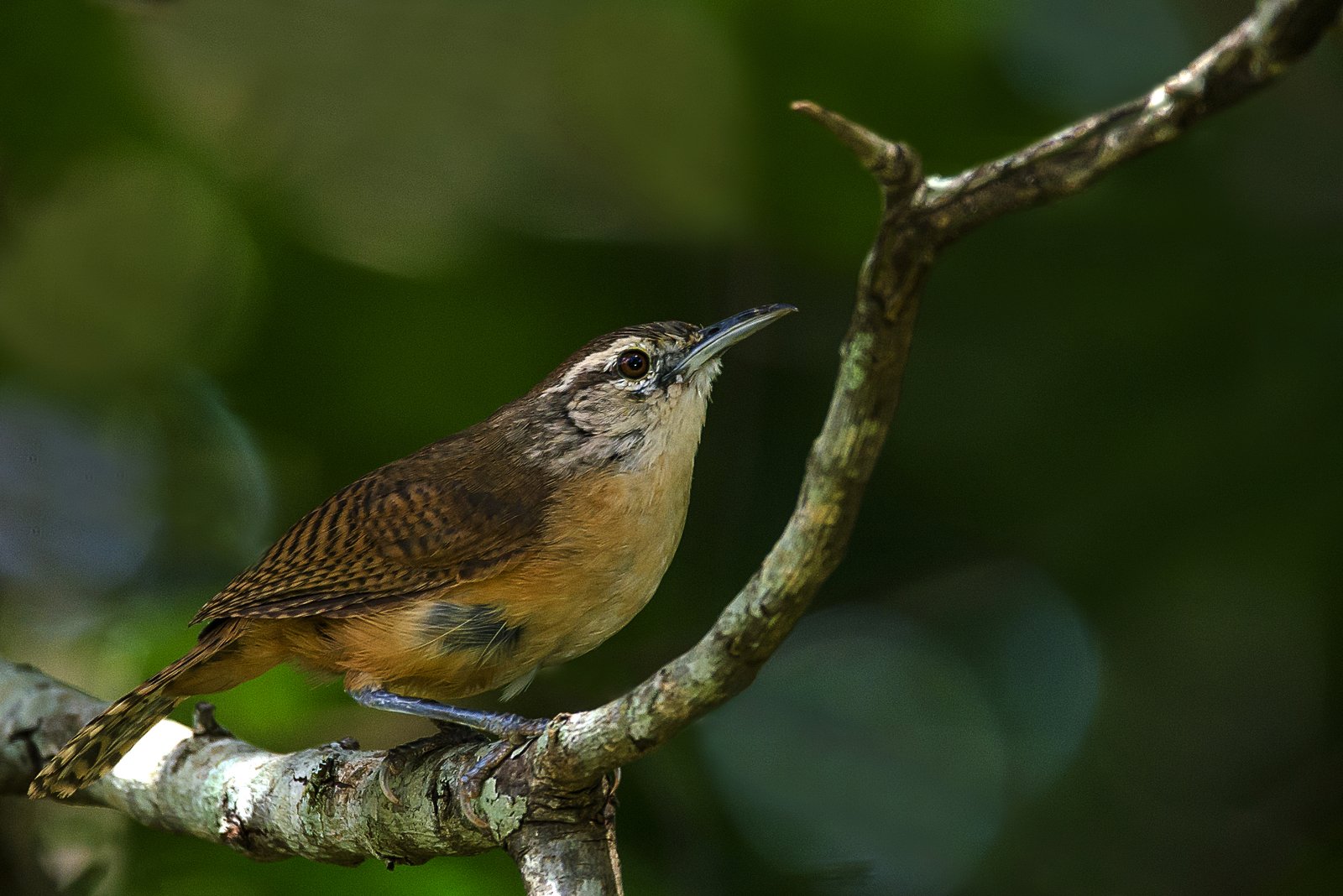
The Buff-breasted Wren is a brown wren with a white supercilium, black-and-white streaked sides of the head and buffy underparts, widespread in the tropical lowlands of northern South America. Pairs live in dense vegetation by water and sing loudly in duet. Of the wrens of the Amazonian lowlands it is the one most tied to riverside growth and flooded forest.
Voice
Loud, clear and rhythmic whistled phrases, rapidly repeated and in duet by the pair; also dry, rattling and ticking calls.
Recording: JAYRSON ARAUJO DE OLIVEIRA — CC BY-NC-SA 4.0 · xeno-canto
Identification
13–14 cm, with a fairly long bill. The upperparts are warm brown, the wings and tail narrowly barred black. The crown is brown, the supercilium white; the sides of the head are streaked black and white. The throat is white, the breast paler buff and the belly and flanks warmer buff-brown to cinnamon. The sexes are alike; young birds are duller, with less distinct facial markings.
Confusion species
Fawn-breasted Wren Cantorchilus guarayanus of Bolivia is very similar, but is smaller and has paler, fawn-brown underparts; the two meet at most in northern Bolivia. Coraya Wren Pheugopedius coraya has almost black sides of the head and a greyer breast, and lives more often in terra firme forest. Moustached Wren Pheugopedius genibarbis has a grey crown, a distinct black malar stripe and a plain rufous back. Rufous-and-white Wren Thryophilus rufalbus in northern Colombia has rufous upperparts and white underparts.
Habitat
Dense vegetation in várzea, on river islands and along the banks of rivers, oxbow lakes and marshes, in gallery forest, palm swamps and young secondary forest; in northern Colombia also in drier scrub. In the lowlands, mostly below 900 m. It forages low in the vegetation for insects and spiders. The nest is a domed structure of grass and plant fibres in a shrub or vine.
Where the bird is most at home, classified by the vegetation units of the Andes and the west coast.


Range and movements
In Colombia in the Caribbean lowlands, the Magdalena valley, the llanos and the Amazonian lowlands. In Ecuador and Peru in the Amazonian lowlands east of the Andes, in Ecuador mainly in the north. In Bolivia in the north, in Pando, Beni and northern La Paz. Absent west of the Andes in Ecuador and Peru and from the Galápagos. Outside the guide area from Panama through Venezuela and the Guianas to the Amazon basin of Brazil.
- Resident
- dark = core range, pale = thinly spread
How and when to look
Along the banks of oxbow lakes and on river islands in the Amazonian lowlands, from a boat or a riverside trail; in the llanos in gallery forest along rivers.
Conservation status
Least Concern. Common and widespread in riverside vegetation and young forest.
Scientific name
Cantorchilus leucotis | (de Lafresnaye, 1845)
De Lafresnaye described the species in 1845 as Thryothorus leucotis; because it was later moved to another genus, the author and year stand in brackets. The genus Cantorchilus was introduced in 2006 by Mann, Barker, Graves, Dingess-Mann & Slater. The genus name combines Latin cantus, 'song', with Greek orkhilos, 'wren'. The species name comes from Greek leukos, 'white', and ous (ōtos), 'ear', for the white ear-coverts. The specimen the first description was based on came from Honda, Tolima, Colombia.