All species › Passerines › Wrens › Superciliated Wren
Superciliated Wren | Cantorchilus superciliaris
Humboldtwinterkoning | Cucarachero cejón | Garrinchão-de-sobrancelhas
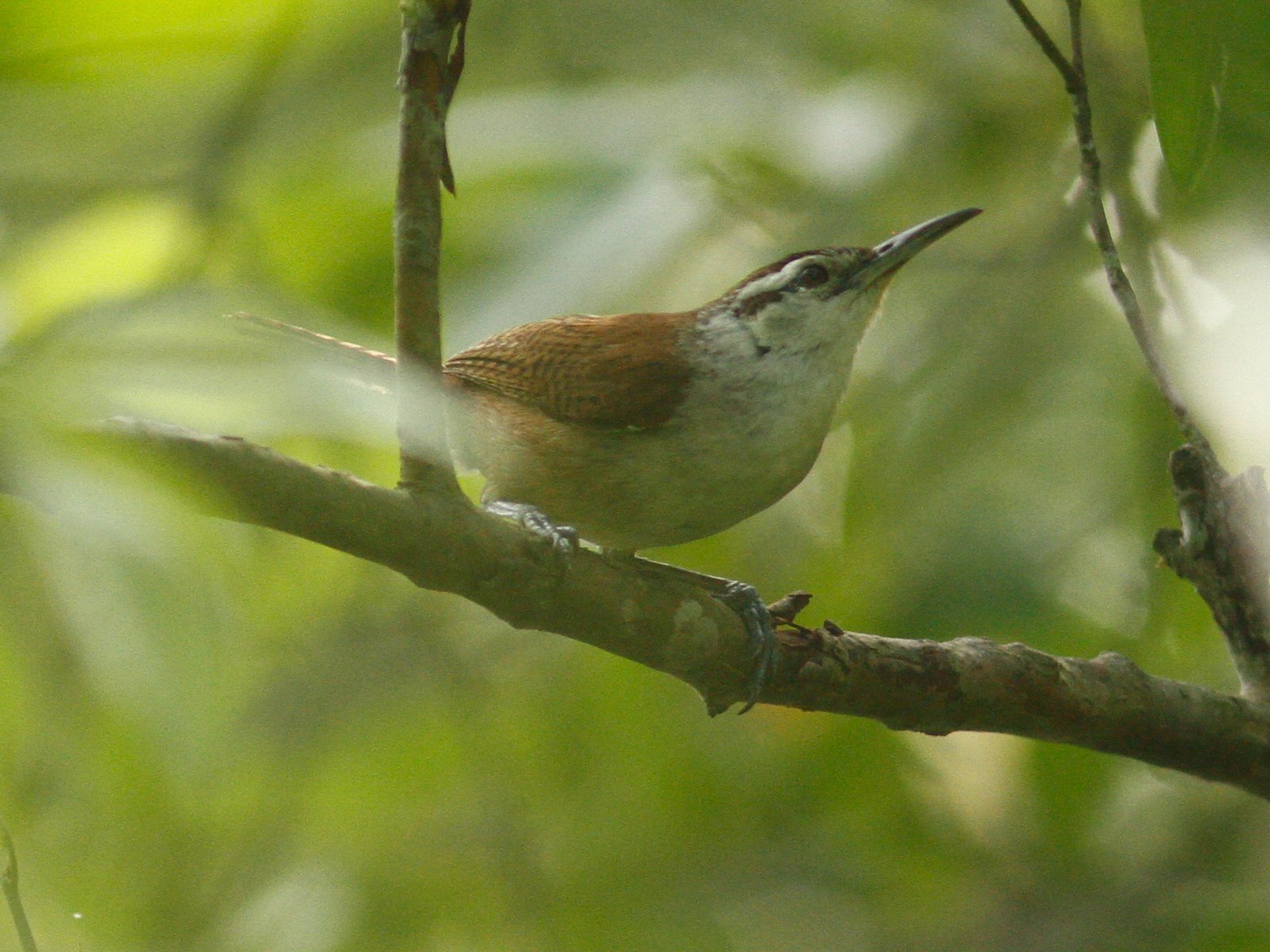
The Superciliated Wren is a rufous-brown wren with a long, bold white supercilium and white underparts, characteristic of the dry Tumbesian region of south-western Ecuador and north-western Peru. Pairs keep to dense, dry scrub and sing loudly in duet. It occurs only in this dry coastal belt.
Voice
Loud, clear whistled phrases, rapidly repeated and often in duet by the pair; also sharp, grating calls and a dry rattling alarm.
Recording: Juan Freile — CC BY-NC-SA 4.0 · xeno-canto
Identification
14–15 cm. The crown and upperparts are bright rufous-brown, the crown slightly redder; the wings and tail are barred black. The long, broad supercilium is white, with a narrow dark eyestripe below; the cheeks are white, sometimes with a few grey flecks. The underparts are white, with an ochre wash on the flanks and undertail coverts. The sexes are alike; young birds are duller.
Confusion species
Speckle-breasted Wren Pheugopedius sclateri partly shares the same area, but has a black-and-white speckled or barred breast. Southern House Wren Troglodytes musculus is smaller and plain grey-brown, without a striking white supercilium. Fasciated Wren Campylorhynchus fasciatus is much larger, with barred upperparts and spotted underparts, and lives in groups.
Habitat
Dry scrub, the understorey of dry forest, rank hedges, dense growth along dry riverbeds and riparian woodland, also gardens and field edges with shrubs; from sea level to about 1800 m. It forages low in the vegetation for insects and spiders. The nest is a domed structure of grass and plant fibres in a thorny shrub.
Where the bird is most at home, classified by the vegetation units of the Andes and the west coast.


Range and movements
In Ecuador in the west and south-west, from Manabí through Guayas and El Oro to Loja. In Peru in the north-west, in Tumbes, Piura, Lambayeque and Cajamarca, south to La Libertad. Absent from Colombia, Bolivia and the Galápagos. Does not occur outside the guide area.
- Resident
- dark = core range, pale = thinly spread
How and when to look
In dry forest and scrub in Tumbes and Piura and in south-western Ecuador, especially in the early morning when pairs sing in duet; birds often come close to the edge of the thicket.
Conservation status
Least Concern. Common in the dry Tumbesian region and tolerant of disturbed landscapes; the dry forest itself is declining through logging and grazing.
Scientific name
Cantorchilus superciliaris | (Lawrence, 1869)
Lawrence described the species in 1869 as Thryothorus superciliaris; because it was later moved to another genus, the author and year stand in brackets. The genus Cantorchilus was introduced in 2006 by Mann, Barker, Graves, Dingess-Mann & Slater. The genus name combines Latin cantus, 'song', with Greek orkhilos, 'wren'. The species name comes from Latin supercilium, 'eyebrow', for the bold supercilium. The specimen the first description was based on came from Puná Island, Ecuador.