All species › Passerines › Wrens › Bay Wren
Bay Wren | Cantorchilus nigricapillus
Kastanjewinterkoning | Cucarachero cabecinegro | Garrinchão-de-barrete-preto
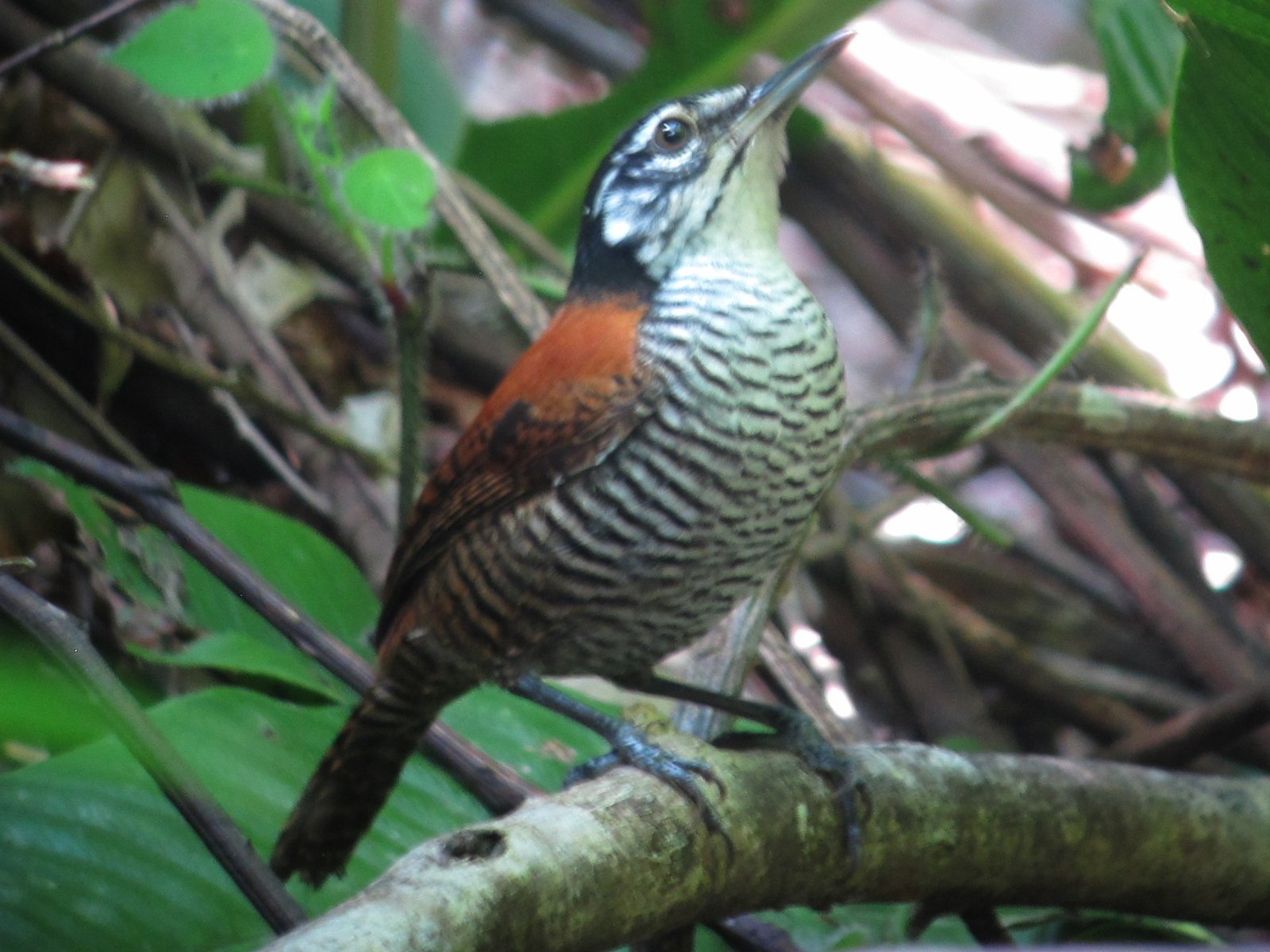
The Bay Wren is a fairly large, chestnut wren with a black cap and a white patch on the side of the head, found in dense vegetation in the humid lowlands west of the Andes. It usually stays hidden in thickets, but its loud, clear song is one of the most frequently heard sounds along forest edges in the Chocó. The amount of black barring on the underparts increases from north to south.
Voice
Loud, rich, repeated whistled phrases, often in duet by the pair, such as choo-wee-choo-wee or weet-choo-choo; also a dry, sharp rattling alarm.
Recording: Juan Freile — CC BY-NC-SA 4.0 · xeno-canto
Identification
14–15 cm. The crown and hindneck are black, the side of the head black with a white patch and a few white streaks. The back and wings are bright chestnut, the tail chestnut with broad black bars. The throat is white. Birds in northern Colombia have a rufous belly with little barring; further south the breast and belly become increasingly barred black and white, and in western Ecuador the underparts are almost entirely barred black and white. The sexes are alike; young birds are duller, with less distinct markings.
Confusion species
Stripe-throated Wren Cantorchilus leucopogon is smaller, without a black cap, with a streaked throat and plain cinnamon-brown underparts. Black-bellied Wren Pheugopedius fasciatoventris has a white throat and breast and a black, finely white-barred belly, without a black cap. Song Wren Cyphorhinus phaeocephalus has bare blue skin around the eye and a rufous throat and breast, and lives on the forest floor.
Habitat
Dense vegetation at forest edges, along streams and in young secondary forest, with plenty of heliconias, vines and cane-like plants; also cacao and banana plantations with undergrowth. From sea level to about 1500 m. It forages low in the vegetation for insects and spiders. The nest is a domed structure of plant fibres, often in a shrub over water.
Where the bird is most at home, classified by the vegetation units of the Andes and the west coast.


Range and movements
In Colombia in the lowlands of the north-west and the Pacific coast, and east to the middle Magdalena valley. In Ecuador in the western lowlands and the lower western slope, south to El Oro. Absent from Bolivia and the Galápagos; in Peru at most exceptional in the far north. Outside the guide area from Nicaragua through Costa Rica to Panama.
- Resident
- dark = core range, pale = thinly spread
How and when to look
Along forest edges and streams with heliconias in western Ecuador and the Chocó; the birds are heard first and, with patient waiting at the edge of the thicket, come into view.
Conservation status
Least Concern. Common and tolerant of disturbed landscapes, as long as dense undergrowth and forest edges remain.
Scientific name
Cantorchilus nigricapillus | (Sclater, 1860)
Sclater described the species in 1860 as Thryothorus nigricapillus; because it was later moved to another genus, the author and year stand in brackets. The genus Cantorchilus was introduced in 2006 by Mann, Barker, Graves, Dingess-Mann & Slater. The genus name combines Latin cantus, 'song', with Greek orkhilos, 'wren'. The species name comes from Latin niger, 'black', and capillus, 'hair of the head', for the black head. The specimen the first description was based on came from Nanegal, Pichincha, Ecuador.