All species › Passerines › Wrens › Stripe-throated Wren
Stripe-throated Wren | Cantorchilus leucopogon
Streepkeelwinterkoning | Cucarachero gorjirrayado | Garrincha-de-garganta-listrada
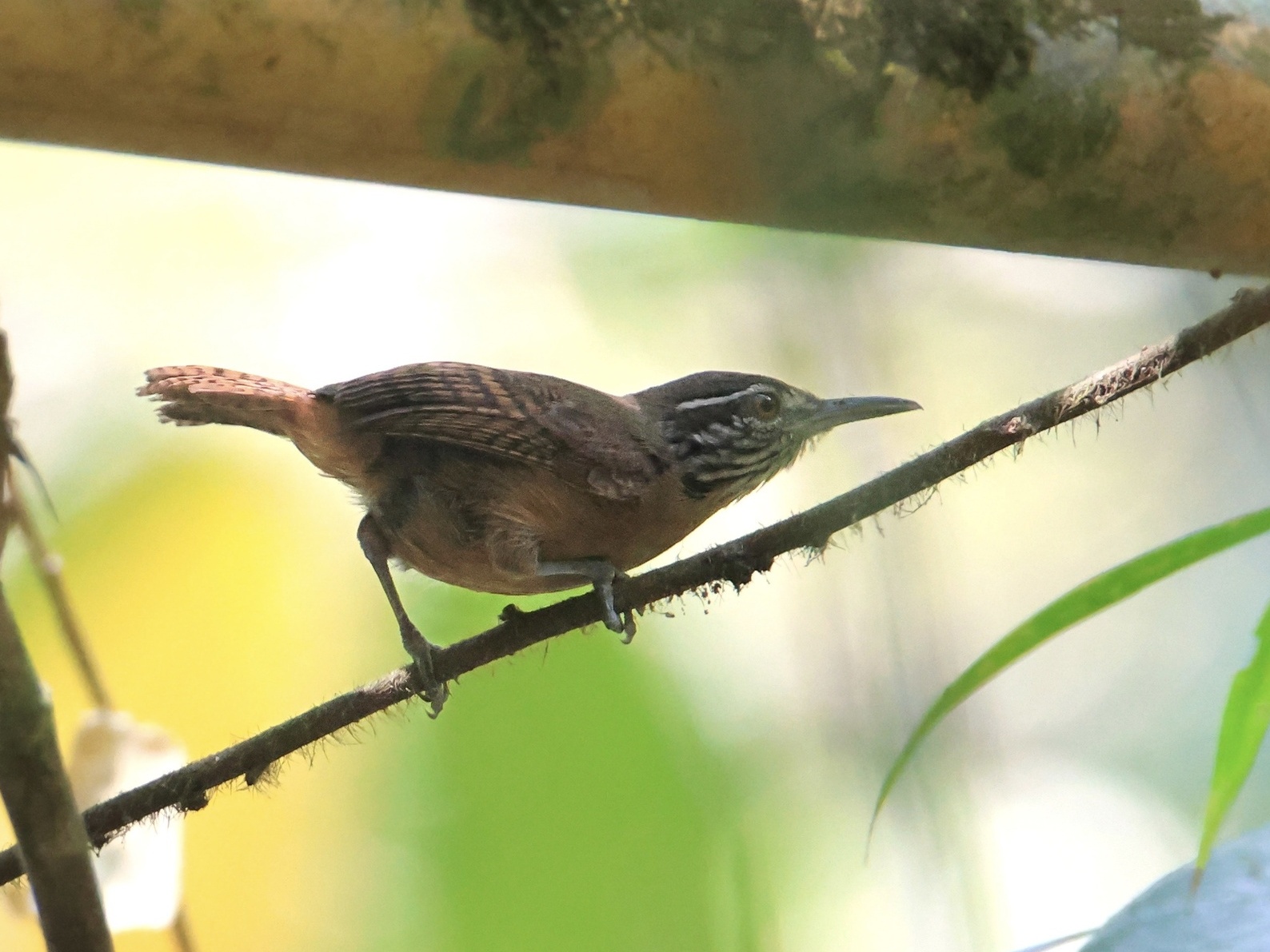
The Stripe-throated Wren is a small wren of the Chocó rainforest, with a black-and-white streaked throat and plain cinnamon-brown underparts. Unlike most of its relatives it often forages high, in vines in the middle storey and lower canopy. Pairs and family groups sing a lot in duet.
Voice
Fast, clear whistled phrases, alternated by the pair in duet, somewhat thinner than those of Bay Wren; also dry, rattling calls.
Recording: Patricio Mena Valenzuela — CC BY-NC-SA 4.0 · xeno-canto
Identification
11–12 cm. The crown and upperparts are warm rufous-brown, the wings and tail barred black. A white supercilium separates the crown from the black-and-white streaked sides of the head. The throat is white with black streaks; the breast and belly are plain cinnamon to ochre-brown, the flanks slightly darker. The sexes are alike; young birds are duller.
Confusion species
Bay Wren Cantorchilus nigricapillus is larger, with a black cap, a white patch on the side of the head and, in western Ecuador, black-barred underparts; it lives lower, in dense thickets. Stripe-breasted Wren Cantorchilus thoracicus of Central America also has the breast streaked. White-breasted Wood Wren Henicorhina leucosticta is smaller, with a short, cocked tail and a white breast, and lives on or just above the ground.
Habitat
Humid lowland forest, forest edges and tall secondary forest, from sea level to about 900 m. It searches vine tangles, epiphytes and dead leaves for insects and spiders, mostly in the middle and upper levels of the forest. The nest is a domed structure of plant fibres.
Where the bird is most at home, classified by the vegetation units of the Andes and the west coast.


Range and movements
In Colombia in the Pacific lowlands, from the border with Panama south to Nariño. In Ecuador in the north-west, mainly in Esmeraldas and north-western Pichincha, more scarcely further south. Absent from Peru, Bolivia and the Galápagos. Outside the guide area in eastern Panama.
- Resident
- dark = core range, pale = thinly spread
How and when to look
In lowland forest in Esmeraldas (Ecuador) and the Chocó of Colombia; listen for duets from vines in the middle storey and follow the birds along forest edges by roads.
Conservation status
Least Concern. Dependent on humid lowland forest, which has been heavily cleared in north-western Ecuador.
Scientific name
Cantorchilus leucopogon | (Salvadori & Festa, 1899)
Salvadori & Festa described the species in 1899 as Thryophilus leucopogon; because it was later moved to another genus, the author and year stand in brackets. The genus Cantorchilus was introduced in 2006 by Mann, Barker, Graves, Dingess-Mann & Slater. The genus name combines Latin cantus, 'song', with Greek orkhilos, 'wren'. The species name comes from Greek leukos, 'white', and pōgōn, 'beard', for the white, streaked throat. The specimen the first description was based on came from Río Peripa, Pichincha, Ecuador.