All species › Passerines › New World warblers › Bay-breasted Warbler
Bay-breasted Warbler | Setophaga castanea
Kastanjezanger | Reinita castaña | Mariquita-de-peito-castanho
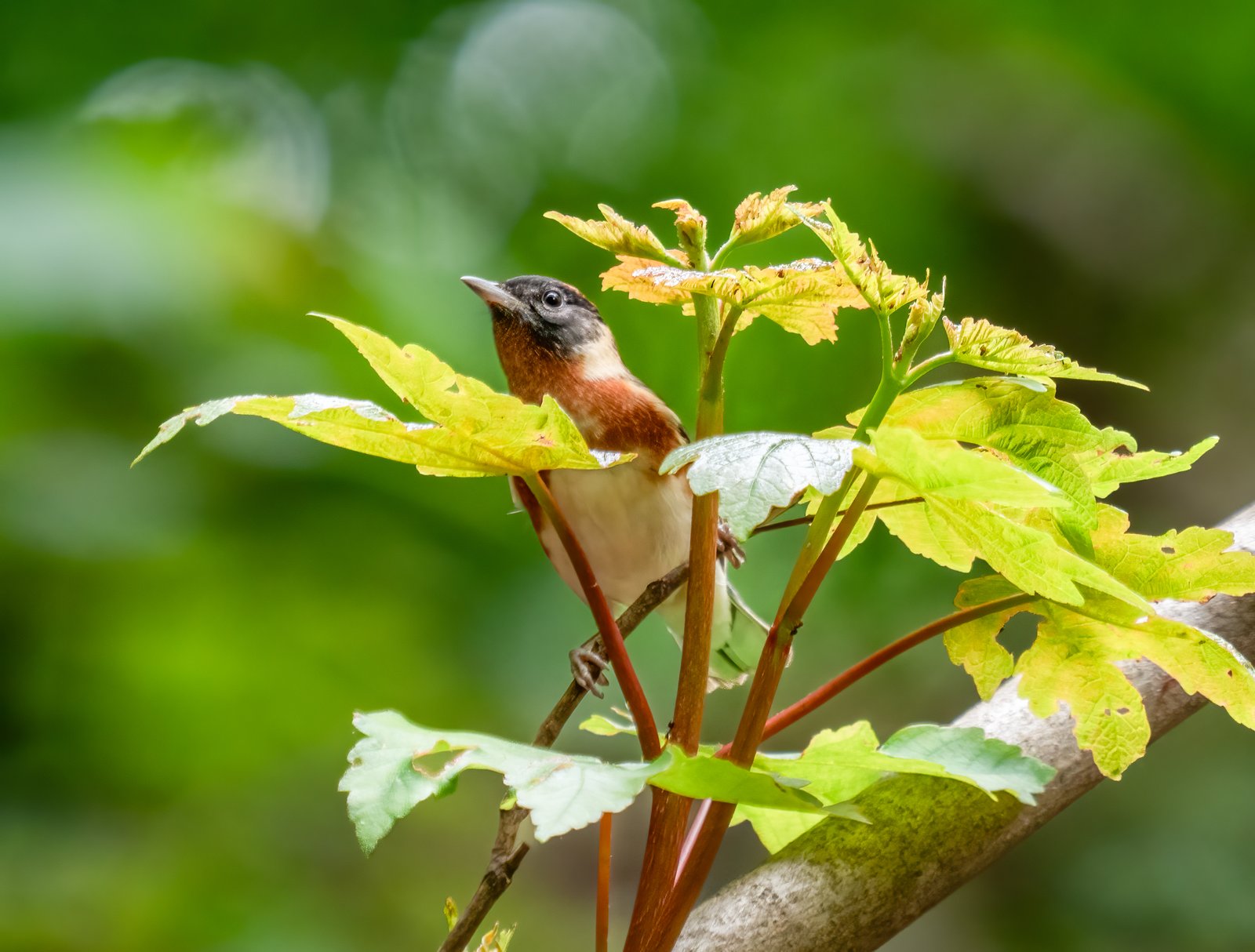
The Bay-breasted Warbler is a fairly large, stocky warbler that breeds in the spruce forests of Canada, where its numbers track outbreaks of spruce budworm. It winters from Panama to north-western Venezuela. In the guide area it is a regular winter visitor mainly in northern Colombia; farther south it quickly becomes rare.
Voice
The call is a soft chip, in flight a high see. The song is a series of very high, thin notes, roughly teesi-teesi-teesi; in the guide area heard mainly in spring.
Recording: David Darrell-Lambert — CC BY-NC-SA 4.0 · xeno-canto
Identification
13–14 cm, with a fairly thick bill and a short tail. In non-breeding plumage the upperparts are olive-green with faint dark streaks, the head greenish with a faint pale supercilium. The underparts are dull yellowish white to buff and almost unstreaked, the undertail coverts buff; often, especially in males, a wash of chestnut on the flanks. Two broad white wing bars. The legs are dark grey. In March and April the male has a chestnut crown, throat and flanks, a black mask and a creamy neck patch; the female then shows less and duller chestnut.
Confusion species
Blackpoll Warbler Setophaga striata in non-breeding plumage has a streaked breast, white undertail coverts and pale, yellowish legs. Chestnut-sided Warbler Setophaga pensylvanica in non-breeding plumage has an unstreaked, bright green back, a grey face with a white eye-ring and greyish-white underparts. Female Blackburnian Warblers Setophaga fusca have a dark cheek patch and pale stripes on the back.
Habitat
In winter in forest edges, secondary forest, riparian forest, shade coffee and semi-open country with trees in the lowlands and on the lower slopes, mostly below 1500 m. It searches for insects in the middle and upper levels of the foliage, often in mixed flocks, and in winter also eats much fruit and nectar. It does not breed in the guide area; the nest is placed in conifers in the north.
Where the bird is most at home, classified by the vegetation units of the Andes and the west coast.


Range and movements
Colombia: fairly common winter visitor in the Caribbean lowlands, the Magdalena valley, the northern Pacific coastal belt and on the lower slopes of the northern Andes; scarcer to the south. Ecuador: rare, with a few records, mainly in the north-west. Peru and Bolivia: at most isolated records. Outside the guide area the species breeds in Canada and the north-eastern United States and winters mainly from Costa Rica and Panama to north-western Venezuela.
How and when to look
Look between November and March in mixed flocks along forest edges and at fruiting trees in northern Colombia, for example around the Sierra Nevada de Santa Marta and in the Urabá region. Note the combination of broad white wing bars, unstreaked buff underparts and dark legs.
Conservation status
Least Concern. The population fluctuates strongly with spruce budworm outbreaks on the breeding grounds and has declined in the long term; lowland forest is being lost in the winter range.
Scientific name
Setophaga castanea | (Wilson, 1810)
Wilson described the species in 1810 as Sylvia castanea; because it was later moved to another genus, the author and year stand in brackets. The genus Setophaga was introduced in 1827 by Swainson. The genus name comes from Greek sēs (genitive sētos), 'moth', and -phagos, '-eating', so 'moth-eater'. The species name comes from Latin castaneus, 'chestnut', for the male's chestnut throat and flanks. The specimen the first description was based on came from Pennsylvania, United States.