All species › Passerines › New World warblers › Magnolia Warbler
Magnolia Warbler | Setophaga magnolia
Magnoliazanger | Reinita de magnolia | Mariquita-de-magnólia
The Magnolia Warbler is a small, yellow and grey warbler that breeds in the conifer forests of Canada and the north-eastern United States. It winters mainly in Mexico and Central America; the guide area lies on the southern edge of its winter range. Its tail pattern, white with a broad black terminal band, is shared by no other warbler here.
Voice
In winter quarters mainly a soft, nasal tlep or enk. The short song, weeta-weeta-weetee, is heard in the guide area at most in spring.
Recording: Mario Reyes Jr — CC BY-NC-SA 4.0 · xeno-canto
Identification
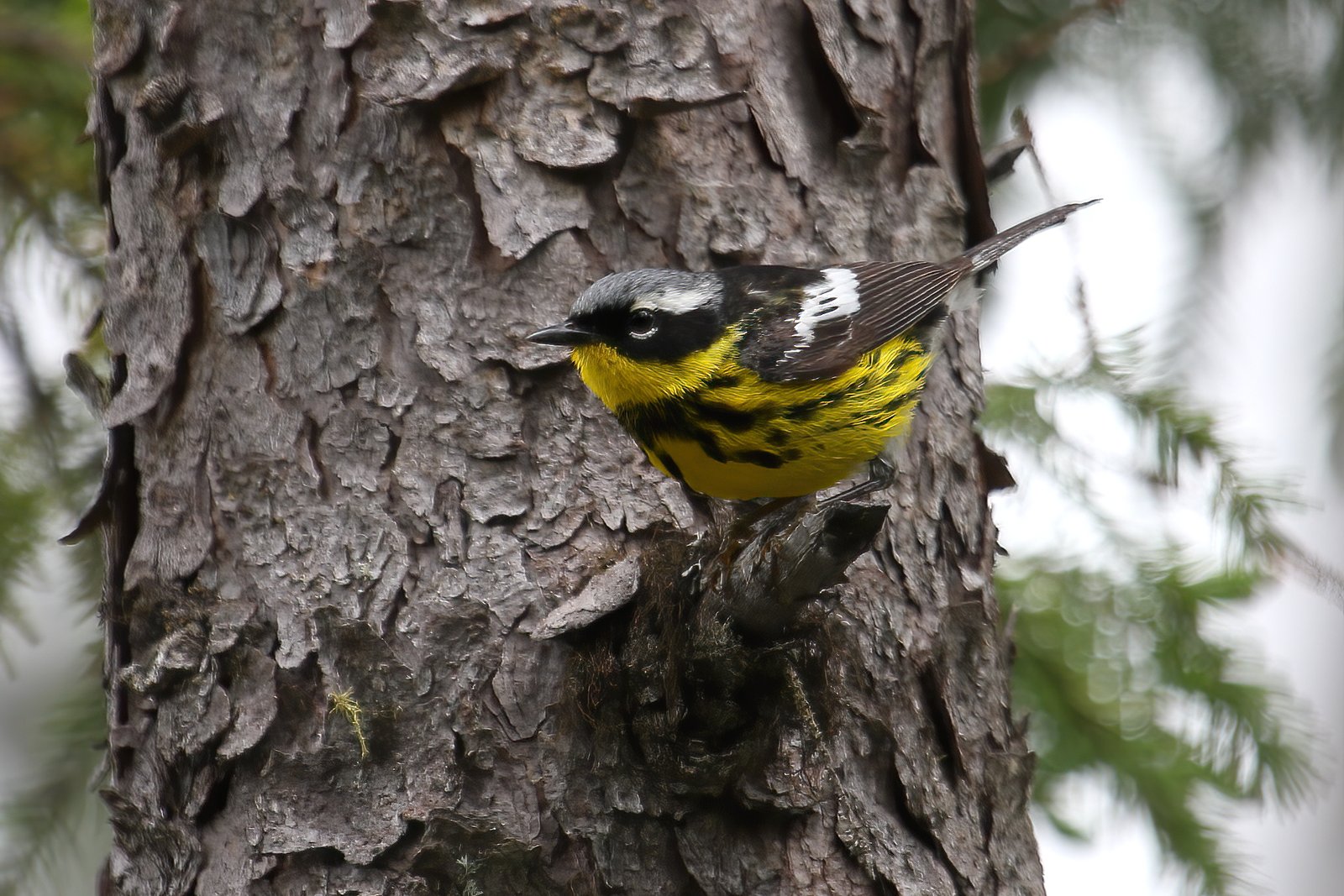
12–13 cm. In non-breeding plumage the head is grey with a white eye-ring, the back olive-green, the rump yellow. The underparts are yellow with a faint grey breast band and fine dark streaks on the flanks; the undertail coverts are white. Two narrow white wing bars. From below the tail is white with a broad black terminal band. In spring, just before departure, the male acquires a black mask, a white stripe behind the eye, a black, streaked necklace, a blackish back and a large white wing patch. Females and young birds remain duller.
Confusion species
Yellow-rumped Warbler Setophaga coronata also has a yellow rump, but whitish, streaked underparts and no white tail band. Cape May Warbler Setophaga tigrina is more heavily streaked, with a yellow patch behind the cheek and no white band in the tail. Canada Warbler Cardellina canadensis has an eye-ring and a necklace, but plain grey upperparts without wing bars and a plain tail. Prairie Warbler Setophaga discolor has a dark arc below the cheek and pumps its tail.
Habitat
In winter in forest edges, secondary forest, shade coffee, gardens and semi-open country with trees, in the lowlands and on the lower slopes up to about 1500 m. It searches for insects in the middle and lower levels of the foliage, often in mixed flocks. It does not breed in the guide area; the nest is placed in young conifers in the north.
Where the bird is most at home, classified by the vegetation units of the Andes and the west coast.


Range and movements
Colombia: scarce winter visitor, mainly in the north and north-west, in the Caribbean lowlands, around the Sierra Nevada de Santa Marta and on the lower slopes of the northern Andes. Ecuador: very scarce, with a few records. In Peru and Bolivia at most isolated records. Outside the guide area the species breeds in Canada and the north-eastern United States and winters mainly from Mexico to Panama and in the Caribbean.
How and when to look
Look between November and March in mixed flocks along forest edges and in coffee plantations in northern Colombia. A small warbler showing a tail with white and a black terminal band is almost certainly this species.
Conservation status
Least Concern. The population is large and stable on the breeding grounds; forest is being lost in the winter range, but the species also uses secondary forest and plantations.
Scientific name
Setophaga magnolia | (Wilson, 1811)
Wilson described the species in 1811 as Sylvia magnolia; because it was later moved to another genus, the author and year stand in brackets. The genus Setophaga was introduced in 1827 by Swainson. The genus name comes from Greek sēs (genitive sētos), 'moth', and -phagos, '-eating', so 'moth-eater'. The species name refers to the magnolia trees in which Wilson found the bird. The specimen the first description was based on came from Fort Adams, Mississippi, United States.