All species › Passerines › Tanagers and allies › Bay-headed Tanager
Bay-headed Tanager | Tangara gyrola
Okerkaptangare | Tangara cabecibaya | Saíra-de-cabeça-castanha
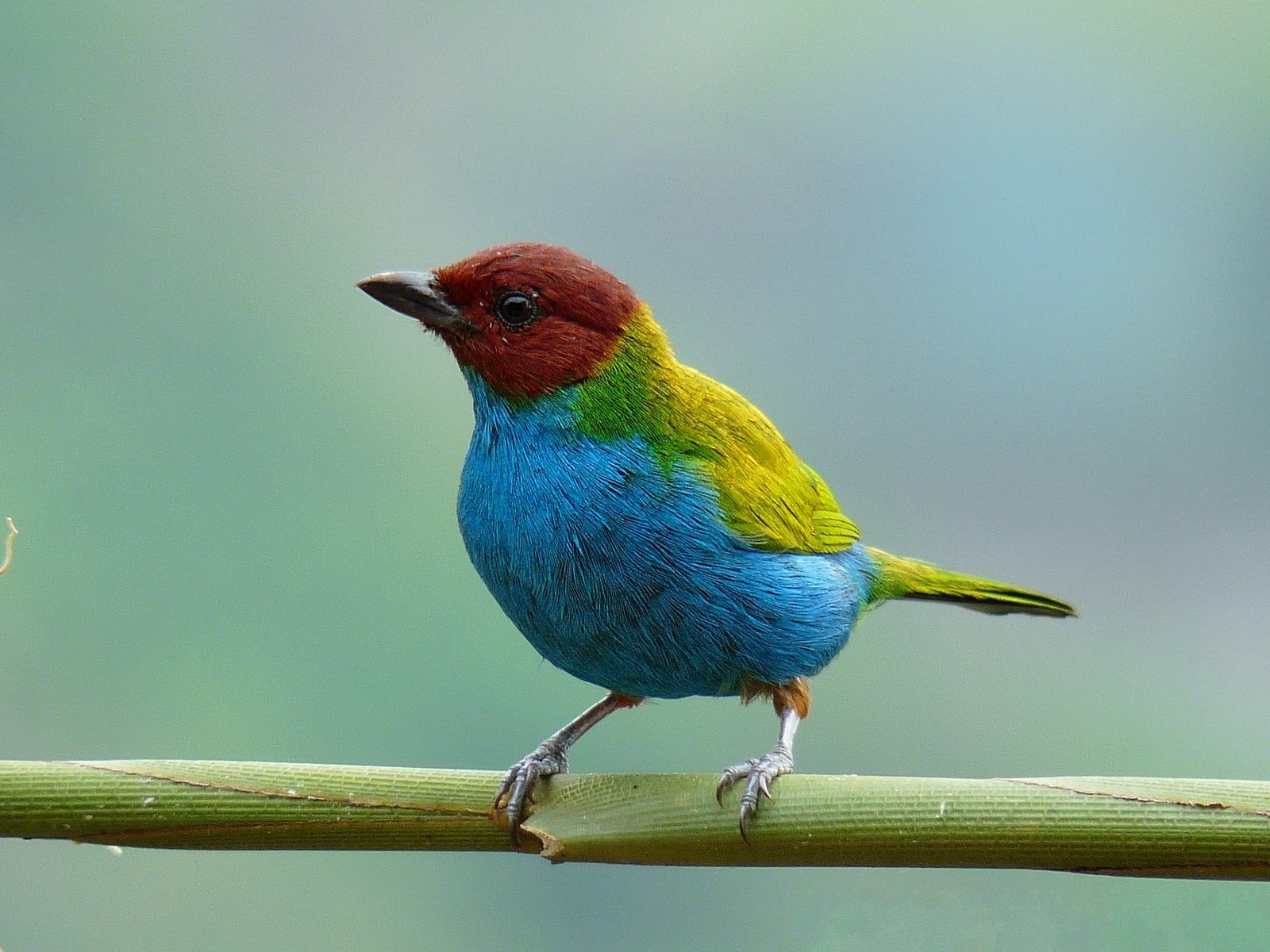
The Bay-headed Tanager is a small, green tanager with a rufous-brown head, widespread in the foothills and lower montane forest of the Andes. It varies strongly across its large range: birds west of the Andes have green underparts, those of the eastern lowlands turquoise-blue. It is a regular member of mixed tanager flocks.
Voice
Thin, high tsit and tsip calls, often in mixed flocks. The song is a short, high series of hissing notes and is inconspicuous.
Recording: JAYRSON ARAUJO DE OLIVEIRA — CC BY-NC-SA 4.0 · xeno-canto
Identification
13–14 cm, with a short, black bill. The whole head is plain rufous-brown to chestnut; some subspecies have a narrow golden-yellow band across the hindneck. The back, wings and tail are bright grass green, the wings with slightly paler edges. The underparts are green in birds from the west and north, and turquoise-blue with green flanks in birds from Amazonia. The sexes are alike. Juveniles are duller green, with less rufous on the head.
Confusion species
Rufous-winged Tanager Tangara lavinia of the Chocó also has a rufous-brown head, but has rufous wings too and a yellow band on the back. Scrub Tanager Stilpnia vitriolina has only a rufous crown and a silvery green-grey body, and lives in drier, open country. Juvenile and female green tanagers lack the plain rufous-brown head.
Habitat
Canopy and edges of humid foothill forest and lower montane rainforest, secondary forest and fruiting trees in semi-open country, roughly between 300 and 2000 m, locally in the lowlands. It eats mainly small fruits and berries and searches thin twigs and the undersides of leaves for insects. The nest is a cup in a tree.
Where the bird is most at home, classified by the vegetation units of the Andes and the west coast.


Range and movements
In Colombia in all three Andean ranges, on the Pacific slope and locally in the lowlands. In Ecuador on both slopes of the Andes, scarcer in the eastern lowlands. In Peru on the eastern slope and locally in the adjacent Amazonian lowlands. In Bolivia on the eastern slope in the north and centre of the country. Does not occur on the Galápagos. Outside the guide area from Costa Rica and Panama to Venezuela, Trinidad, the Guianas and Amazonian Brazil.
- Resident
- dark = core range, pale = thinly spread
How and when to look
Check fruiting trees at forest edges and along roads in the foothills, for example around Mindo and in the Río Bombuscaro valley in Ecuador or along the Manu road in Peru; the rufous-brown head stands out against the green.
Conservation status
Least Concern. Common and widespread; tolerates forest edges and secondary forest, but declines locally through deforestation of the foothills.
Scientific name
Tangara gyrola | (Linnaeus, 1758)
Linnaeus described the species in 1758 as Fringilla Gyrola; because it was later moved to another genus, the author and year stand in brackets. The genus Tangara was introduced in 1760 by Brisson. The genus name comes from the extinct Tupi language, in which tangara means 'dancer'. The specific name is a diminutive of Latin gyrus, 'ring'. The specimen the first description was based on came from Suriname.